Creative Biolabs is offering the most comprehensive services for antibody development projects. With strict regulation and effective execution, we are dedicated to providing the most valuable solutions to complete your projects.
HighlightsCreative Biolabs is offering the most comprehensive services for antibody development projects. With strict regulation and effective execution, we are dedicated to providing the most valuable solutions to complete your projects.
HighlightsCreative Biolabs has established a broad range of platforms for developing novel antibodies or equivalents. These cutting-edge technologies enable our scientists to meet your demands from different aspects and tailor the most appropriate solution that contributes to the success of your projects.
HighlightsWith deep understanding in antibody-related realms and extensive project experience, Creative Biolabs offers a variety of references to help you learn more about our capacities and achievements, including infographic, flyer, case study, peer-reviewed publications, and all kinds of knowledge that can assist your projects. You are also welcome to contact us directly for more specific solutions.
HighlightsGet a real taste of Creative Biolabs, one of the most professional custom service providers in the world. We are committed to providing highly customized comprehensive solutions with the best quality to advance your projects.
HighlightsCreative Biolabs stands at the forefront of therapeutic innovation, harnessing the power of our proprietary MemDX™ platform and specialized transgenic mice to deliver premier, fully human single domain antibodies (sdAbs). This cutting-edge service overcomes the limitations of traditional antibody discovery methods, providing unparalleled access to novel epitopes and generating high-affinity sdAbs with superior therapeutic potential. Tailored for researchers in oncology, immunology, and infectious diseases, our platform accelerates the development of next-generation biologics, ensuring optimal efficacy and reduced immunogenicity.
While traditionally sourced from camelids, the discovery of fully human sdAbs presents a significant challenge, often requiring extensive and complex humanization processes. Creative Biolabs has engineered a superior solution: utilizing genetically modified mice that produce fully human heavy-chain-only antibodies (HCAbs). Our transgenic mouse platform provides a robust in vivo environment for generating and maturing high-quality human sdAbs.
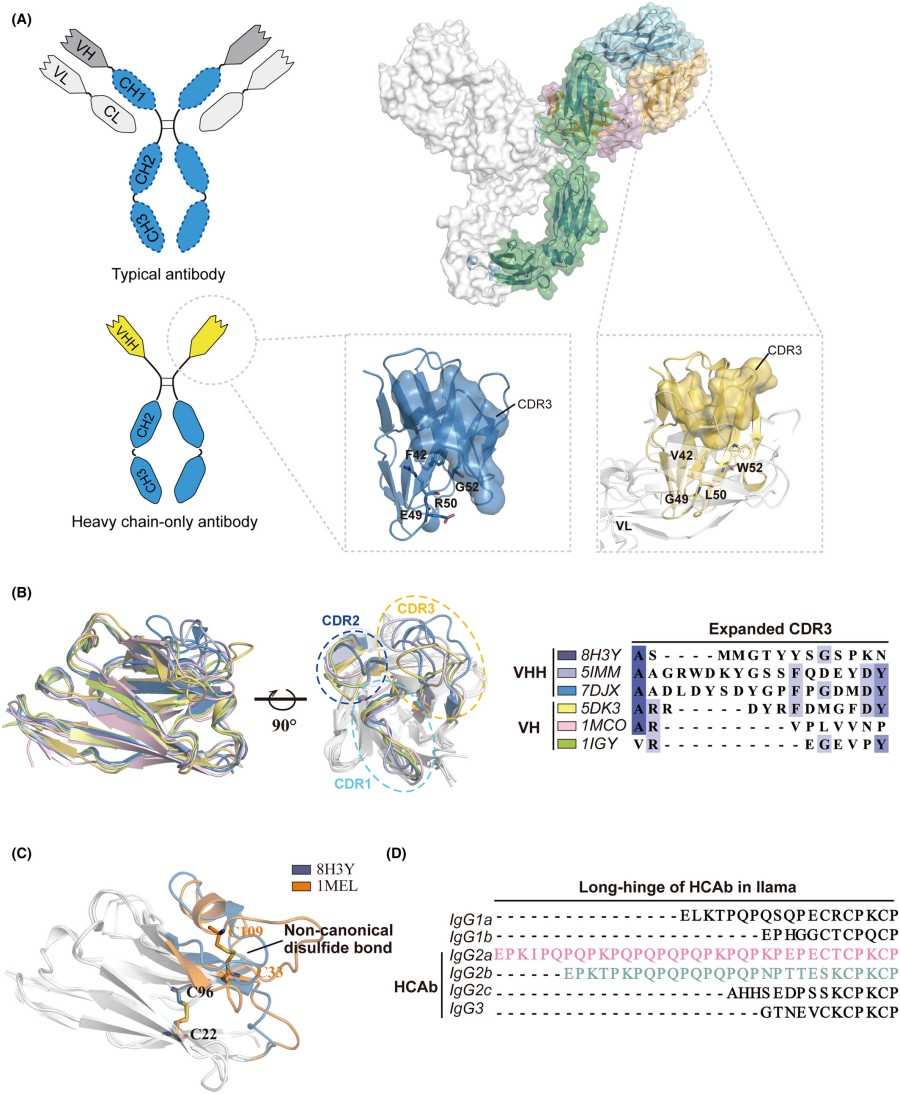 Fig. 1 Adaptive evolution of HCAbs and Single domain antibody structures.1
By introducing human heavy-chain variable gene loci into mice while inactivating their endogenous immunoglobulin machinery, our platform ensures that upon immunization, the B-cell repertoire matures to produce a diverse array of high-affinity, fully human sdAbs.
Table 1. Advantages of Our Transgenic Mouse Platform
| Feature | Creative Biolabs' Transgenic Mice | Traditional Camelid Immunization |
| Antibody Origin | Fully human | Camelid (Requires humanization) |
| Immunogenicity Risk | Minimized | Potential for residual immunogenicity |
| Affinity Maturation | Robust in vivo somatic hypermutation | Natural in vivo maturation |
| Diversity | Broad repertoire of human VH genes | Limited to camelid VHH repertoire |
| Timeline | Streamlined and predictable | Variable immunization responses |
| Follow-up Engineering | None required for humanization | Mandatory, multi-step humanization |
The true power of our service lies in the integration of our advanced transgenic mice with the versatile MemDX™ discovery platform. MemDX™ is not a single technology but a suite of integrated, state-of-the-art strategies designed to tackle the most challenging targets and deliver superior antibody candidates. This synergy creates a discovery engine of unparalleled efficiency and success.
We employ a range of immunization techniques, including our specialized DNA immunization protocol, to elicit potent immune responses, even against traditionally difficult targets like GPCRs, ion channels, and other multi-pass membrane proteins. This ensures the generation of a diverse and high-affinity sdAb repertoire within the transgenic mice.
Leveraging the robust immune response from our transgenic mice, we can deploy multiple downstream discovery methodologies to isolate the ideal sdAb candidates.
Our service is a comprehensive, end-to-end solution designed for clarity, efficiency, and success.
The unique properties of human sdAbs discovered through our platform open up a vast landscape of therapeutic and diagnostic applications:
Two Decades of Expertise: We are seasoned experts in antibody discovery and engineering, with a proven track record of success.
Creative Biolabs is your one-stop solution for all antibody development needs. In addition to our flagship humanization service, we offer a full suite of related services to accelerate your program:
Contact us today to discuss your project and discover how our expertise can accelerate your path to therapeutic success.
Q: What are the main advantages of using your transgenic mice over traditional camelid (llama or alpaca) immunization for sdAb discovery?
A: The primary advantage is that our transgenic mice produce fully human single domain antibodies (sdAbs) directly. This completely bypasses the need for a subsequent humanization step, which is mandatory for camelid-derived VHH antibodies. Eliminating this step saves significant time, reduces the risk of altering antibody affinity or stability during the engineering process, and results in a final therapeutic candidate with the lowest possible risk of immunogenicity in human patients.
Q: What makes a single domain antibody "fully human"?
A: A "fully human" sdAb means that the entire variable domain sequence is encoded by human immunoglobulin germline genes. Our transgenic mice are engineered with human heavy-chain variable (V), diversity (D), and joining (J) gene segments. During an immune response, the mouse's cellular machinery performs V(D)J recombination and somatic hypermutation on these human genes, resulting in a mature antibody that is structurally identical to one that could be produced in the human body.
Q: Can this platform be used to discover antibodies against difficult targets like GPCRs or ion channels?
A: Absolutely. This is a key strength of our integrated MemDX™ platform. We utilize advanced immunization strategies, including proprietary DNA immunization and cell-based immunization with stabilized antigens, to elicit robust immune responses against complex multi-pass membrane proteins like GPCRs and ion channels. The powerful in vivo affinity maturation within the mouse, combined with our specialized screening methods, is highly effective at identifying functional sdAbs against these challenging targets.
Q: How does the affinity of sdAbs from your transgenic mice compare to those from other sources?
A: The affinities are typically very high, often in the low nanomolar to picomolar range. This is because the antibodies undergo a rigorous in vivo maturation process within the mouse's germinal centers, where B cells are naturally selected for the tightest binding. This biological selection process is incredibly efficient at producing high-affinity antibodies, often exceeding what can be achieved with in vitro display methods alone.
Q: Can the discovered sdAbs be used to create other formats, like bispecific antibodies or CAR constructs?
A: Yes. Single domain antibodies are excellent building blocks for generating more complex biologics. Their small size, high stability, and simple structure make them easy to engineer into multispecific formats (e.g., bispecifics, trispecifics), antibody-drug conjugates (ADCs), or chimeric antigen receptor (CAR) constructs for cell therapy. We also offer downstream services to assist with the design and production of these advanced formats.
All listed services and products are For Research Use Only. Do Not use in any diagnostic or therapeutic applications.