Creative Biolabs is offering the most comprehensive services for antibody development projects. With strict regulation and effective execution, we are dedicated to providing the most valuable solutions to complete your projects.
HighlightsCreative Biolabs is offering the most comprehensive services for antibody development projects. With strict regulation and effective execution, we are dedicated to providing the most valuable solutions to complete your projects.
HighlightsCreative Biolabs has established a broad range of platforms for developing novel antibodies or equivalents. These cutting-edge technologies enable our scientists to meet your demands from different aspects and tailor the most appropriate solution that contributes to the success of your projects.
HighlightsWith deep understanding in antibody-related realms and extensive project experience, Creative Biolabs offers a variety of references to help you learn more about our capacities and achievements, including infographic, flyer, case study, peer-reviewed publications, and all kinds of knowledge that can assist your projects. You are also welcome to contact us directly for more specific solutions.
HighlightsGet a real taste of Creative Biolabs, one of the most professional custom service providers in the world. We are committed to providing highly customized comprehensive solutions with the best quality to advance your projects.
HighlightsAt Creative Biolabs, we understand that your therapeutic antibody is the result of years of research and significant investment. Our Antibody Humanization services are meticulously designed to mitigate these risks by seamlessly converting non-human (e.g., murine, rat, rabbit) antibodies into safe, effective, and fully functional humanized antibodies. Using our proprietary, cutting-edge platforms, we ensure your molecule achieves the low immunogenicity profile, enhanced half-life, and superior therapeutic efficacy required for clinical success.
Non-human antibodies, while excellent for initial discovery and targeting, contain immunogenic epitopes within their framework and complementarity-determining regions (CDRs) that can be recognized as foreign by the human immune system. This triggers a human anti-mouse antibody (HAMA) or similar anti-species response. Humanization is the critical step that reduces this risk, allowing your antibody to function optimally in a human clinical setting.
The benefits of a well-executed antibody humanization process are clear and compelling:
At Creative Biolabs, we don't rely on a single, one-size-fits-all approach. Our strategy is based on rational, in silico design combined with extensive experimental validation. We select the most suitable platform for your specific antibody to ensure the highest retention of antigen-binding affinity and biological activity.
Our core expertise lies in in silico analysis and structural modeling. Before any lab work begins, we perform a deep bioinformatics analysis of your antibody's amino acid sequence and structure. This allows us to:
This data-driven approach dramatically improves the chances of success, reducing both time and cost by focusing our efforts on the most promising humanization strategies.
CDR grafting is the foundational technique for antibody humanization. We meticulously graft the six hypervariable CDR loops from the parent non-human antibody onto a carefully selected human framework.
Beyond standard grafting, our team utilizes advanced framework region (FR) engineering. We understand that some framework residues, while not directly in the CDRs, are crucial for maintaining the correct CDR loop conformation and antibody stability. Through our rational design process, we identify and selectively "back-mutate" a minimal number of key human framework residues to their original non-human counterparts, only when absolutely necessary to restore full antigen-binding affinity. This refined approach ensures a perfect balance between reduced immunogenicity and retained function.
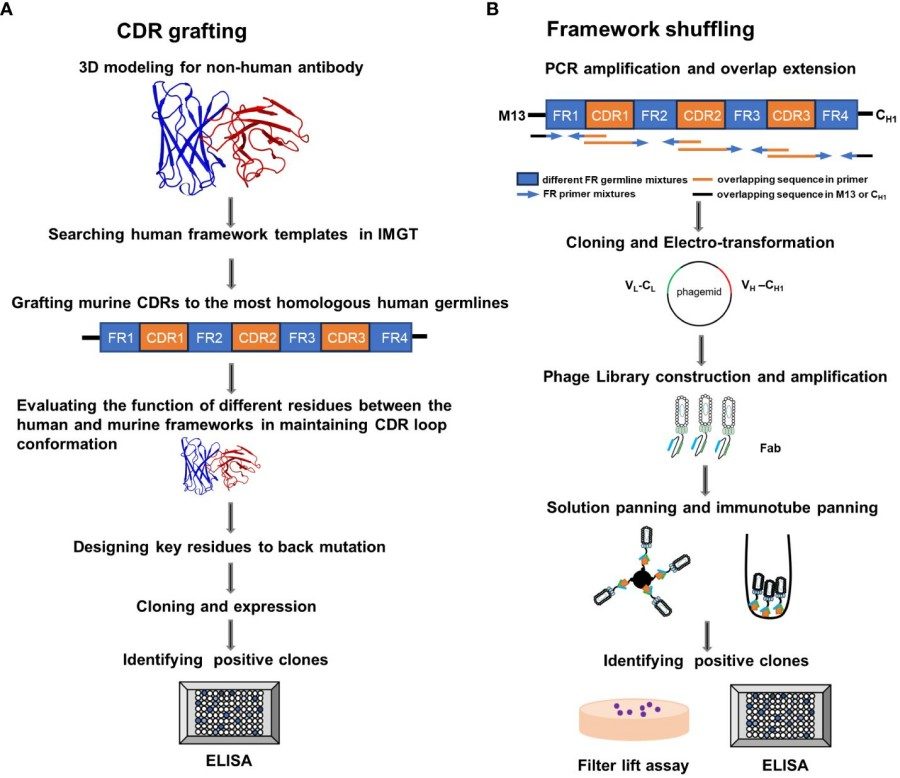 Fig. 1 Schematic illustration of the complementarity determining region (CDR) grafting and framework (FR) shuffling humanization strategies.1
For more challenging antibodies, we employ surface resurfacing. This technique involves altering the solvent-exposed surface residues of the non-human antibody to resemble those of a human antibody, without affecting the core structure or antigen-binding site. This method is particularly effective for reducing immunogenicity in cases where CDR grafting alone is insufficient.
Our proven, streamlined workflow ensures a seamless process from project initiation to final delivery.
Step 1: Parent Antibody & Sequence Analysis
We begin by thoroughly analyzing the sequence of your parent antibody. If not provided, we offer full sequencing services. Our in silico team performs a detailed analysis to identify potential immunogenic sites and select the optimal human acceptor framework.
Step 2: Humanization Strategy Design
Based on our analysis, we propose and discuss the most effective humanization strategy (e.g., CDR grafting with minimal back mutations, veneering) with you. This collaborative step ensures the project aligns perfectly with your goals.
Step 3: Gene Synthesis & Recombinant Expression
The newly designed humanized antibody genes are synthesized and cloned into our proprietary expression vectors. We use our high-yield mammalian expression systems (e.g., CHO, HEK293) for robust production.
Step 4: Antibody Purification
The recombinant humanized antibodies are purified using advanced chromatography techniques (e.g., Protein A/G) to achieve high purity, typically >95%.
Step 5: Comprehensive Antibody Characterization
This is a critical phase where we validate the success of the humanization process. We perform a full suite of analytical assays to ensure the humanized antibody performs on par with its parent:
Our commitment to quality, innovation, and client success is what sets us apart. When you partner with Creative Biolabs for your antibody humanization needs, you benefit from:
Creative Biolabs is your one-stop solution for all antibody development needs. In addition to our flagship humanization service, we offer a full suite of related services to accelerate your program:
Contact us today to discuss your project and discover how our expertise can accelerate your path to therapeutic success.
Q: What is the difference between a chimeric and a humanized antibody?
A: chimeric antibody combines the entire variable region from a non-human antibody with the constant region of a human antibody. A humanized antibody is a more refined version where only the CDRs from the non-human antibody are grafted onto a human framework. This results in a much lower immunogenicity risk for humanized antibodies.
Q: What is the average time for an antibody humanization project?
A: A typical project can range from 2 to 4 months, depending on the complexity of the antibody and the level of characterization required. Our project management team will provide a detailed timeline at the start of your project.
Q: Is it possible to improve the affinity of an antibody during humanization?
A: While the primary goal is to retain affinity, our rational design process and affinity maturation services can be used in parallel to identify and incorporate mutations that improve antigen-binding affinity.
Q: What are the typical deliverables for this service?
A: You will receive a detailed report including all data (sequencing, QC, binding analysis, etc.), the expression vector containing the humanized antibody gene, purified humanized antibody, and a final summary.
All listed services and products are For Research Use Only. Do Not use in any diagnostic or therapeutic applications.