Creative Biolabs is offering the most comprehensive services for antibody development projects. With strict regulation and effective execution, we are dedicated to providing the most valuable solutions to complete your projects.
HighlightsCreative Biolabs is offering the most comprehensive services for antibody development projects. With strict regulation and effective execution, we are dedicated to providing the most valuable solutions to complete your projects.
HighlightsCreative Biolabs has established a broad range of platforms for developing novel antibodies or equivalents. These cutting-edge technologies enable our scientists to meet your demands from different aspects and tailor the most appropriate solution that contributes to the success of your projects.
HighlightsWith deep understanding in antibody-related realms and extensive project experience, Creative Biolabs offers a variety of references to help you learn more about our capacities and achievements, including infographic, flyer, case study, peer-reviewed publications, and all kinds of knowledge that can assist your projects. You are also welcome to contact us directly for more specific solutions.
HighlightsGet a real taste of Creative Biolabs, one of the most professional custom service providers in the world. We are committed to providing highly customized comprehensive solutions with the best quality to advance your projects.
HighlightsIn the modern landscape of biopharmaceutical research and precision medicine, the B-cell receptor (BCR) repertoire represents an untapped reservoir of diagnostic and therapeutic information. As a global leader in immunology and antibody engineering, Creative Biolabs provides a comprehensive BCR Repertoire Analysis Solution that leverages cutting-edge high-throughput sequencing (NGS) to provide an unprecedented view of the immune system's adaptive landscape.
The B-cell receptor (BCR) is the membrane-bound immunoglobulin molecule that allows a B-cell to detect and respond to specific antigens. The collective diversity of all BCRs within an individual constitutes the B-cell receptor (BCR) repertoire. This repertoire is a dynamic record of an organism's immunological history, reflecting past infections, vaccinations, and the development of autoimmune conditions or malignancies. Through BCR Repertoire Analysis, researchers can track the maturation of B-cells from naive stages to memory or plasma cells. This involves monitoring V(D)J recombination, somatic hypermutation (SHM), and class-switch recombination (CSR). Understanding these processes is critical for:
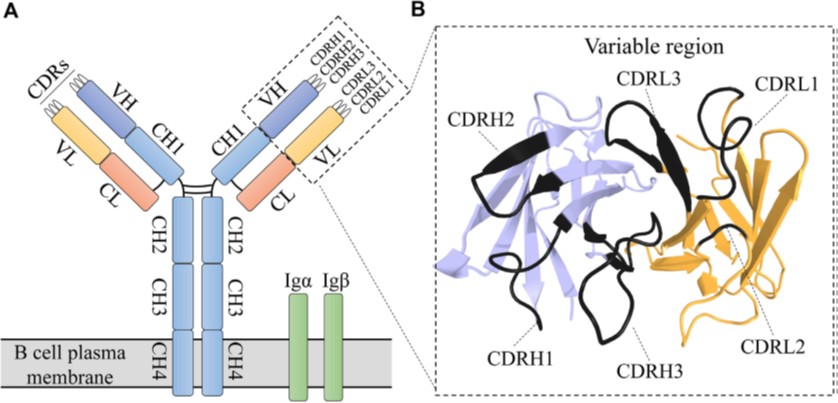 Fig. 1 BCR structure.1
Our end-to-end service is engineered to ensure data integrity and biological accuracy at every milestone.
We support a vast array of starting materials, including:
For the most accurate B-cell receptor (BCR) repertoire analysis, we generally recommend RNA as the starting template. This captures the active, functional repertoire and avoids the interference of non-functional pseudogenes and large intronic regions present in genomic DNA.
The quality of BCR Repertoire Sequencing is determined by the library. We utilize two sophisticated strategies:
Using our advanced high-throughput sequencing platform, we generate massive datasets with high Q30 scores.
Data is processed through our proprietary pipeline, which includes:
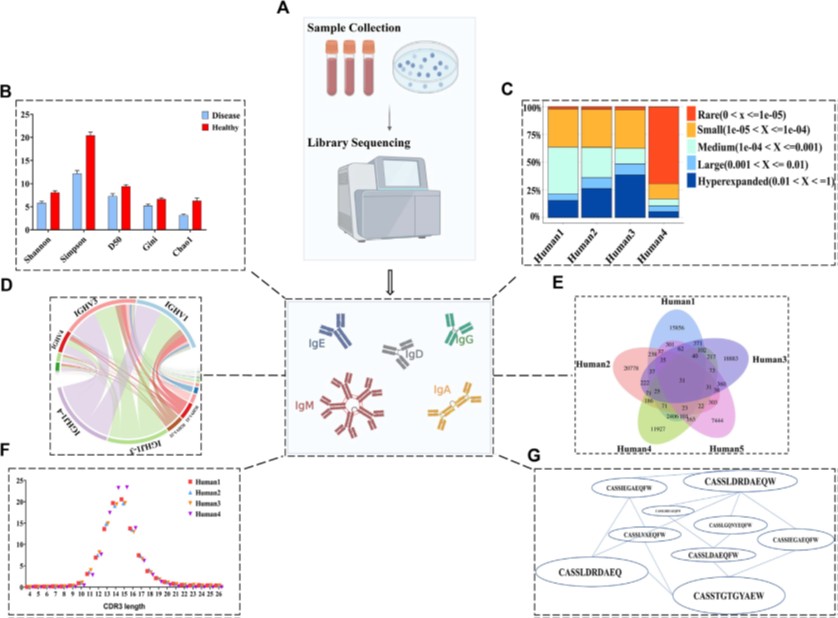 Fig. 2 BCR repertoire sequence analysis.1
By analyzing the B-cell receptor (BCR) repertoire of immunized animals or convalescent patients, we can rapidly identify high-affinity lead candidates. The pairing information from our single-cell high-throughput sequencing platform accelerates the transition from "sequence" to "synthetic antibody."
BCR Repertoire Sequencing allows researchers to measure the "breadth" and "depth" of the immune response elicited by a vaccine candidate. We track the emergence of broadly neutralizing antibodies (bNAbs) and the establishment of long-lived memory B-cell pools.
In B-cell lymphomas and leukemias, the BCR repertoire becomes highly polarized. Our NGS sequencing solutions provide sensitive monitoring for Minimal Residual Disease (MRD) and the evaluation of B-cell reconstitution following CAR-T therapy or bone marrow transplantation.
Identify pathogenic B-cell clones in diseases like Rheumatoid Arthritis or Multiple Sclerosis. Understanding the BCR repertoire dynamics helps in identifying potential biomarkers for disease progression and therapeutic response.
For over 20 years, Creative Biolabs has been synonymous with excellence in antibody research. Our BCR Repertoire Analysis services are built on a foundation of:
To provide a full-spectrum BCR Repertoire Solution, Creative Biolabs offers several interconnected services:
Ready to accelerate your immunology research? Our experts are standing by to discuss your specific B-cell receptor (BCR) repertoire analysis needs.
References
All listed services and products are For Research Use Only. Do Not use in any diagnostic or therapeutic applications.