Creative Biolabs is offering the most comprehensive services for antibody development projects. With strict regulation and effective execution, we are dedicated to providing the most valuable solutions to complete your projects.
HighlightsCreative Biolabs is offering the most comprehensive services for antibody development projects. With strict regulation and effective execution, we are dedicated to providing the most valuable solutions to complete your projects.
HighlightsCreative Biolabs has established a broad range of platforms for developing novel antibodies or equivalents. These cutting-edge technologies enable our scientists to meet your demands from different aspects and tailor the most appropriate solution that contributes to the success of your projects.
HighlightsWith deep understanding in antibody-related realms and extensive project experience, Creative Biolabs offers a variety of references to help you learn more about our capacities and achievements, including infographic, flyer, case study, peer-reviewed publications, and all kinds of knowledge that can assist your projects. You are also welcome to contact us directly for more specific solutions.
HighlightsGet a real taste of Creative Biolabs, one of the most professional custom service providers in the world. We are committed to providing highly customized comprehensive solutions with the best quality to advance your projects.
HighlightsIn the landscape of cardiovascular medicine, the inability to deliver therapeutic or diagnostic agents specifically to atherosclerotic plaques remains a significant bottleneck. Creative Biolabs, a global leader in phage display technology with over two decades of expertise, offers a sophisticated Atherosclerosis Targeting In Vivo Phage Library Screening Service. This platform is engineered to bypass the limitations of traditional in vitro methods, identifying highly specific homing peptides or antibodies that recognize the complex molecular signatures of atherosclerotic lesions within a living physiological environment.
Atherosclerosis is not merely a lipid-storage disease but a chronic inflammatory condition involving intricate interactions between endothelial cells, macrophages, smooth muscle cells, and the extracellular matrix. Traditional in vitro cell-based screening often fails because:
Our In Vivo Phage Library Screening platform overcomes these hurdles by injecting high-diversity libraries directly into animal models of atherosclerosis, allowing the physiological "sieve" of the circulatory system to select for the most effective binders.
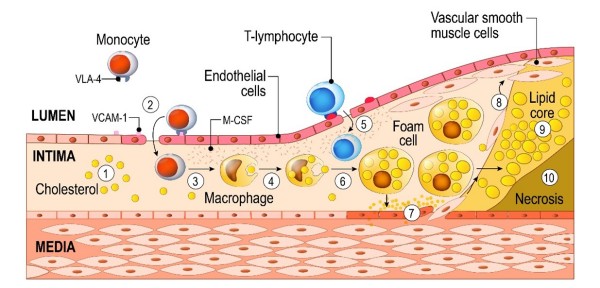 Fig. 1 Pathogenesis of atherosclerosis.
Creative Biolabs utilizes a variety of phage systems and library formats to maximize the probability of success.
| Library Category | Phage System | Diversity | Applications |
| Random Peptide Libraries | M13, T7 | 109 - 1013 | Discovery of short, stable homing peptides. |
| scFv/Fab Libraries | M13 | 108 - 1011 | Discovery of high-affinity antibody fragments for immunotherapy. |
| Single Domain Antibody Libraries | M13 | 109 | Discovery of small, highly penetrative VHH fragments. |
| Cyclic Peptide Libraries | M13 | 109 | Enhanced stability and binding affinity via constrained structures. |
To ensure absolute specificity for Atherosclerosis Targeting In Vivo Phage Library Screening, we employ "Negative Selection" or "Pre-adsorption" strategies. By first circulating the library in healthy control models or using "subtractive biopanning" against non-target organs (liver, lungs, kidneys), we eliminate non-specific binders, leaving only those with high affinity for atherosclerotic plaques.
The process of In Vivo Phage Display for Atherosclerosis is a multi-step, iterative cycle designed to enrich for the most potent candidates.
We begin by selecting the appropriate animal model that mimics human atherosclerotic progression—from fatty streaks to vulnerable plaques.
The phage library is administered intravenously. We meticulously control the circulation time to allow for optimal binding while minimizing non-specific internalization.
To remove unbound phages, the animal undergoes systemic perfusion with a physiological buffer. The atherosclerotic tissues (e.g., aorta, carotid arteries) are then harvested.
Bound phages are recovered via acid elution or bacterial infection and subsequently amplified for the next round of screening. Usually, 3–5 rounds of selection are performed.
Unlike traditional methods that sequence only a few dozen clones, we utilize Next-Generation Sequencing (NGS) to analyze the entire enriched pool. Our bioinformatics pipeline identifies:
The transition from in vitro to in vivo is often where most candidates fail. Our platform bridges this gap by ensuring the selection process occurs under real-world physiological conditions.
Table 1. Comparison: In Vivo vs. In Vitro Screening for Atherosclerosis
| Feature | In Vitro (Cell-Based) | In Vivo (Atherosclerosis Models) |
| Target Environment | Static and artificial; lacks systemic complexity. | Dynamic and physiological; includes blood flow and shear stress. |
| Vascular Architecture | Limited to monolayer cell cultures. | Intact, multi-layered plaque structure (intima, media, adventitia). |
| Bioavailability Insight | None; cannot predict clearance or off-target binding. | High; considers blood-clearance and non-specific organ uptake. |
| Ligand Specificity | High risk of "plastic binders" or artifacts. | Highly relevant to the actual disease state in the vessel wall. |
| Clinical Translation | Low success rate due to loss of target relevance. | High; identifies "homing" candidates ready for preclinical testing. |
Through Atherosclerosis Targeting In Vivo Phage Library Screening, we have successfully mapped numerous vascular markers that define the progression of the disease. Our service allows you to tailor the screening process to target specific stages of plaque development—from early lipid accumulation to late-stage rupture risk.
| Target Component | Key Molecular Signatures | Strategic Application |
| Activated Endothelium | VCAM-1, E-selectin, P-selectin | Early-stage detection and delivery of anti-inflammatory agents. |
| Foam Cells & Macrophages | Scavenger receptors (SR-AI), CD68 | Targeting the primary drivers of plaque inflammation and growth. |
| Necrotic Core & Matrix | Cryptic collagen, Tenascin-C, Extracellular DNA | Identifying advanced, high-risk plaques for stabilization therapy. |
| Plaque Angiogenesis | αvβ3 integrin, VEGFR | Assessing neovascularization and predicting potential plaque rupture. |
| Thrombus & Fibrin | Fibrinogen, Activated Platelets | Detecting acute events and localized delivery of thrombolytic drugs. |
By combining the physiological relevance of In Vivo Phage Display with the specificity of these molecular targets, Creative Biolabs empowers your research to achieve higher precision and faster clinical translation in the fight against Atherosclerosis.
To further your research, consider our integrated In Vivo Phage Library Screening Services modules:
Learn more about other Phage Display Library Screening Services:
Atherosclerosis Targeting In Vivo Phage Library Screening is a transformative tool for the development of the next generation of cardiovascular diagnostics and therapeutics. Creative Biolabs combines deep biological expertise with cutting-edge technology to deliver high-affinity, high-specificity ligands that pave the way for precision medicine.
Contact our expert team today to discuss how we can accelerate your atherosclerosis targeting research.
Reference
All listed services and products are For Research Use Only. Do Not use in any diagnostic or therapeutic applications.