Creative Biolabs is offering the most comprehensive services for antibody development projects. With strict regulation and effective execution, we are dedicated to providing the most valuable solutions to complete your projects.
HighlightsCreative Biolabs is offering the most comprehensive services for antibody development projects. With strict regulation and effective execution, we are dedicated to providing the most valuable solutions to complete your projects.
HighlightsCreative Biolabs has established a broad range of platforms for developing novel antibodies or equivalents. These cutting-edge technologies enable our scientists to meet your demands from different aspects and tailor the most appropriate solution that contributes to the success of your projects.
HighlightsWith deep understanding in antibody-related realms and extensive project experience, Creative Biolabs offers a variety of references to help you learn more about our capacities and achievements, including infographic, flyer, case study, peer-reviewed publications, and all kinds of knowledge that can assist your projects. You are also welcome to contact us directly for more specific solutions.
HighlightsGet a real taste of Creative Biolabs, one of the most professional custom service providers in the world. We are committed to providing highly customized comprehensive solutions with the best quality to advance your projects.
HighlightsBiotechnology research remains focused on Bacteriophage T7 because it targets Escherichia coli and demonstrates exceptional gene expression abilities along with precise protein production capabilities. The Podoviridae family member bacteriophage T7 possesses a short rigid tail making it ideal for molecular biology applications applications and practices including protein engineering and biopharmaceutical development. The bacteriophage has a simple structure consisting of a double-stranded DNA genome that spans 40kb including replication machinery information and structural elements together with other essential proteins.
The utility of T7 phage in phage display systems depends on understanding its structural components. The T7 structure contains a head region that holds the phage genome and a tail that functions for bacterial host cell attachment. The phage head displays icosahedral symmetry through pentameric proteins at its base and hexameric proteins constructing its sides.
Within the phage head the genetic material maintains a highly condensed and organized structure because the viral genome forms a DNA-protein complex. The phage tail fibers which recognize specific receptors on E. coli surfaces enable the phage to attach to host cells and inject its genetic material.
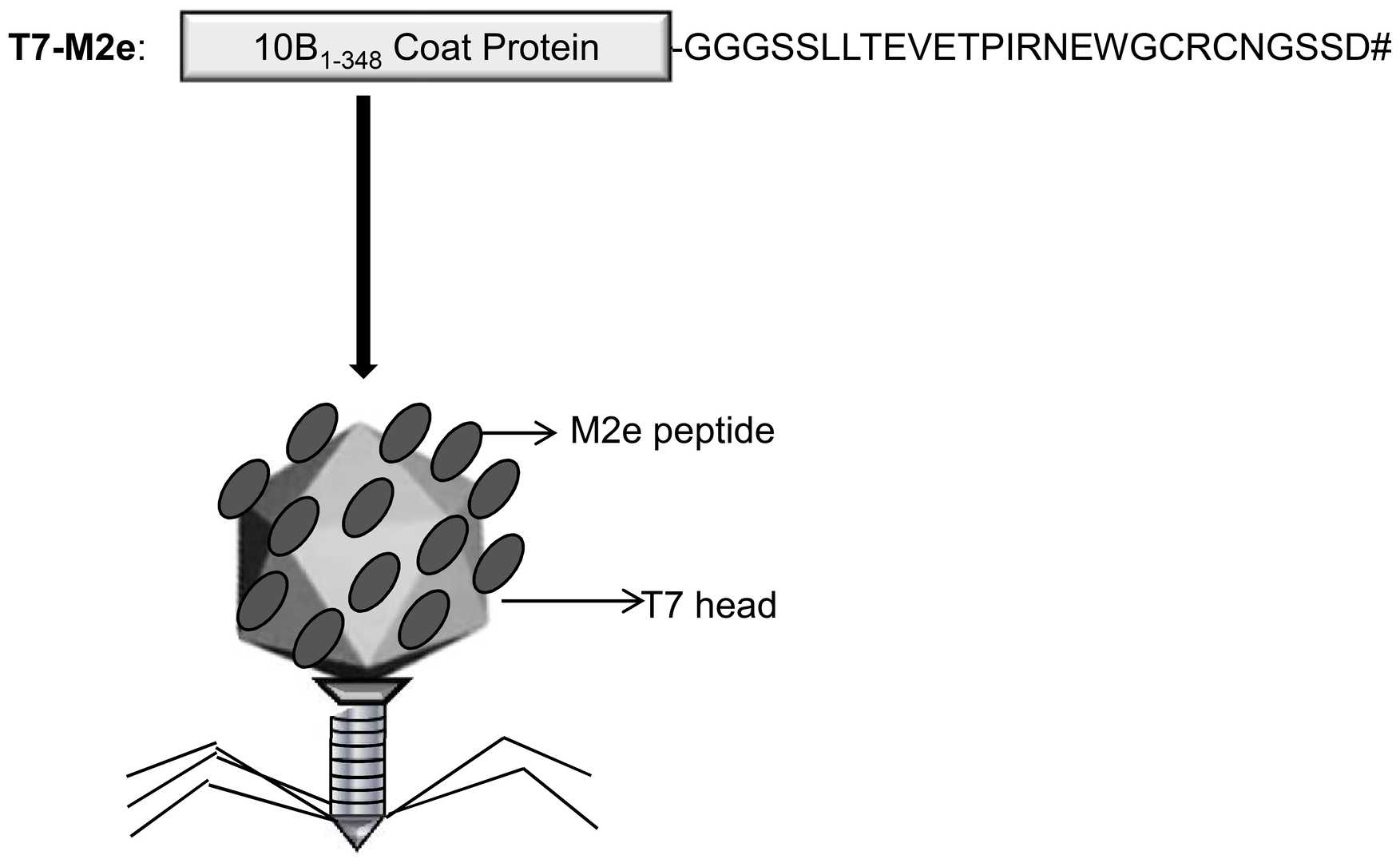 Fig.1 Schematic diagram of the 10B-M2e chimeric capsid protein displayed on the T7-M2e phage nanoparticles.1, 3
T7 phage's capability to display peptides or proteins externally makes it essential for researching protein interactions and creating biological treatments. T7 phage display systems enable precise peptide library attachment to phage particles which permits researchers to discover binding partners for target proteins. The adaptability and performance of T7 phage display establish its essential role in drug discovery, antibody engineering, and biomolecular screening among other areas.
Phage display technology enables bacteriophages to present proteins or peptides on their surfaces because these proteins or peptides' genetic information exists in the phage DNA. The T7 phage display system benefits from T7 phage's inherent properties which enable efficient E. coli infection and the production of considerable amounts of surface proteins for display. These fusion proteins integrate into the phage capsid after infection occurs. The phage surface displays these peptides which become accessible for interactions with potential binding entities like antibodies or receptors.
The T7 phage display system relies on the infection cycle of T7 phages for its mechanism. The recombinant phages infect E. coli cells to produce peptides or proteins that are displayed on the phage surface. The phage genome encodes the genetic information for displayed peptides while fusion proteins assemble inside the phage particle during replication.
Once phage particles are assembled they become useful for different assays like affinity-based selection which involves immobilizing target molecules on a surface to allow interactions with displayed peptides. The approach enables researchers to discover peptides that demonstrate strong affinity toward target molecules which yields important data for drug development and vaccine production along with other uses.
The T7 phage display system provides multiple benefits when compared to M13 phage display system and lambda phage display system. These advantages include:
The T7 phage display library development process requires generating various peptide and protein variants for use in screening procedures. The process involves generating a collection of recombinant phages where each phage contains a unique peptide sequence. Researchers can produce libraries through several techniques including random peptide synthesis or combinatorial methods.
T7 phage display systems frequently utilize cDNA libraries to express either protein fragments or full-length proteins. Researchers insert cDNA reverse transcribed from messenger RNA into the phage genome to enable protein expression and surface display.
Building a T7 phage display library requires following a multi-step process.
 Fig. 2 Schematic description of the established workflow for the screening of DAvp-1.2, 3
Building a phage library demands strict quality control and adequate diversity. Quality control checks both the clonal population of the library and the representation of various peptide sequences. Researchers implement DNA sequencing and functional assays to verify the successful construction of the library and its peptide diversity.
T7 phage display kits are commercially available systems that provide all the necessary reagents and protocols to perform phage display experiments. These kits typically include:
Over years, Creative Biolabs has established a comprehensive list of libraries for de novo discovery of therapeutically relevant antibodies and peptides.
The kits provide all required elements needed to build libraries and perform expression and selection tasks with high efficiency. Both academic institutions and commercial enterprises employ these kits to discover new peptides which aid in drug discovery as well as in the development of vaccines and diagnostic instruments.
Using a T7 phage display kit involves:
The surface of recombinant T7 phages presents peptides or proteins of interest as they are customized phages. Production of recombinant T7 phages requires the integration of a target gene into the T7 genome to enable the desired peptide expression on the phage capsid.
The T7 phage display technique plays a pivotal role in drug discovery by enabling the identification of small molecule inhibitors and monoclonal antibodies as well as targeted therapies. Phage display systems enable scientists to perform high-throughput screening to identify drug candidates quickly and effectively.
Antibody screening utilizes T7 phage display system extensively. Researchers can determine monoclonal antibodies that attach to antigenic peptides or proteins presented on phage surfaces which helps develop diagnostic tests and therapeutic antibodies.
Scientists can construct extensive peptide libraries through T7 phage display to identify bioactive compounds or peptides that bind to specific molecular targets. Scientists use these libraries to discover drug leads as well as antagonists and agonists.
All listed services and products are For Research Use Only. Do Not use in any diagnostic or therapeutic applications.