"Creative Biolabs is committed to providing highly customized comprehensive solutions with the best quality to advance our global clients’ projects."
Advanced Cell based Library Screening Service
Background Platform Screening Strategy Workflow Deliverable Advantage Related Service FAQ Online Inquiry
In the modern era of biopharmaceutical development, the ability to identify high-affinity binders against targets in their natural environment is the "Holy Grail" of drug discovery. Traditional in vitro screening methods, while efficient for soluble proteins, often fail when applied to complex, multi-pass membrane proteins like G-protein coupled receptors (GPCRs), ion channels, and transporters. At Creative Biolabs, we have spent over 20 years refining our Cell-based Library Screening services to bridge this gap. Our proprietary Cell-based Phage Display Screening Platform allows researchers to bypass the need for purified protein antigens, instead utilizing whole cells that present targets in their native, functional conformations. This ensures that the resulting candidates—whether antibodies, peptides, or scaffolds—possess superior biological relevance and clinical potential.
Discuss Your Project Today
The Imperative for Cell-based Library Screening
The complexity of the mammalian cell surface is staggering. Proteins are not isolated entities; they are glycosylated, lipid-modified, and often part of multi-protein complexes. When these proteins are extracted and purified for traditional solution-based screening, they frequently lose their native folding or shed critical epitopes.
Cell based Library Screening addresses these challenges by maintaining the target's integrity. By utilizing live cells as the "bait" for a Cell based Library, we ensure:
-
Preservation of Native Epitopes: Targeting extracellular loops and conformational epitopes that do not exist in denatured or truncated protein fragments.
-
Post-Translational Modifications (PTMs): Capturing binders that recognize specific glycosylation patterns or other cellular modifications.
-
Functional Relevance: Screening for binders that not only bind but can also trigger or inhibit biological signaling pathways directly on the cell surface.
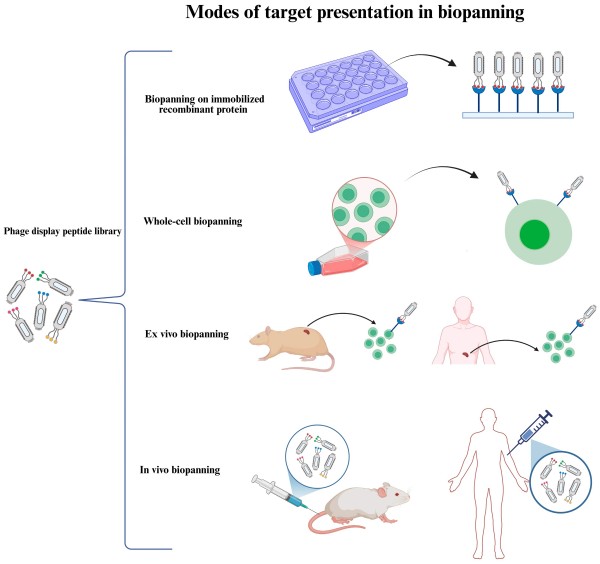 Fig. 1 Different modes of target presentation in biopanning.1
Our State-of-the-Art Cell-based Phage Display Platform
Creative Biolabs utilizes a cutting-edge Cell based phage screening platform that integrates high-diversity libraries with sophisticated sorting technologies. Whether you are performing phage display screening for scFv, Fab, or VHH (Single Domain Antibody) formats, our platform is optimized for the unique challenges of "panning" on whole cells.
High-Diversity Cell-based Library Construction
The success of any Cell based library screening campaign begins with the library itself. We offer:
-
Immune Libraries: Sourced from animals or humans with specific disease states or immunization histories.
-
Naïve Libraries: Boasting diversities up to 1011 to ensure the identification of novel binders against virtually any target.
-
Synthetic/Semi-synthetic Libraries: Engineered for optimal biophysical properties and reduced immunogenicity.
Diverse Display Formats
We offer a variety of display systems tailored to specific project needs:
-
M13 Phage Display: The industry standard for scFv and Fab screening.
-
T7 Phage Display: Ideal for screening peptides or proteins where folding in the cytoplasm is required.
-
Yeast Display: Often used in tandem with phage display for fine-tuning affinity and stability.
Advanced Strategies in Cell-based Phage Display Screening
Success in cell-based phage display library screening requires more than just mixing phage with cells. It demands a strategic approach to eliminate non-specific binding and maximize enrichment against the specific target.
Subtractive Screening Strategy
To identify binders specific to a target (e.g., a tumor-associated antigen), we employ a subtractive approach. The library is first "pre-absorbed" against a control cell line (the same cell type but lacking the target protein). This removes phage that bind to common cell-surface markers, leaving only those that recognize the target of interest.
Competitive Panning
When targeting a specific functional site (like a ligand-binding pocket), we introduce known ligands or competing antibodies during the Cell based Screening process. This "competitor-driven" approach forces the library to compete for the most biologically relevant epitopes.
FACS-Assisted Phage Sorting
By combining phage display with Fluorescence-Activated Cell Sorting (FACS), we can achieve unprecedented precision. Phage-bound cells are labeled with fluorescent markers, allowing us to sort and recover only the highest-affinity binders based on real-time fluorescence intensity.
Technical Workflow of Cell-based Phage Display Library Screening
At Creative Biolabs, our workflow is designed for maximum transparency and data-driven decision-making.
-
Cell Line Validation: We confirm the expression levels of the target on the surface of the host cell using flow cytometry (FACS).
-
Negative Selection (Pre-adsorption): Incubation with target-negative cells to remove background binders.
-
Positive Selection (Panning): Incubation of the depleted library with target-positive cells.
-
Washing and Recovery: Stringent washing to remove weak binders, followed by elution of high-affinity phage.
-
Amplification: Recovered phage are amplified in E. coli for the next round of selection.
-
Polyclonal & Monoclonal ELISA/FACS: After 3-4 rounds, we analyze the enrichment and pick individual clones for validation.
-
NGS Analysis: We utilize Next-Generation Sequencing to track the evolution of the library across rounds, ensuring we don't miss "rare" but high-potency clones.
Technical Specifications & Data Deliverables
Upon completion, Creative Biolabs will deliver:
-
Summary of cell lines and conditions used
-
Enrichment statistics across panning rounds
-
ELISA or binding assay data for top clones
-
NGS or Sanger sequencing data of enriched clones
-
Optional clone expression and validation data
-
Full experimental report with recommendations
We also store enriched libraries for 3 months for any requested follow-up services.
Why Choose Creative Biolabs?
With two decades of leadership in Cell based Library Screening, we offer more than just a service; we offer a partnership.
-
Unrivaled Expertise: Our scientists have successfully completed thousands of cell-based screening projects for global pharmaceutical companies.
-
Customized Cell Engineering: We can generate stable overexpressing cell lines or create custom knockout lines for subtractive panning.
-
Integrated Solutions: Beyond screening, we offer antibody humanization, affinity maturation, and comprehensive biophysical characterization.
-
Global Reach, Local Support: We provide detailed technical reports and consultation at every stage of the project.
Explore Our Comprehensive Services
Learn more about other Phage Display Library Screening Services:
Creative Biolabs provides the expertise, the technology, and the dedication to ensure your Cell based Library Screening project is a success. By leveraging our Cell based phage screening platform, you are choosing a path that prioritizes biological relevance and technical excellence.
Contact us today to discuss your specific target and how our Cell based library screening can accelerate your discovery pipeline.
Contact Us Today for a Free Quote!
Frequently Asked Questions (FAQs)
-
Q: How do you ensure the phage are not binding to common cell surface proteins?
A: We utilize a rigorous subtractive panning process. Before the library is exposed to the target-positive cells, it is incubated with "decoy" cells that are identical to the target cells except for the specific antigen expression.
-
Q: Can I provide my own cell lines for the screening?
A: Yes. We frequently work with client-provided cell lines. We will perform a preliminary QC to ensure expression levels and cell viability are sufficient for a successful screening.
-
Q: What is the advantage of Cell-based Phage Display over Yeast Display?
A: While both are powerful, phage display libraries typically offer much higher diversity (1010–1011) compared to yeast (107–109). This makes phage display better suited for the initial discovery phase against difficult targets.
-
Q: How do you handle targets with low expression levels?
A: For low-expression targets, we often employ FACS-assisted sorting or utilize our proprietary "Pan-Sorting" strategy to maximize the signal-to-noise ratio.
-
Q: Is it possible to screen for internalizing antibodies using this platform?
A: Absolutely. We can modify the panning protocol to specifically select for phage that are internalized into the cell, which is crucial for Antibody-Drug Conjugate (ADC) and toxin delivery applications.
-
Q: Do you offer screening against primary cells or tissue samples?
A: Yes, though cell lines are more common, we can adapt our Cell based Screening protocols for primary cells or even ex vivo tissue fragments, provided the viability is maintained.
-
Q: What formats of antibodies can be recovered?
A: Our libraries are most commonly in scFv, Fab, or VHH formats. Once a binder is identified, we can readily convert it into a full-length IgG of any species or isotype.
-
Q: How do you distinguish between binders to the target and binders to the cell membrane lipids?
A: Through careful buffer optimization and the use of competitive blockers, we minimize lipid binding. Furthermore, secondary validation using ELISA or SPR with purified extracellular domains (if available) helps confirm specificity.
Reference
-
Bakhshinejad, Babak, and Saeedeh Ghiasvand. "A beautiful bind: phage display and the search for cell-selective peptides." Viruses 17.7 (2025): 975. Distributed under Open Access license CC BY 4.0, without modification. https://doi.org/10.3390/v17070975