Creative Biolabs is offering the most comprehensive services for antibody development projects. With strict regulation and effective execution, we are dedicated to providing the most valuable solutions to complete your projects.
HighlightsCreative Biolabs is offering the most comprehensive services for antibody development projects. With strict regulation and effective execution, we are dedicated to providing the most valuable solutions to complete your projects.
HighlightsCreative Biolabs has established a broad range of platforms for developing novel antibodies or equivalents. These cutting-edge technologies enable our scientists to meet your demands from different aspects and tailor the most appropriate solution that contributes to the success of your projects.
HighlightsWith deep understanding in antibody-related realms and extensive project experience, Creative Biolabs offers a variety of references to help you learn more about our capacities and achievements, including infographic, flyer, case study, peer-reviewed publications, and all kinds of knowledge that can assist your projects. You are also welcome to contact us directly for more specific solutions.
HighlightsGet a real taste of Creative Biolabs, one of the most professional custom service providers in the world. We are committed to providing highly customized comprehensive solutions with the best quality to advance your projects.
HighlightsHarnessing unparalleled affinity and novel epitope recognition, Rabbit Monoclonal Antibodies (rMAbs) have emerged as indispensable tools in diagnostics, research, and therapeutic development. Creative Biolabs stands at the forefront of antibody engineering, offering a premier Rabbit Monoclonal Antibody Discovery Service built upon a state-of-the-art phage display immune antibody library platform. Our expert-driven approach overcomes the traditional challenges of rabbit hybridoma instability, allowing us to rapidly isolate high-affinity binders from a vast, immunized repertoire. By integrating advanced immunization strategies with the robust construction and screening of immune antibody library technology, we deliver rabbit monoclonal antibodies with sub-nanomolar affinity and exquisite specificity, tailored precisely to your research needs.
The rabbit immune system is a powerful engine for generating superior antibodies. Unlike rodents, rabbits utilize a unique B-cell development mechanism to generate a highly diverse antibody repertoire. This biological distinction translates into significant advantages for researchers.
The inherent limitations of mouse-derived antibodies—such as reduced immunogenicity for conserved human proteins and a more restricted epitope range—are effectively overcome by leveraging the rabbit immune system. This makes Rabbit Monoclonal Antibody Discovery a critical strategy for today's most challenging research targets.
Traditional rabbit hybridoma technology is notoriously difficult and inefficient due to the instability of rabbit B-cell fusion partners. Creative Biolabs has engineered a robust, high-throughput platform that bypasses these limitations entirely: Phage Display-Based Rabbit Monoclonal Antibody Discovery from an immune antibody library. This platform combines the power of in vivo rabbit immunization with the scalability of in vitro phage display screening.
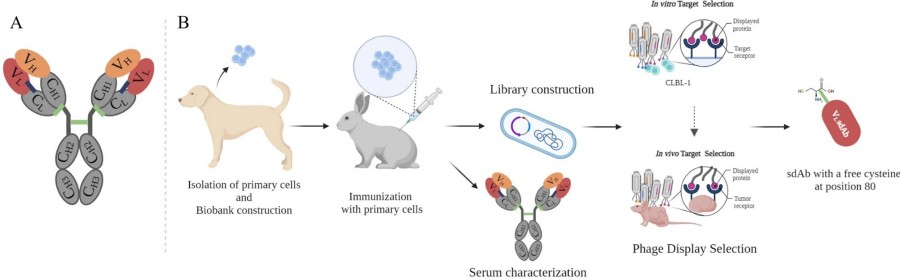 Fig. 1 Schematic illustration of the adopted strategy for the development of rabbit derived sdAb ADC.1
An immune antibody library is a collection of antibody genes (VH and VL) cloned from the B-cells of an immunized animal. These genes are expressed on the surface of bacteriophages, creating a direct link between the antibody fragment (the phenotype) and its encoding DNA (the genotype). This library represents the complete, affinity-matured antibody response of the rabbit to your specific antigen.
We have refined every step of the construction and screening of immune antibody library process to maximize success.
Choosing the right discovery platform is critical. While Creative Biolabs is also expert in B-cell sorting and hybridoma techniques, our phage display immune antibody library platform offers distinct advantages for Rabbit Monoclonal Antibody Discovery.
| Feature | Phage Display (Immune Library) | Traditional Rabbit Hybridoma | Single B-cell Sorting |
| Technology Basis | In vitro screening of V-gene repertoire from immunized B-cells. | In vitro fusion of B-cells with myeloma partners. | Isolation and cloning of V-genes from single, antigen-specific B-cells. |
| Primary Challenge | Requires high-quality library construction. | Extremely low fusion efficiency and hybridoma instability. | Requires highly sensitive and specialized sorting equipment. |
| Throughput | Extremely High. Screens >109 clones. | Very Low. Screens ~104 clones. | High. Screens ~106 - 107 cells. |
| Speed to Hit | Fast. | Very Slow. | Very Fast. |
| Affinity | Excellent. Enriched in vitro from an in vivo matured pool. | Excellent. Derived from in vivo matured plasma cells. | Excellent. Captures in vivo matured natural pairs. |
| Creative Biolabs' Edge | Our robust platform for construction and screening of immune antibody library is a high-success, high-throughput workhorse. | We offer this as a legacy service but recommend more modern platforms. | We offer this as a parallel, complementary platform for rapid discovery. |
Our immune antibody library for Rabbit Monoclonal Antibody Discovery combines the speed and throughput of in vitro display with the power of in vivo affinity maturation, representing a "best of both worlds" approach.
When you choose Creative Biolabs for Rabbit Monoclonal Antibody Discovery, you are not just purchasing a service; you are gaining a dedicated scientific partner.
While our phage display immune antibody library platform is a powerful engine, we offer a comprehensive suite of discovery technologies to ensure we always use the right tool for the job. Our Monoclonal Antibody Generation from Various Immunized Antibody Libraries Services:
Unlock the full potential of your research with antibodies of superior affinity and specificity. Contact our team of experts to discuss your target and receive a customized project proposal.
Q: What is the primary advantage of your phage display-based Rabbit Monoclonal Antibody service over traditional rabbit hybridoma?
A: The primary advantages are speed and reliability. Traditional rabbit hybridoma is plagued by the low efficiency of B-cell fusion and the high instability of the resulting hybridoma cell lines. Our phage display immune antibody library platform bypasses fusion entirely. We capture the immunized V-gene repertoire and use the robust, high-throughput phage display system to screen billions of clones in just a few weeks, leading to a much higher success rate and faster timeline.
Q: How large is the typical immune antibody library for Rabbit Monoclonal Antibody that you construct?
A: Our proprietary cloning technology and primer sets consistently produce libraries with diversities in the range of 109 to 1010 individual clones. This high complexity is crucial for ensuring that we capture the full diversity of the rabbit's immune response, including rare, high-affinity binders.
Q: Can you generate rabbit antibodies against "difficult" targets like small molecules or PTMs?
A: Yes. This is a key strength of our platform. We employ specialized immunization strategies using optimized carriers and conjugation methods to generate strong immune responses against haptens (small molecules) and specific PTM-containing peptides. The high sensitivity of our construction and screening of immune antibody library workflow allows us to isolate highly specific binders to these challenging epitopes.
Q: What is the typical affinity I can expect from this service?
A: While affinity is antigen-dependent, our platform is optimized to enrich for high-affinity binders. It is standard for our Rabbit Monoclonal Antibody Discovery service to yield antibodies with affinities (KD) in the sub-nanomolar range (e.g., 10-9 to 10-11 M).
Q: What format are the final antibodies delivered in?
A: Our platform initially discovers antibodies in a fragment format (scFv or Fab). However, our standard service includes sub-cloning the V-genes into a mammalian expression vector to produce the final antibody in a full-length rabbit IgG format. We are flexible and can deliver the antibody in virtually any format you require, including chimeric (e.g., rabbit V-genes on a human IgG1 backbone) or bispecific formats.
Q: What if my project requires an antibody that recognizes the native conformation of a membrane protein?
A: Our platform is well-suited for this. We can perform immunization with whole cells or nanodiscs displaying your protein of interest. Furthermore, the screening and biopanning steps can be performed directly on live cells or other native-conformation substrates to ensure the antibodies we discover recognize the functional form of the protein.
All listed services and products are For Research Use Only. Do Not use in any diagnostic or therapeutic applications.