Creative Biolabs is offering the most comprehensive services for antibody development projects. With strict regulation and effective execution, we are dedicated to providing the most valuable solutions to complete your projects.
HighlightsCreative Biolabs is offering the most comprehensive services for antibody development projects. With strict regulation and effective execution, we are dedicated to providing the most valuable solutions to complete your projects.
HighlightsCreative Biolabs has established a broad range of platforms for developing novel antibodies or equivalents. These cutting-edge technologies enable our scientists to meet your demands from different aspects and tailor the most appropriate solution that contributes to the success of your projects.
HighlightsWith deep understanding in antibody-related realms and extensive project experience, Creative Biolabs offers a variety of references to help you learn more about our capacities and achievements, including infographic, flyer, case study, peer-reviewed publications, and all kinds of knowledge that can assist your projects. You are also welcome to contact us directly for more specific solutions.
HighlightsGet a real taste of Creative Biolabs, one of the most professional custom service providers in the world. We are committed to providing highly customized comprehensive solutions with the best quality to advance your projects.
HighlightsCreative Biolabs accelerates your ADC program by bypassing animal immunization. We deploy massive premade human antibody libraries and specialized screening strategies to isolate high-affinity candidates. Our process ensures these antibodies not only recognize your target but also facilitate rapid internalization for precise cytotoxic payload delivery.
In ADC development, binding is only the beginning. The ADC Paradox often presents a challenge: high-affinity binders may fail to internalize, or internalize without reaching the lysosome. Furthermore, the antibody must remain stable once conjugated to hydrophobic payloads. Creative Biolabs solves this at the source. We combine our massive premade human libraries with Internalization-First screening. We don't just look for binders; we filter for carriers, which are antibodies that bind specifically, internalize rapidly, and possess the biophysical robustness required for conjugation chemistry.
At Creative Biolabs, screening is a strategic filter for therapeutic efficacy. Our phage and yeast display platforms are engineered to identify antibodies that drive receptor-mediated endocytosis. Through pH-sensitive elution strategies and cell-based internalization tests early in the funnel, we systematically eliminate surface-stuck binders. We also perform early developability triage to ensure your candidates have clean hydrophobicity profiles, preventing aggregation catastrophic to ADC formulation.
|
Endocytosis-Driven Selection Screening strategies tuned to identify rapid internalizers. |
High Specificity Stringent negative selection to minimize off-target toxicity. |
Conjugation-Ready Frameworks Optimized sequences with low surface hydrophobicity. |
Diverse Epitope Coverage Access epitopes that trigger receptor clustering and uptake. |
Target name, Indication, Payload class, Internalization goals.
Ranked internalizing binders, epitope bins, sequence families, IgG mini-panel, developability metrics.
We offer a curated selection of libraries optimized for finding stable, internalizing antibodies suitable for conjugation.
| Antibody Library ID | Display Technology | Library Format | Library Size |
|
HuScL-6 Highly Recommended |
pIII-fusion, Phagemid Phage Display | Naïve scFv | 2.1×10¹¹ |
| HuScL-3S | pIII-fusion, Phagemid Phage Display | Semi-synthetic scFv | >1.0×10¹¹ |
| HuFabL-4 | pIII-fusion, Phagemid Phage Display | Naïve Fab | 1.9×10¹⁰ |
| HuFabssL-1 | pIII-fusion, Phagemid Phage Display | Naïve & synthetic Fab | 1.8×10¹⁰ |
| Discovery of Species Cross-Reactive scFv Antibodies for Next-Generation ADC Development | |
| Objective |
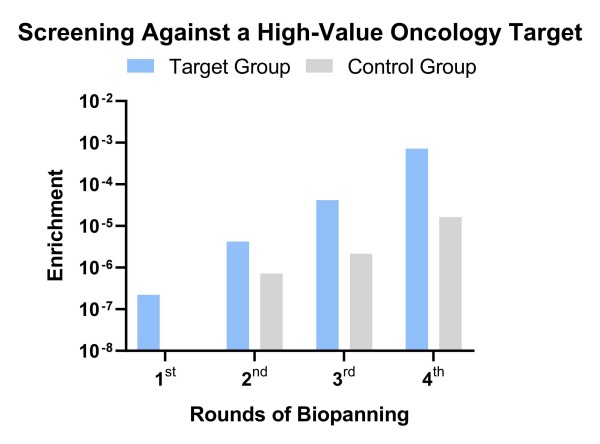
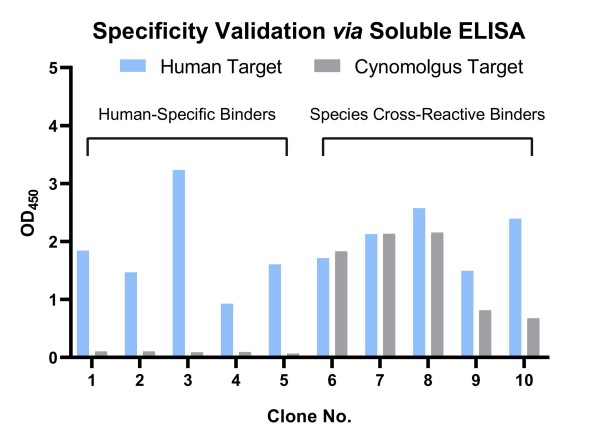
In the development of ADCs for solid tumors, such as Renal Cell Carcinoma (RCC), identifying leads with cross-species reactivity is a critical success factor. To facilitate accurate safety and efficacy evaluations in non-human primates (NHP), the antibody must recognize both the human antigen and its Cynomolgus/Rhesus ortholog with similar affinity. This case study demonstrates our ability to use a Premade Synthetic Human scFv Library to isolate high-affinity binders against a high-value RCC surface target, while strategically identifying clones with cross-reactive properties. |
| Target Analysis & Strategy |
The target in this study is a key enzyme overexpressed in specific carcinomas. Bioinformatics analysis revealed a high sequence identity (>90%) between the Human and Rhesus versions of the extracellular domain. To ensure the highest affinity for the therapeutic lead while capturing species-broadening candidates, we implemented a Human-Target-Driven Selection with Parallel Identification strategy:
|
| Key Results |
Our platform successfully identified ~10 unique human scFv clones with distinct binding profiles, providing the client with multiple options for their ADC pipeline:
|
| Value-Added Technical Support for ADC Programs |
We go beyond providing sequences by offering integrated downstream consultancy to ensure the "developability" of the leads as ADCs:
|
 Functional-First Triage
We go beyond simple binding by integrating cell-based internalization assays early in the screening process. This ensures we select candidates based on their biological ability to deliver cytotoxic payloads into the target cell, rather than just affinity alone.
Superior VHH Scaffolds
Our premade VHH libraries provide robust scaffolds that yield high-affinity VHH clones. These single-domain antibodies are ideal for ADCs due to their deep tissue penetration in solid tumors and ease of engineering into multi-valent formats.
Weeks, Not Months
Our premade synthetic platform bypasses the traditional 3-4 months animal immunization phase. We compress the hit-to-lead timeline to just 8-12 weeks, allowing you to begin conjugation and cytotoxicity testing sooner.
Cross-Species Reactivity
We actively screen for human, cyno, and mouse cross-reactivity during discovery. This enables you to enter syngeneic models and toxicology studies using the same lead candidate, eliminating the need to develop separate surrogate antibodies for preclinical testing.
High Stability & Low Aggregation
ADC conjugation processes can be harsh. We prioritize candidates with high thermal stability and low aggregation propensity, ensuring the resulting ADC remains stable and effective during both manufacturing and circulation.
Site-Specific Engineering Support
From protein biotinylation to identifying optimal conjugation sites, we provide technical support to ensure your antibody leads are ADC-ready from day one.
Ready to move fast? Creative Biolabs will scope your target, advise on best library and protocol, and get screening up and running as soon as possible.
All listed services and products are For Research Use Only. Do Not use in any diagnostic or therapeutic applications.