Creative Biolabs is offering the most comprehensive services for antibody development projects. With strict regulation and effective execution, we are dedicated to providing the most valuable solutions to complete your projects.
HighlightsCreative Biolabs is offering the most comprehensive services for antibody development projects. With strict regulation and effective execution, we are dedicated to providing the most valuable solutions to complete your projects.
HighlightsCreative Biolabs has established a broad range of platforms for developing novel antibodies or equivalents. These cutting-edge technologies enable our scientists to meet your demands from different aspects and tailor the most appropriate solution that contributes to the success of your projects.
HighlightsWith deep understanding in antibody-related realms and extensive project experience, Creative Biolabs offers a variety of references to help you learn more about our capacities and achievements, including infographic, flyer, case study, peer-reviewed publications, and all kinds of knowledge that can assist your projects. You are also welcome to contact us directly for more specific solutions.
HighlightsGet a real taste of Creative Biolabs, one of the most professional custom service providers in the world. We are committed to providing highly customized comprehensive solutions with the best quality to advance your projects.
HighlightsCreative Biolabs accelerates your immuno-oncology program by bypassing immunization. We leverage massive premade human antibody libraries and specialized ligand-competition screening strategies to identify functional candidates that modulate immune responses, ranging from high-potency antagonists to precision agonists.
Targeting immune checkpoints requires more than just binding; it requires demonstrable biological function. Whether your goal is disrupting a high-affinity ligand interaction, such as the PD-1/PD-L1 axis, or clustering receptors for agonistic activation, including OX40 and 4-1BB, standard screening often yields sticky binders that fail in functional assays.
Creative Biolabs addresses this challenge by combining our massive premade human libraries with specialized ligand-guided screening. We navigate this vast diversity to isolate developable, high-affinity antibodies that effectively break immune tolerance or enhance effector function. This approach delivers downstream-ready leads with greater speed and reliability than traditional immunization.
|
Functional Precision Direct screening for ligand-receptor blockade or receptor activation. |
Cross-Species Reactivity Strategies to identify binders cross-reactive to Cynomolgus or Mouse (Surrogates). |
Diverse Epitope Coverage Access rare epitopes on complex targets (e.g., TIM-3, LAG-3, TIGIT). |
Developability-First Human frameworks optimized for stability and low immunogenicity. |
Accelerated Timelines Move to in vivo syngeneic models and combinatorial studies in weeks. |
Target name (e.g., TIGIT), MoA (Antagonist/Agonist), Cross-reactivity needs (Cyno/Mouse), Ligand info.
Ranked functional binders, epitope bins, sequence families, IgG mini-panel, full report.
We offer a curated selection of libraries optimized for finding rare functional epitopes on checkpoint targets.
| Antibody Library ID | Display Technology | Library Format | Library Size |
|
HuScL-6 ☆Highly Recommended |
pIII-fusion, Phagemid Phage Display | Naïve scFv | 2.1×10¹¹ |
| HuScL-3S | pIII-fusion, Phagemid Phage Display | Semi-synthetic scFv | >1.0×10¹¹ |
| HuFabL-4 | pIII-fusion, Phagemid Phage Display | Naïve Fab | 1.9×10¹⁰ |
| HuFabssL-1 | pIII-fusion, Phagemid Phage Display | Naïve & synthetic Fab | 1.8×10¹⁰ |
| Discovery of Potent Blocking Antibodies for Next-Generation Immune Checkpoints | |
| Objective |
The success of cancer immunotherapy relies heavily on the ability to identify antibodies that do more than just bind; they must functionally block the interaction between immune checkpoint receptors (e.g., PD-1, TIGIT, or LAG-3) and their respective ligands. This case study highlights our capability to utilize our Premade Camel Synthetic Single Domain Antibody Library to rapidly isolate VHH clones with high blocking efficiency, using a ligand-mediated competitive elution strategy. |
| Targeted Functional Screening |
To ensure the discovery of antibodies with biological activity, we implemented a specialized In-solution Functional Selection workflow designed to favor clones that compete for the same binding site as the natural ligand. Materials: Target 1 (Immune Checkpoint Receptor), Ligand 1 (Natural Binding Partner) Library: Our Premade Synthetic Camelid VHH Library, optimized for high diversity and structural stability. Precision Screening Workflow:
|
| Key Results |
1. Efficient Library Enrichment The screening process yielded the increase in phage titers across successive rounds. The use of Ligand 1 for elution ensured that the enriched pool was highly focused on functional candidates rather than non-blocking binders. 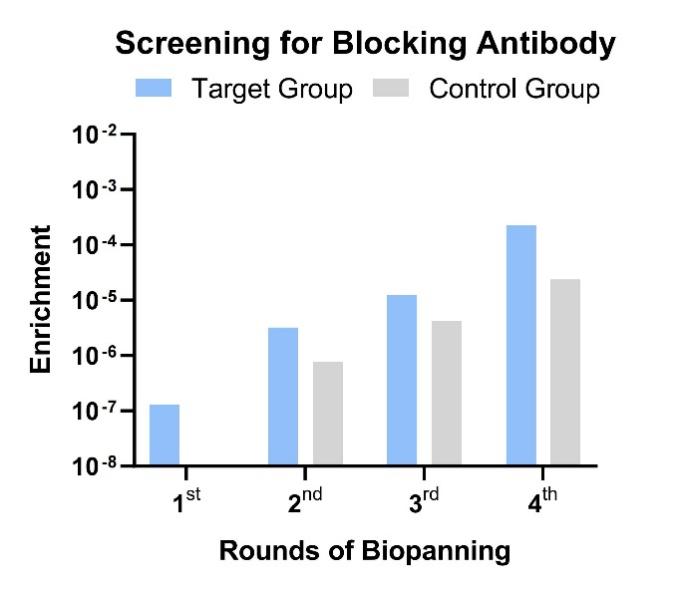 2. Validation of Blocking Activity Following monoclonal identification, over 5 unique binders were initially identified. These were further subjected to a Competitive Blocking ELISA. Three lead candidates demonstrated superior blocking activity, successfully preventing the interaction between Target 1 and Ligand 1 in a dose-dependent manner. 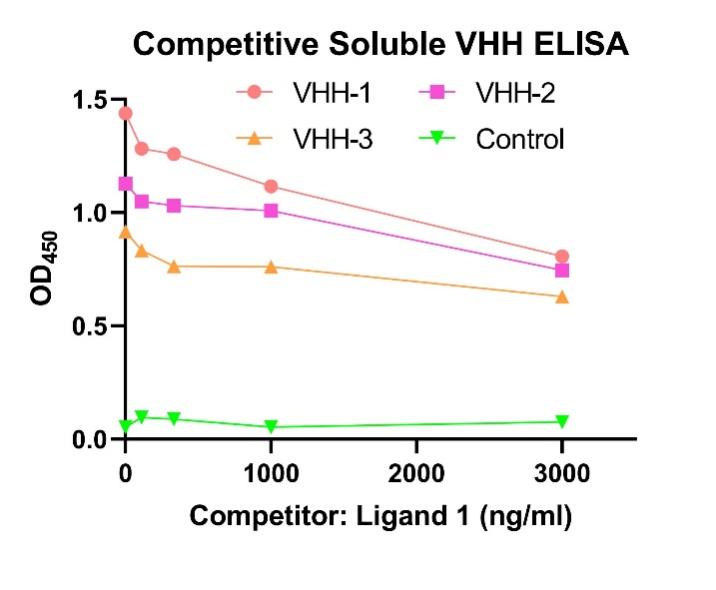
|
 Mechanism-Driven Screening
We don't just find binders; we isolate functional modulators. By integrating ligand-competition panning early in the process, we identify blockers that effectively disrupt inhibitory signaling pathways from the outset.
Massive Diversity
Our premade human antibody libraries provide the vast sequence space necessary to identify rare clones against challenging or conserved checkpoint targets.
The VHH Advantage
Our specialized VHH library yields high-affinity single-domain antibodies. These robust scaffolds offer exceptional stability and deep tissue penetration, which is a critical factor for penetrating the dense microenvironments of solid tumors.
Cross-Species Reactivity
We proactively screen for human, cyno, and mouse cross-reactivity. This strategy enables you to enter syngeneic mouse models and toxicology studies using a single lead candidate, eliminating the need for separate surrogate development.
Radical Data Access
You receive end-to-end data, including NGS clonotype clustering and full sequence deliverables. This transparency empowers your team to make informed, data-driven decisions for IP expansion.
Full-Spectrum Support
From high-purity protein biotinylation and MHC assembly to sophisticated functional characterization, we provide a seamless end-to-end solution for your checkpoint discovery programs.
Ready to move fast? Creative Biolabs will scope your target, advise on best library and protocol, and get screening up and running as soon as possible.
All listed services and products are For Research Use Only. Do Not use in any diagnostic or therapeutic applications.