Creative Biolabs is offering the most comprehensive services for antibody development projects. With strict regulation and effective execution, we are dedicated to providing the most valuable solutions to complete your projects.
HighlightsCreative Biolabs is offering the most comprehensive services for antibody development projects. With strict regulation and effective execution, we are dedicated to providing the most valuable solutions to complete your projects.
HighlightsCreative Biolabs has established a broad range of platforms for developing novel antibodies or equivalents. These cutting-edge technologies enable our scientists to meet your demands from different aspects and tailor the most appropriate solution that contributes to the success of your projects.
HighlightsWith deep understanding in antibody-related realms and extensive project experience, Creative Biolabs offers a variety of references to help you learn more about our capacities and achievements, including infographic, flyer, case study, peer-reviewed publications, and all kinds of knowledge that can assist your projects. You are also welcome to contact us directly for more specific solutions.
HighlightsGet a real taste of Creative Biolabs, one of the most professional custom service providers in the world. We are committed to providing highly customized comprehensive solutions with the best quality to advance your projects.
HighlightsCreative Biolabs provides specialized Guinea Pig Hybridoma-based Antibody Discovery Services, delivering high-affinity monoclonal antibodies tailored to your specific research needs. We leverage the unique immunological characteristics of guinea pigs and our cutting-edge guinea pig hybridoma technique to exploit a novel source of outbreeding non-murine immune repertoire with stable productivity. This approach allows us to offer clients a powerful solution for developing novel therapeutics and advancing biomedical research, with a commitment to exceptional quality and customized service.
The guinea pig, a historically significant animal in scientific experimentation, presents unique advantages in immunological studies. These animals have been utilized in research for approximately two centuries, notably in early investigations of infectious diseases such as tuberculosis and diphtheria. In fact, the guinea pig is considered the "gold standard" for preclinical studies of new drugs and vaccines, various administration methods, and safety evaluations, particularly for tuberculosis research. Guinea pigs are also an ideal source for generating antibodies for extreme allergic reactions or anaphylaxis research. Guinea pig hybridoma technology involves harnessing the distinctive immune responses of guinea pigs to produce monoclonal antibodies. This process entails fusing antibody-producing B cells from immunized guinea pigs with myeloma cells, resulting in hybridomas that secrete highly specific and stable monoclonal antibodies.
Our Guinea Pig Hybridoma Generation Service is designed to provide a comprehensive and tailored solution for your monoclonal antibody development needs. Our general service content encompasses the entire workflow, from antigen preparation and animal immunization to hybridoma generation, screening, and antibody production. We excel in handling diverse antigens to deliver high-quality, high-affinity antibodies.
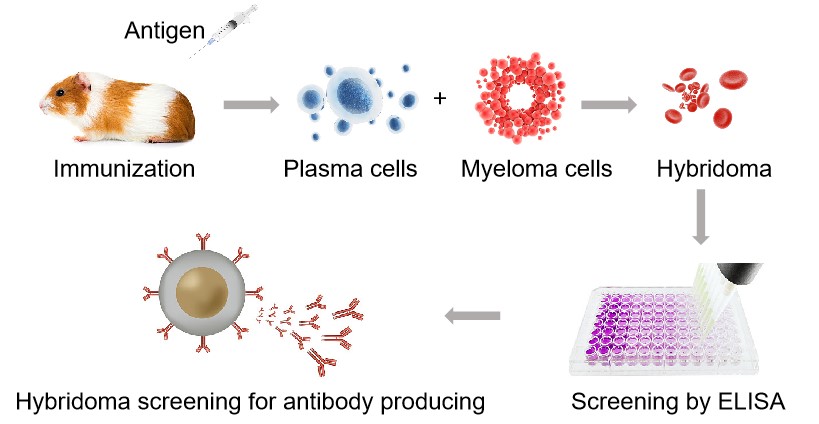 Fig.1 Workflow for the production of monoclonal antibodies using guinea pigs. (Creative Biolabs Original)
The process starts with meticulous antigen preparation. We collaborate to understand your antigen's characteristics, including purity, stability, and concentration. Our team handles diverse antigen types (proteins, peptides, carbohydrates, and small molecules) using techniques like recombinant protein expression, chemical synthesis, or purification. We also offer conjugation to carrier proteins to enhance immunogenicity in guinea pigs.
Next, we immunize guinea pigs to elicit a robust and specific immune response. Our facility adheres to high animal care standards. We design customized immunization protocols based on antigen properties and desired antibody characteristics, potentially involving multiple injections with adjuvants. We monitor the animals and track the development of antigen-specific antibodies in their serum.
Once sufficient immune response is achieved, we proceed to hybridoma generation. Spleen cells containing antibody-producing B lymphocytes are isolated and fused with immortal myeloma cells using a fusogen (e.g., polyethylene glycol). The resulting hybridomas combine the characteristics of both cell types: specific antibody production and continuous growth.
Following hybridoma generation, we screen to identify those that produce antibodies with the required specificity and affinity. Hybridomas are cultured, and the supernatant is tested for antigen-specific antibodies. We employ various screening techniques, including ELISA, flow cytometry, immunocytochemistry, or Western blotting, tailored to project needs. This iterative process ensures the selection of the most promising hybridomas.
We then perform cloning to isolate individual hybridoma cells and establish stable cell lines. Limiting dilution is commonly used, involving serial dilution until single cells are deposited in individual wells. Wells with single-clone growth is expanded. Cloning ensures antibody monoclonality, meaning production by a single-cell clone for uniform structure and specificity. Selected clones are expanded for antibody production and characterization.
The final stage involves antibody production and purification. We offer in vitro (bioreactor/cell culture) and in vivo (ascites) production. Antibodies are purified from cell culture supernatant or ascites fluid using techniques like affinity chromatography. Purified antibodies undergo rigorous quality control to ensure purity, concentration, and activity.
We keep the ordering procedure as easy as possible. Please submit the following information to assist us in correlating your antigen with your order and accelerate the process:
|
Guinea pig-derived monoclonal antibodies are highly versatile tools with wide-ranging applications in research, diagnostics, and therapeutics. Their exceptional specificity makes them invaluable for dissecting complicated biological processes and disease causes. Researchers use these antibodies to precisely target and investigate individual proteins, gaining a deeper understanding of molecular interactions and signaling pathways in areas like cell biology, immunology, and neuroscience. Furthermore, these antibodies hold great potential in developing targeted therapies for diseases such as cancer, autoimmune disorders, and infectious diseases, minimizing off-target effects and enhancing therapeutic efficacy. In diagnostics, they enable accurate and reliable detection of specific biomarkers in various assay formats, including ELISA, immunohistochemistry, and flow cytometry, crucial for early disease diagnosis and monitoring treatment response.
According to these properties, guinea pigs are considered with huge potential to generate novel target-specific monoclonal antibodies for a series of research and therapeutic studies.
|
A: We adhere to rigorous quality control (QC) standards throughout the entire antibody production process. This begins with the initial antigen quality assessment and continues through immunization, hybridoma screening, and antibody purification. We employ a range of analytical techniques to ensure the identity, purity, and activity of the final antibody product. These may include SDS-PAGE, HPLC, ELISA, and mass spectrometry. We also perform functional assays, such as binding assays and activity measurements, to validate the antibody's performance in its intended application.
A: Yes, we have extensive experience in developing antibodies against targets with low immunogenicity. Guinea pigs are advantageous in this regard, as they often mount a stronger immune response to such targets compared to other species. We also utilize a variety of techniques to enhance immunogenicity, including antigen modification (e.g., conjugation to carrier proteins), the use of potent adjuvants, and optimized immunization protocols. Our expertise in hybridoma technology and screening allows us to isolate rare hybridomas that produce antibodies of the desired specificity, even from weak immune responses.
A: We offer flexible solutions for antibody production, scaling from small research quantities to large-scale production for diagnostic or therapeutic applications. For large-scale production, we utilize in vitro methods, employing bioreactors and cell culture systems to maximize yield and consistency. We have the capacity to produce gram quantities of purified antibody, and we can work with you to optimize production parameters to meet your specific needs. Our purification processes are also scalable, ensuring that the quality and purity of the antibody are maintained throughout the scale-up process.
A: Yes, we offer antibody sequencing as part of our service. Sequencing is crucial for producing recombinant antibodies (for purity, scalability, and engineering) and developing antibody-based therapeutics (humanization, affinity maturation). We use NGS to ensure accurate sequencing, and our bioinformatics pipeline provides heavy and light chain variable region sequences.
A: We provide comprehensive post-delivery support, including answering questions about antibody use, storage, and characterization. We offer technical assistance with downstream applications (e.g., assay development) and troubleshooting to ensure client satisfaction and foster long-term collaborations.
A: We protect client confidentiality and intellectual property through strict CDAs, secure data handling with restricted access, employee training, and controlled facility access.
As a well-recognized expert in antibody research, Creative Biolabs can proudly offer the unique guinea pig hybridoma technology to generate monoclonal guinea pig antibodies. Through fusing with our specific myeloma as a partner, guinea pig hybridoma can be developed with excellent stability and productivity. Our scientists are confident in developing guinea pig hybridoma that produces monoclonal antibodies with high affinity and specificity.
If you have any questions, please feel free to contact us, we welcome to discuss the project solutions with you further.
All listed services and products are For Research Use Only. Do Not use in any diagnostic or therapeutic applications.