Our proprietary engineering ensures the IL-15 proliferative signal is delivered conditionally and locally, resulting in CD8+ T and NK cell persistence while significantly mitigating systemic cytokine toxicity and CRS risk.
IL-15 driven Multispecific Immune Engager Engineering Service
Creative Biolabs provides a comprehensive, research-focused solution for generating highly complex protein assets. We specialize in designing custom trispecific NK engager architectures that solve critical T and NK cell persistence challenges in molecular biology. Clients receive validated, high-purity protein batches, extensive functional data packages (binding kinetics, STAT5 signaling, cytotoxicity), and a detailed developability report. Our expertise in biased IL-15 agonism and sdAb scaffolding ensures you acquire a next-generation research molecule with superior stability and specificity for your advanced research programs.
Introduction What We Can Offer Workflow Why Creative Biolabs Customer Reviews FAQs Related Services Contact Us
Engineering IL-15 Enhanced Multispecific Immune Engagers
The IL-15 driven multispecific immune engager (MSE) platform is designed to address the critical Signal 3 deficit in immunotherapies, a component essential for sustained effector cell persistence. IL-15 is structurally distinct from IL-2; it selectively promotes the survival and proliferation of CD8+ T and NK cells while avoiding Treg expansion. Existing literature validates that integrating IL-15 directly into the engager scaffold enhances anti-tumor cytotoxicity, reduces systemic toxicity, and provides superior in vivo efficacy against solid tumor models such as B7-H3. This targeted approach maximizes the molecule's utility in research.
For an in-depth analysis of how our services can be tailored to your specific project needs, request a consultation.
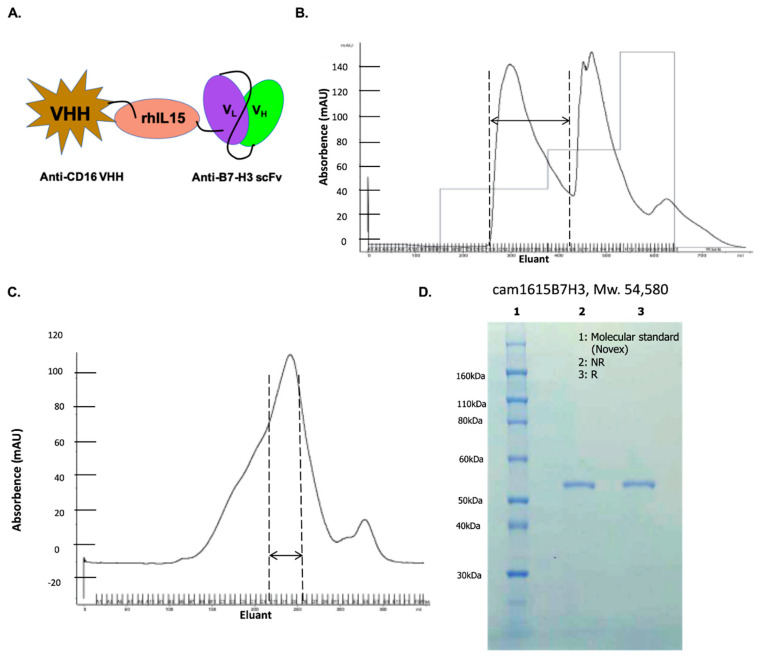 Fig.1 Construction and isolation of cam1615B7H3 tri-specific killer engager. 1
What We Can Offer
Precision IL-15 Biased Agonism
Robust sdAb Scaffold Integration
We utilize highly stable single-domain antibody domains to prevent the aggregation and structural instability common in large multispecifics, thereby guaranteeing a high-yield, high-purity protein asset batch.
End-to-End Functional Validation
From gene design and optimized expression/purification to rigorous in vitro assays (e.g., STAT5 signaling, NK cell proliferation) and preclinical in vivo efficacy confirmation in solid tumor models.
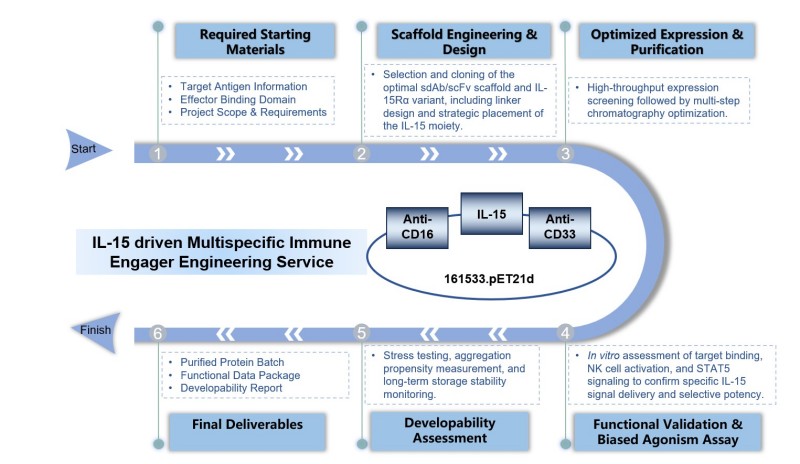
IL-15 driven Multispecific Immune Engager Engineering Service at Creative Biolabs
Highlights
Proprietary sdAb Scaffold
We employ advanced humanized camelid sdAb scaffolds, which are small, highly stable, and versatile. This design overcomes the steric hindrance that compromises IL-15 activity in larger scFv-based constructs.
Validated IL-15 Biased Agonism
Our engineering ensures the IL-15 signal is delivered in a highly localized manner. This reduces systemic exposure and avoids off-target toxicities associated with administering recombinant IL-2 or first-generation IL-15 agonists.

Proof of Concept in Solid Tumors
Our IL-15 MSEs have demonstrated robust in vivo efficacy against aggressive solid tumor models like B7-H3-positive ovarian cancer, confirming translatability across research oncology indications.
Accelerated Developability
Our expertise in placing the IL-15 component strategically improves the molecule's isoelectric point and stability, resulting in improved purification yields and overall enhanced protein stability for manufacturing.
To fully understand the Creative Biolabs advantage, we invite you to get a quote today.
Customer Reviews
-
Overcoming Folding Hurdles
The Creative Biolabs IL-15 driven multispecific immune engager engineering service has substantially improved the stability and yield of our tri-specific molecule. Their sdAb scaffold design successfully eliminated the aggregation liabilities encountered with the initial scFv-based design, transforming a previously non-developable asset into a viable research candidate. - Prof. S**y V**u. -
Preclinical Validation
Engagement with the Creative Biolabs IL-15 driven multispecific immune engager engineering service has significantly enhanced the in vivo translatability of our NK cell therapy for solid tumors. The B7-H3 targeting data provided necessary mechanistic evidence of NK cell persistence within the tumor microenvironment, which represented a major technical hurdle previously. - Dr. El**a F*a.
FAQs
Q How does the IL-15 MSE platform compare to conventional bispecific T cell engagers?
A Conventional bispecific T cell engagers provide Signals 1 and 2 (T-cell activation/engagement) but lack the essential Signal 3 (survival/proliferation). The IL-15 driven MSEs directly furnish Signal 3, leading to enhanced T cell and NK cell persistence and a more durable anti-tumor response in models. Comparative data demonstrating this persistence benefit can be provided upon request.
Q Does the inclusion of IL-15 in the engager architecture raise concerns regarding cytokine release syndrome (CRS)?
A The architectural design prioritizes molecular safety evaluation. Through the utilization of targeted delivery (biased agonism), the IL-15 signal is preferentially restricted to the engaging cell (e.g., NK cells via CD16) at the tumor site, minimizing widespread systemic exposure and off-target T cell activation. Rigorous in vitro specificity assays confirm this favorable profile for the research target.
Related Services
Efficacy Models
Customizable PDX (patient-derived xenograft) and xenograft models, including those for solid tumor malignancies, are offered to rigorously test the in vivo potency, NK cell infiltration, and systemic safety of the final MSE candidate.
Learn More →scFv Generation and Optimization
This service addresses post-discovery enhancement, employing advanced techniques to maximize affinity, reduce potential immunogenicity of non-humanized domains, and optimize expression characteristics for complex multispecific architectures.
Learn More →How to Contact Us
Creative Biolabs delivers the specialized engineering expertise, proprietary scaffolds, and rigorous functional validation necessary to transform a therapeutic concept into a successful research asset. To initiate a discussion regarding project requirements or to receive a detailed quotation, please contact us.
Reference
- Vallera, Daniel A et al. "NK-Cell-Mediated Targeting of Various Solid Tumors Using a B7-H3 Tri-Specific Killer Engager In Vitro and In Vivo." Cancers vol. 12,9 2659. 18 Sep. 2020. Distributed under an Open Access license CC BY 4.0, without modification. https://doi.org/10.3390/cancers12092659
 Download our brochure
Loading case studies...
Online Inquiry