Systematic identification and functional prioritization of gene mutations to distinguish true oncogenic drivers from background passenger variations.
Learn More →Integrated Genome Instability & Mutation Analysis Services for Oncology Research
Are you currently facing challenges such as complex tumor heterogeneity, difficulty distinguishing true driver mutations from extensive background noise, fragmented genomic datasets generated from different platforms, or limited ability to connect genomic alterations with functional and phenotypic outcomes? In many oncology projects, isolated mutation detection or single-dimensional analysis fails to explain tumor evolution, therapeutic resistance, or pathway vulnerability. Creative Biolabs’ integrated genome instability & mutation analysis services help you move beyond fragmented data by systematically integrating mutation profiles, genomic instability metrics, and phenotype-linked interpretation, enabling more reliable mechanistic insights and translational decision-making.
Overview Service Portfolio What We Can Offer Workflow Required Materials Highlights Publication Customer Reviews FAQs Related Services
Overview
Genome instability is a defining hallmark of cancer, driving tumor initiation, evolution, and therapeutic resistance. Extensive studies demonstrate that mutations, chromosomal alterations, replication stress, and defective DNA damage responses collectively shape oncogenic behavior. Integrated analysis combining mutation profiling, structural variation, and functional consequence mapping has emerged as a robust approach to decipher tumor biology. By consolidating these dimensions into a unified analytical framework, Creative Biolabs supports oncology research with biologically grounded, data-driven insights that extend beyond isolated genomic readouts.
Creative Biolabs adopts a multi-layered analytical strategy designed to capture both the causes and consequences of genome instability in cancer systems. Our approach integrates seven critical dimensions:
- Gene Mutation Profiling & Driver Mutation Detection to distinguish functional oncogenic events from background variation.
- Chromosomal Instability & Copy Number Variation Analysis to define large-scale genomic imbalance shaping tumor evolution.
- Replication Stress & DNA Damage Quantification to assess ongoing genomic fragility.
- DNA Damage Response Defect Analysis to uncover pathway-level repair vulnerabilities.
- Telomere Dysfunction & ALT Mechanism Profiling to evaluate telomere-driven instability.
- Mutational Signature Attribution Analysis to infer underlying mutagenic processes.
- Phenotypic Consequence Mapping to connect genomic alterations with measurable cellular outcomes.
Accelerate Innovation with Creative Biolabs – Start Your Consultation Today
Service Portfolio
Gene Mutation Profiling & Driver Mutation Detection
Chromosomal Instability & Copy Number Variation Analysis
Comprehensive assessment of large-scale chromosomal alterations and copy number changes that reshape tumor genome architecture and evolution.
Learn More →Replication Stress & DNA Damage Quantification
Quantitative evaluation of replication-associated stress and DNA damage features reflecting ongoing genomic fragility in cancer cells.
Learn More →DNA Damage Response Defect Analysis
Pathway-level analysis of DNA repair and checkpoint deficiencies that contribute to mutation accumulation and genome instability.
Learn More →Telomere Dysfunction & ALT Mechanism Profiling
Characterization of telomere maintenance abnormalities and alternative lengthening mechanisms driving chromosomal instability in tumors.
Learn More →Mutational Signature Attribution Analysis
Attribution of observed mutation patterns to underlying biological processes and mutagenic mechanisms shaping tumor development.
Learn More →Phenotypic Consequence Mapping
Correlation of genomic instability features with functional cellular phenotypes to support mechanism-driven oncology research.
Learn More →What We Can Offer
Integrated Mutation Profiling
Comprehensive detection and annotation of gene mutations, enabling accurate identification of driver events relevant to oncogenic signaling and tumor evolution.
Chromosomal Instability & Structural Alteration Analysis
Systematic assessment of copy number variation and large-scale chromosomal imbalance to reveal genomic architecture changes shaping malignancy.
Genome Stress & Damage Quantification
Quantitative evaluation of replication stress and DNA damage features to characterize ongoing genomic fragility within cancer systems.
DNA Damage Response Pathway Assessment
In-depth analysis of DNA repair and checkpoint pathway defects to uncover repair vulnerabilities and instability drivers.
Telomere Dysfunction & ALT Profiling
Characterization of telomere maintenance abnormalities and alternative lengthening mechanisms contributing to chromosomal instability.
Mutational Signature & Etiology Analysis
Attribution of mutational patterns to underlying biological or environmental processes, providing insight into tumor origin and evolution.
Phenotypic Consequence Mapping
Correlation of genomic instability features with functional phenotypes to support mechanism-based hypothesis generation and validation.
Workflow
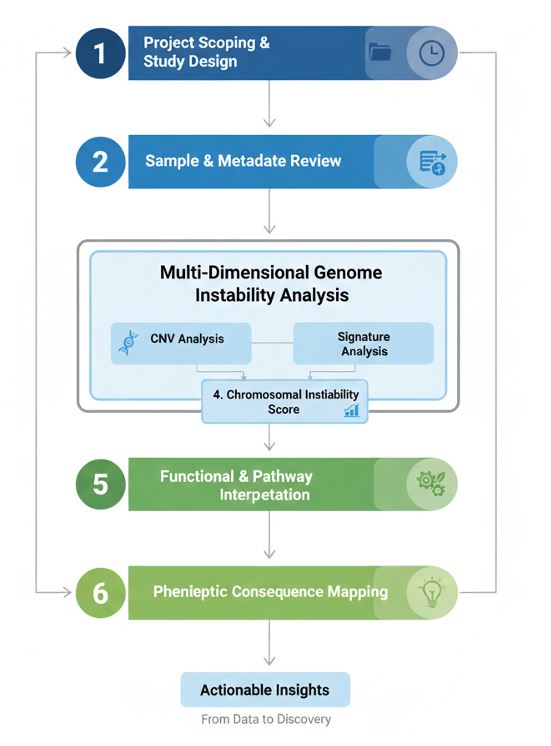
1. Project Scoping & Study Design
We align analytical depth, sample type, and research objectives to define a coherent genome instability strategy tailored to your oncology project.
2. Sample & Metadata Review
Input materials and experimental context are evaluated to ensure analytical compatibility and biological relevance.
3. Sequencing Data Integration
Mutation, structural variation, and instability-related datasets are harmonized into a unified analytical framework.
4. Multi-Dimensional Genome Instability Analysis
Comprehensive assessment covering mutation profiles, chromosomal instability, replication stress, DNA damage markers, telomere status, and mutational signatures.
5. Functional & Pathway Interpretation
Detected alterations are mapped to oncogenic pathways, DNA repair processes, and stress response mechanisms.
6. Phenotypic Consequence Mapping
Genomic findings are correlated with proliferation, survival, genomic fragility, or treatment-response phenotypes where applicable.
Required Starting Materials
- Paired tumor-normal or tumor-only samples with basic quality metrics.
- Sample background information such as tumor type, treatment status, or model system.
- Defined research objectives, such as driver mutation identification or instability mechanism exploration.
Highlights
Comprehensive Genome Instability Coverage
Our service captures genome instability across sequence-level mutations, chromosomal alterations, replication stress indicators, and telomere dysfunction, ensuring no critical instability signal is overlooked in oncology research.
Mechanism-Oriented Interpretation
Rather than reporting isolated variants, we emphasize pathway-level and process-level interpretation, allowing researchers to understand how genomic instability actively drives tumor behavior and progression.

Phenotype-Linked Genomic Insights
Genomic alterations are systematically mapped to observable cellular phenotypes such as proliferation, survival advantage, or genomic fragility, strengthening biological relevance and experimental confidence.
Flexible Depth for Diverse Oncology Projects
From exploratory discovery studies to hypothesis-driven validation projects, our analytical framework adapts in depth and scope without compromising data integrity or interpretability.
Discover the Creative Biolabs Advantage – Contact Us for a Customized Quote
Publication
Microsatellite instability testing illustrates how genome-level repair defects can be detected with a practical, highly interpretable readout. When microsatellite loci are amplified from matched normal and tumor DNA and separated by capillary electrophoresis, stable tumors produce aligned peak patterns across samples, while unstable tumors show clear length shifts caused by insertion–deletion errors at repeat tracts. This pattern directly reflects mismatch repair dysfunction and serves as a robust marker of replication error accumulation, a key driver of increased mutational load and tumor immunogenicity. Because the readout is locus-specific and comparison-based, it can detect instability even when protein expression assays appear equivocal, and it supports consistent classification of tumors into stable or unstable categories. In oncology research and translational workflows, this approach provides a reliable gateway biomarker to stratify samples for downstream immunotherapy-related investigation and broader mutational load characterization.
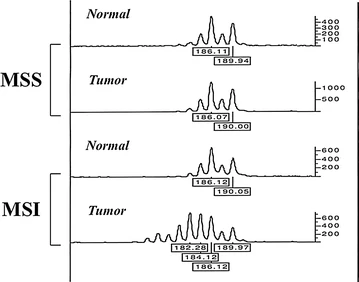 Fig.1 Representative electropherograms of microsatellite markers from normal and tumor DNAs.1
Customer Reviews
- Actionable driver mutation identification using Creative Biolabs' integrated genome instability & mutation analysis services in our research has significantly improved pathway prioritization in solid tumor models. Long-term collaboration, Mar*** Lee.
- Clear CNV and chromosomal instability interpretation using Creative Biolabs' integrated genome instability & mutation analysis services has significantly facilitated our understanding of therapy resistance mechanisms. Ongoing study, Ann*** Cho.
- Phenotype-linked mutation analysis using Creative Biolabs' integrated genome instability & mutation analysis services has significantly improved translational relevance in our functional oncology assays. Multi-project usage, Dav*** Kim.
FAQs
Can this service be applied to both exploratory and hypothesis-driven oncology studies?
Yes, the analytical framework is adaptable, supporting discovery-driven research as well as targeted validation of known pathways.
How does integrated analysis improve over single-method mutation testing?
By combining multiple instability dimensions, integrated analysis reveals mechanistic relationships that isolated tests often miss.
Is the service suitable for cell line and patient-derived samples?
Both model systems and patient-derived materials are supported with appropriate analytical adjustment.
How are driver mutations distinguished from passenger alterations?
Functional annotation, recurrence patterns, pathway context, and phenotypic correlation are jointly applied.
Related Services
Integrated Carcinogenic Factor Analysis
We provide integrated carcinogenic factor analysis to systematically assess genetic alterations, genome instability features, and associated risk drivers that contribute to cancer initiation, progression, and heterogeneity.
Learn More →Comprehensive Oncogene & Tumor Suppressor Profiling
We provide comprehensive profiling of oncogenes and tumor suppressor genes to accurately define functional alterations, pathway disruption, and their roles in tumor development and response mechanisms.
Learn More →Creative Biolabs' integrated genome instability & mutation analysis services are designed to help researchers move from complex genomic data to biologically meaningful conclusions. By integrating mutation detection, instability characterization, and phenotype-driven interpretation, we support clearer mechanistic understanding and more confident oncology research decisions.
Connect with Creative Biolabs to explore how integrated genome instability and mutation analysis can strengthen your oncology research strategy. Contact our team for more information and to discuss your project needs in detail.
Reference
- Palmieri, Giuseppe et al. "Genetic instability and increased mutational load: which diagnostic tool best direct patients with cancer to immunotherapy?." Journal of translational medicine vol. 15,1 17. 21 Jan. 2017. Distributed under Open Access license CC BY 4.0, without modification. https://doi.org/10.1186/s12967-017-1119-6
 Download our brochure
Loading case studies...
Online Inquiry