A dedicated, end-to-end partnership from rational IL-2 mutein design to comprehensive preclinical data packages, ensuring a seamless transition from discovery to lead candidate validation.
Lymphocyte targeted IL-2 Engineering Service
Creative Biolabs' lymphocyte targeted IL-2 engineering service provides custom; precision cytokine design focused on overcoming the dual liabilities of broad cell activation and limited durability that plague conventional IL-2 molecules. We provide comprehensive IL-2 mutein design and QbD-guided manufacturing, leveraging our proprietary Cis-Targeting and partial agonism technologies. Clients gain a novel IL-2 lead candidate with > 500 selectivity for beneficial CD8+ T cells, robust CD25 activity mitigation, superior T cell persistence, and the complete CMC and PK/PD data package required to accelerate transition to advanced preclinical development and lead validation.
Introduction What We Can Offer Workflow Why Creative Biolabs Customer Reviews FAQs Related Services Contact Us
Introduction of Lymphocyte Targeted IL-2 Engineering Service
IL-2 is a potent but pleiotropic cytokine, limited by the IL-2 Paradox, where the necessary doses for Teff/NK cell activation cause high systemic activity and Treg activation (suppression). Early formats like proleukin and second-generation NKG2D conjugates addressed some issues but failed to fully decouple desirable immune activity from systemic non-specific effects (due to NK cell activation). Creative Biolabs' lymphocyte targeted IL-2 engineering service uses next-generation precision protein design to concentrate IL-2 signaling exclusively on CD8+ T cells, resulting in a superior research profile.
For an in-depth analysis of how our services can be tailored to your specific project needs, request a consultation.
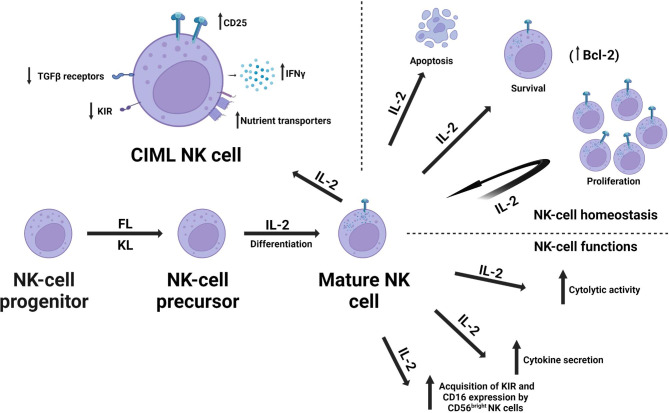 Fig.1 The multifaceted role of IL-2 in the homeostasis and functional dynamics of CD56+CD3− large granular lymphocytes. 1
What We Can Offer
Customized Design-to-Preclinical Lead Service
Dual-Mechanism Engineering
Integration of CD25 affinity attenuation for robust mitigation of unwanted IL-2 activity and proprietary partial agonism for enhanced T cell persistence (TCF-1 high phenotype).
Integrated Quality and Regulatory Support
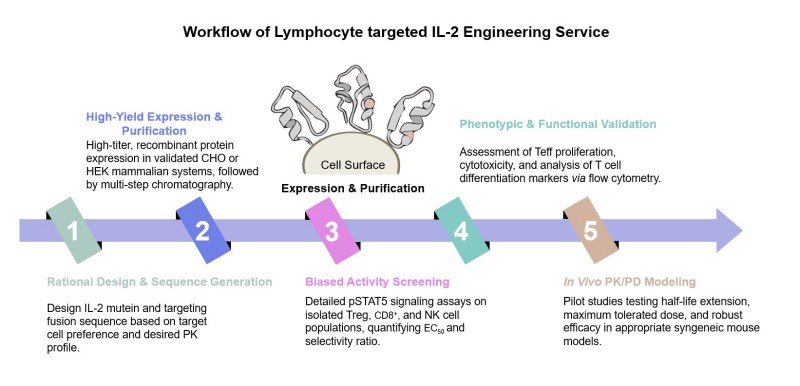
QbD-guided process development and mammalian expression (CHO/HEK) validated for robust, clinical-scale manufacturing feasibility.
Flexible Fusion Strategy
Custom conjugation services, including Fc-fusion, PEGylation, and TME-targeting scFv development to meet your specific pharmacokinetic (PK) and pharmacodynamic (PD) requirements for research models.
Lymphocyte targeted IL-2 Engineering Service at Creative Biolabs
Why Choose Us?
| Key Advantages | Unique Features |
|---|---|
| Next-Generation Specificity | We move beyond the limitations of older conjugates, which still cause significant off-target-mediated activity in research models. |
| Signaling for Persistence | Our expertise in engineering partial agonists at the complex is proprietary. This feature is crucial for preventing T cell exhaustion in - and research, ensuring the creation of durable, long-term immune memory for in vivo studies. |
| Validated Structural Biology | Our understanding of the full receptor complex, including the structure and its role in non-specific cell activation, ensures our designs are fundamentally de-risked against known liabilities in preclinical studies. |
To fully understand the Creative Biolabs advantage, we invite you to get a quote today.
Customer Reviews
-
Unparalleled CD8+ Selectivity
Using Creative Biolabs' lymphocyte targeted IL-2 engineering service in our research has significantly improved the research window of our lead cytokine, allowing us to achieve specific CD8+ expansion that was impossible with older IL-2 formats, eliminating the NK-driven confounding factors. -M. H***. -
Superior T cell Persistence
Creative Biolabs' partial agonism engineering facilitated long-term TCF-1 expression, critical for CAR-T cell support, dramatically outperforming high-affinity IL-2 analogs that led to rapid T cell exhaustion. This is a game-changer for durability studies. - Dr. K. D***.
FAQs
Q: Is the partial agonism feature compatible with cell-based therapies like CAR-T cell research?
A: Absolutely. The partial agonism feature is specifically engineered to subtly attenuate STAT5 signaling. This prevents the terminal differentiation and exhaustion of T cells and promotes the critical TCF-1 stem cell-like phenotype. This leads to enhanced persistence and superior long-term activity in preclinical models when supporting CAR-T or TIL cells in vivo.
Q: What makes your CD25 mutein design superior to the older R38A and F42K variants?
A: While the historical R38A and F42K substitutions established the proof-of-concept for CD25 attenuation, Creative Biolabs utilizes proprietary structural optimization to achieve a more profound and consistent reduction in CD25 affinity, guaranteeing mitigation of non-specific activity. More importantly, we integrate this mutein with our cell-specific targeting methods.
Related Services
TAA targeted IL-2 Engineering
This strategic conjugation ensures preferential delivery of the IL-2 mutein payload directly to the disease site, significantly increasing local concentration and enhancing research efficacy while rigorously limiting systemic activity.
Learn More →ECM targeted IL-2 Engineering
This platform focuses on creating IL-2 mutein conjugates designed to bind specifically to components of the extracellular matrix (ECM) within the tumor microenvironment (TME).
Learn More →How to Contact Us
Creative Biolabs provides de-risked and highly specific research leads ready for advanced validation by focusing on CD25 elimination, CD8 Cis-Targeting, and partial agonism for superior persistence. Our expert team is available to guide you through selecting the ideal IL-2 engineering strategy for your specific target and research goal. Please contact us.
Reference
- Muhammad, Shan et al. "Reigniting hope in cancer treatment: the promise and pitfalls of IL-2 and IL-2R targeting strategies." Molecular cancer vol. 22,1 121. 29 Jul. 2023. Distributed under an Open Access license CC BY 4.0, without modification. https://doi.org/10.1186/s12943-023-01826-7
 Download our brochure
Loading case studies...
Online Inquiry