We provide a fully integrated workflow that manages every stage of your project, from initial bioinformatic target prediction and vector cloning to the final confirmation of functional phenotypes, ensuring a seamless and efficient research experience.
MicroRNA-Oncogene/Tumor Suppressor Interaction Analysis Service
Creative Biolabs offers a specialized research service designed to elucidate the intricate regulatory networks governing interactions among microRNAs, oncogenes, and tumor suppressors. Utilizing a comprehensive experimental workflow, this service systematically converts computational predictions into biologically verified findings. Through the integration of advanced luciferase reporter systems, site-directed mutagenesis, and phenotypic screening platforms, definitive and high-fidelity data are generated. Consequently, research initiatives are empowered to rigorously validate molecular targets, clearly delineate mechanisms of action, and expedite early-stage discovery processes with precision and efficiency.
Introduction What We Can Offer Workflow Why Creative Biolabs Customer Reviews FAQs Related Services Contact Us
Advances in miRNA Interaction Analysis
MicroRNAs (miRNAs) serve as fundamental post-transcriptional regulators, modulating the expression of approximately 30% of the protein-coding genome. Within oncological research, these molecules are principally stratified into OncomiRs, which inhibit tumor suppressor genes, and tumor suppressor miRNAs, which repress oncogenic transcripts. Delineating these complex regulatory networks is essential for therapeutic advancement. These studies underscore the critical necessity for rigorous validation of seed-region specificity and the deployment of CRISPR-mediated technologies for definitive interaction mapping.
To explore our strategic solutions, request a consultation.
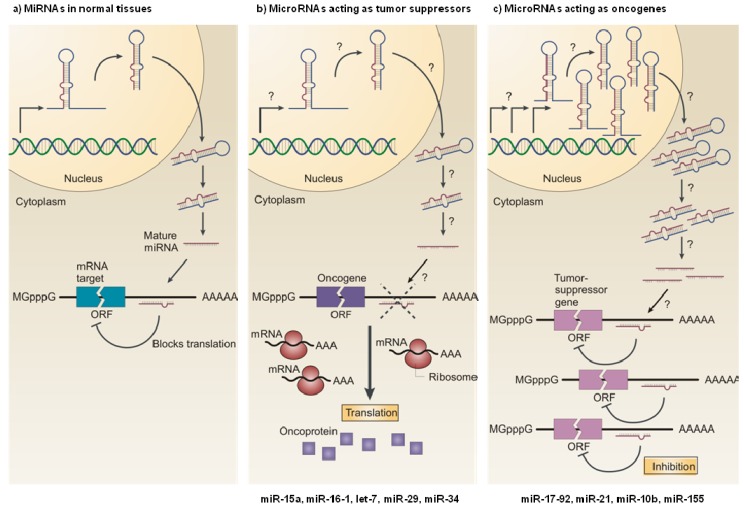 Fig.1 MicroRNAs as tumor suppressors and oncogenes. 1
What We Can Offer
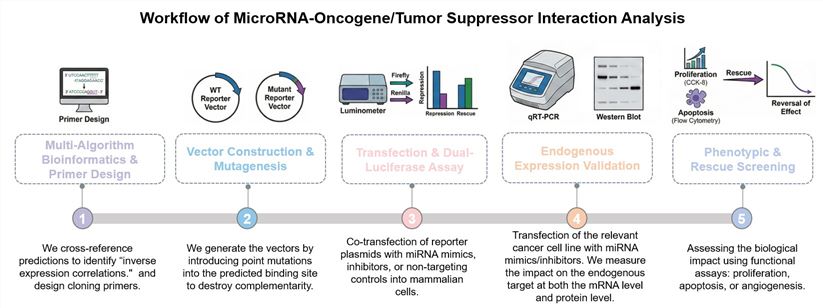
One-stop Interaction Validation
Rigorous Assay Standards
We employ gold-standard dual-luciferase reporter systems characterized by strict normalization protocols and mandatory seed-region mutant controls, effectively eliminating false positives to ensure that your data reflects true physiological interactions and reliable biological insights.
Multi-Dimensional MOA Analysis
Our approach integrates the assessment of mRNA stability via qRT-PCR with the analysis of protein translational repression using Western Blot, fully defining the specific mechanism of action underlying the observed regulatory effects.
Customized Phenotypic Screens
We design tailored functional assays, including proliferation, apoptosis, migration, and angiogenesis screens, that are specifically calibrated to your disease model and target pathway, providing relevant biological context to your molecular interaction data.
MicroRNA-Oncogene/Tumor Suppressor Interaction Analysis at Creative Biolabs
Why Choose Us?
Strict Specificity Controls
We mandate seed-region mutant controls for every reporter assay. By verifying that binding is abolished upon mutation, we rigorously filter out non-specific interactions, ensuring that you invest resources only in biologically validated and authentic targets.
Context-Aware Analysis
We go beyond generic HEK293 screens by validating interactions within your specific disease-relevant cell lines. This ensures that the observed regulatory effects are physiologically accurate and directly applicable to your specific therapeutic indication or cancer model.
To leverage the proven Creative Biolabs scientific advantage, we invite you to get a quote today.
Customer Reviews
-
Eliminating False Positives
The utilization of Creative Biolabs' interaction analysis service has substantially refined our target identification strategy. The rigorous enforcement of seed-region mutagenesis protocols identified a primary candidate as an off-target artifact, thereby preventing the misallocation of significant research resources. - Dr. S**h J***. -
Comprehensive Data Integration
The integration of human umbilical vein endothelial cell (HUVEC) tube formation assays within the phenotypic screening framework proved pivotal. This capability facilitated the direct correlation of miRNA activity with angiogenic processes, thereby circumventing the requirement for internal assay development and optimizing resource allocation. - Dr. M**l R***.
FAQs
Why is the "Mutant Control" so important in your workflow?
The binding of a miRNA is primarily determined by nucleotides 2-8 (the "seed region"). Without mutating this specific region in the reporter vector, it is impossible to distinguish between specific physiological binding and non-specific "off-target" effects, which are common in overexpression assays.
Can you validate interactions in difficult-to-transfect cell lines?
Yes. While we often use HEK293T for the initial Luciferase assay due to its high transfection efficiency, we perform the functional validation (qPCR/Western) in your specific disease-relevant cell lines (e.g., suspension leukemic lines or primary cells) using optimized electroporation or lentiviral delivery systems.
Related Services
Cell Line Development Service
The engineering and establishment of cell lines designed for the sustained, stable expression of miRNA mimics or molecular sponge constructs, thereby facilitating rigorous longitudinal investigations.
Learn More →Tumor Single Cell Lineage Tracing Technology
Utilizing advanced barcoding and single-cell sequencing to map clonal evolution and track the developmental trajectory of tumor cell subpopulations.
Learn More →How to Contact Us
Creative Biolabs offers a scientifically rigorous, data-driven pathway to validate your cancer targets. From bioinformatic prediction to validated phenotypic outcomes, we provide the evidence you need to advance your therapeutic pipeline.
Ready to validate your targets? Contact our scientific team today to discuss your project requirements and receive a customized experimental plan.
Reference
- Costa, Pedro M, and Maria C Pedroso de Lima. "MicroRNAs as Molecular Targets for Cancer Therapy: On the Modulation of MicroRNA Expression." Pharmaceuticals (Basel, Switzerland) vol. 6,10 1195-220. 30 Sep. 2013. Distributed under an Open Access license CC BY 3.0, without modification. https://doi.org/10.3390/ph6101195
 Download our brochure
Loading case studies...
Online Inquiry