Seamless combination of ultra-deep NGS and the long-read power of TGS, to resolve complex genomic structures and eliminate short-read blind spots.
Oncogene Fusion & Structural Variant Detection Service
Creative Biolabs' oncogene fusion & structural variant detection service constitutes a dedicated diagnostic and research platform engineered to circumvent the inherent restrictions of conventional sequencing methodologies in the accurate identification of complex genomic rearrangements. We provide high-resolution detection of oncogene fusions and structural variants (SVs) through the integration of superior TGS long-read technology and definitive DNA/RNA expression validation. Clients gain definitive, actionable genomic intelligence to rapidly nominate novel therapeutic drug targets, accelerate functional validation studies, and precisely characterize complex disease models for preclinical research.
Introduction What We Can Offer Workflow Why Creative Biolabs Customer Reviews FAQs Related Services Contact Us
Accurate Oncogene Fusions and Structural Variant Detection for Functional Cancer Genomics
Oncogene fusions and structural variants are large-scale DNA rearrangements that act as potent drivers of cancer, particularly in solid tumors like breast cancer, where they are known to be abundant. Their detection requires advanced genomic technology due to their inherent complexity and the short-read length limitations of older next-generation sequencing (NGS). The integration of third-generation sequencing (TGS), with its long-read length capability, is essential to accurately resolve these complex structural events and provide the comprehensive picture necessary for functional genomics research, including the critical identification of immunogenic neoantigens for vaccine development.
We invite you to initiate a project consultation with our scientific team.
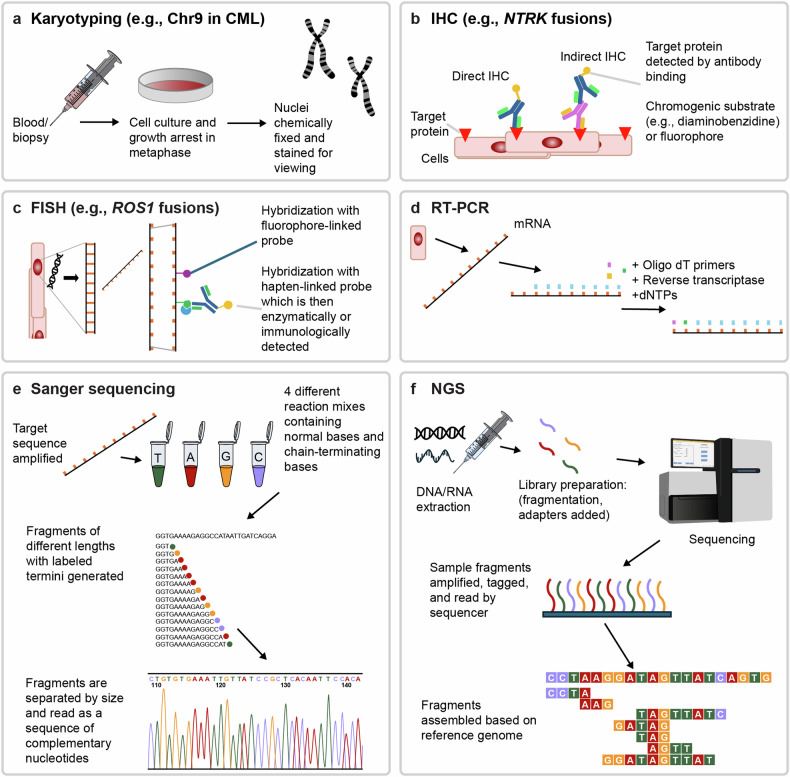 Fig.1 Illustrated overview of different methods used to detect fusions in oncology. 1
What We Can Offer
Integrated Multi-Modal Sequencing
Customizable Panels and Workflows
Tailored bait design and bioinformatics pipelines adjusted to your specific tumor type, target gene set, or unique research cohort, ensuring maximum relevance and efficiency for your project goals.
High-Resolution Breakpoint Precision
Near single-nucleotide mapping accuracy for SV breakpoints. This level of precise resolution is a direct result of utilizing TGS long reads, which span the entire junction region, bypassing the ambiguity inherent in short-read data.
Definitive Expression Validation
A proprietary, efficient DNA/RNA co-validation approach that confirms the active expression of fusion transcripts, ensuring you focus resources only on functional, actionable targets.
Oncogene Fusion & Structural Variant Detection at Creative Biolabs
Why Choose Us?
Integrated Multi-Modal Platform
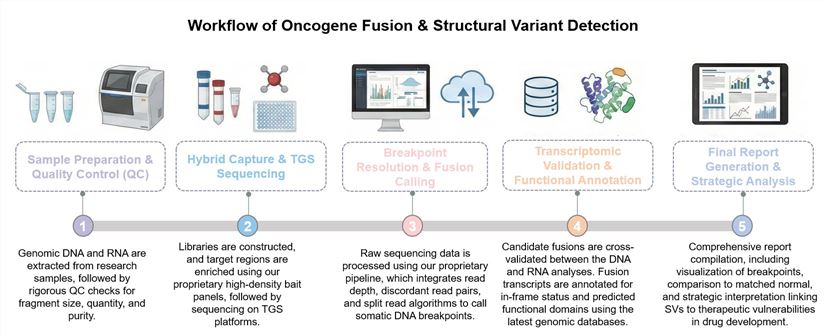
We do not rely on a single technology. Our platform seamlessly integrates ultra-deep NGS with the power of TGS and advanced transcriptomic validation, overcoming the limitations that cause false negatives in conventional short-read assays.
Superior Sensitivity for Low-AF Detection
Our ultra-deep coverage ensures reliable detection of low-frequency SVs and fusions (relevant for low-burden research models), an essential capability proven by our published data. This high sensitivity is vital for accurately profiling low-burden research models.

The Power of Long Reads
Our TGS integration provides the long read length necessary to accurately resolve complex genomic structures, highly repetitive regions, and large introns that commonly obscure oncogene fusions. This approach is critical for accurately detecting the abundant somatic SVs and fusion genes characteristic of solid tumors.
Immunogenicity Insight
We specifically identify fusions that are highly likely to generate immunogenic neoantigens - a critical factor for therapeutic response and personalized vaccine development - providing an increase in neoantigen discovery.
To fully realize the potential of these advantages, we encourage principal investigators and program managers to formally request a quotation today.
Customer Reviews
-
Resolving Breakpoints
The application of the Creative Biolabs' service in our research has resulted in a marked enhancement in the resolution of intricate genomic breakpoints within sarcoma models, a domain where short-read sequencing data previously exhibited complete ambiguity. - J. Sm*h. -
Low-AF Detection
The ultra-deep coverage provided by Creative Biolabs facilitated the reliable detection of a critical low-AF fusion in a patient-derived xenograft (PDX) model, confirming its viability for our functional studies. - Dr. K. Ch**e.
FAQs
Why do I need TGS integration when I already run a standard NGS panel?
Standard NGS panels struggle with long, repetitive, and complex genomic regions where SVs often occur, leading to 'blind spots' and high false-negative rates. Our TGS integration uses long reads to span these complex regions, ensuring superior accuracy and specificity in resolving the full structural rearrangement, which is essential for defining precise research targets.
How do you differentiate between functionally relevant fusions and passenger mutations?
We use advanced transcriptomic validation. By confirming active gene expression via RNA-seq and checking for in-frame status (the potential to code for a functional protein), we filter out non-expressed passenger mutations. This integrated DNA/RNA approach is key to focusing on functionally actionable driver mutations.
Related Services
Neoepitope Identification Service
Following high-resolution SV detection, we leverage our proprietary immunoinformatics pipeline to predict and prioritize the most immunogenic fusion-derived neoantigen peptides.
Learn More →Oncogene Mutation & Copy Number Alteration Analysis Service
A focused bioinformatic and pre-clinical interpretation service that pinpoints actionable single-nucleotide variants (SNVs), Indels, and focal copy number alterations (CNAs) in known cancer driver genes.
Learn More →How to Contact Us
Creative Biolabs' oncogene fusion & structural variant detection service, powered by integrated TGS and transcriptomics, provides the certainty required to nominate targets, characterize models, and accelerate breakthrough therapies. For detailed technical specifications, case studies, or to begin planning your project, please reach out to our team of scientific experts.
Reference
- Liu, Stephen V et al. "Oncogenic gene fusions in cancer: from biology to therapy." Signal transduction and targeted therapy vol. 10,1 111. 14 Apr. 2025. Distributed under an Open Access license CC BY 4.0, without modification. https://doi.org/10.1038/s41392-025-02161-7
 Download our brochure
Loading case studies...
Online Inquiry