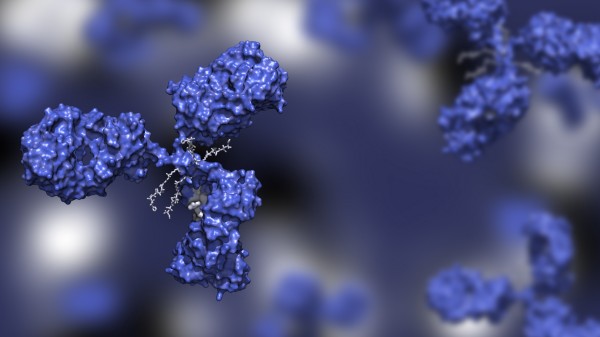
Creative Biolabs is offering the most comprehensive services for antibody development projects. With strict regulation and effective execution, we are dedicated to providing the most valuable solutions to complete your projects.
HighlightsCreative Biolabs is offering the most comprehensive services for antibody development projects. With strict regulation and effective execution, we are dedicated to providing the most valuable solutions to complete your projects.
HighlightsCreative Biolabs has established a broad range of platforms for developing novel antibodies or equivalents. These cutting-edge technologies enable our scientists to meet your demands from different aspects and tailor the most appropriate solution that contributes to the success of your projects.
HighlightsWith deep understanding in antibody-related realms and extensive project experience, Creative Biolabs offers a variety of references to help you learn more about our capacities and achievements, including infographic, flyer, case study, peer-reviewed publications, and all kinds of knowledge that can assist your projects. You are also welcome to contact us directly for more specific solutions.
HighlightsGet a real taste of Creative Biolabs, one of the most professional custom service providers in the world. We are committed to providing highly customized comprehensive solutions with the best quality to advance your projects.
HighlightsDeveloping next-generation therapeutics for allograft rejection requires a delicate balance: potent suppression of pathogenic alloreactivity without the broad toxicity of conventional immunosuppressants. Creative Biolabs combines massive premade human antibody libraries (up to 1011 diversity) with specialized functional screening strategies designed to identify highly specific co-stimulation blockers and cytokine modulators. We deliver fully human, developable antibody candidates.
The gold standard for preventing allograft rejection is shifting from broad systemic immunosuppression to targeted biologic modulation. However, discovering antibodies that effectively induce tolerance while remaining safe for chronic use is challenging. Creative Biolabs' Premade Antibody Library Service addresses this by leveraging massive repertoires to find rare antagonists against co-stimulatory molecules and inflammatory cytokines. Our integrated platform moves beyond simple binding, prioritizing candidates that functionally inhibit T-cell activation.
Our phage and yeast display platforms are tuned to navigate our premier libraries with surgical precision. We utilize competitive panning strategies to identify potent blockers of receptor-ligand interactions (e.g., immune checkpoints) and integrate early functional triage. By systematically eliminating non-specific binders and prioritizing clones that perform in lymphocyte suppression assays, we deliver candidates that survive the rigors of downstream development.
Target, MoA goal (antagonist/blocker), species cross-reactivity (Human/Cyno), assay endpoints.


Ranked functional binders, epitope bins, sequence families, IgG mini-panel, full report.
| Antibody Library ID | Display Technology | Library Format | Library Size |
|
HuScL-6 ☆Highly Recommended |
pIII-fusion, Phagemid Phage Display | Naïve scFv | 2.1×10¹¹ |
| HuScL-3S | pIII-fusion, Phagemid Phage Display | Semi-synthetic scFv | >1.0×10¹¹ |
| HuFabL-4 | pIII-fusion, Phagemid Phage Display | Naïve Fab | 1.9×10¹⁰ |
| HuFabssL-1 | pIII-fusion, Phagemid Phage Display | Naïve & synthetic Fab | 1.8×10¹⁰ |
| High-Selectivity Discovery of Antibodies Targeting a Non-Classical MHC Immune Tolerance Molecule | ||||
| Objective |
In transplant immunology and precision oncology, targeting Peptide-MHC (pMHC) complexes represents the pinnacle of epitope discrimination. These TCR-like antibodies must navigate extreme structural homology, as the difference between a Mutant Target pMHC and its Wild-Type (WT) Control often resides in a single amino acid side chain. The primary challenge is not just finding a binder, but identifying clones with a distinct Differential Binding Profile that is capable of prioritizing the mutant neoantigen over the endogenous native complex despite the >99% structural identity of the pMHC scaffold. |
|||
| Strategic Approach |
To solve this high-homology challenge, our team implemented a High-Stringency Subtractive Selection workflow using our Premade Human scFv Library. Pre-discovery Consultancy: We provided strategic guidance on antigen stabilization to ensure the pMHC complex maintained its native conformation.
|
|||
| Key Results & Validation Data |
1. High-Resolution Monoclonal Identification Following four rounds of high-stringency biopanning, an intensive monoclonal screening campaign was executed to isolate rare clones capable of fine-tuned epitope discrimination. 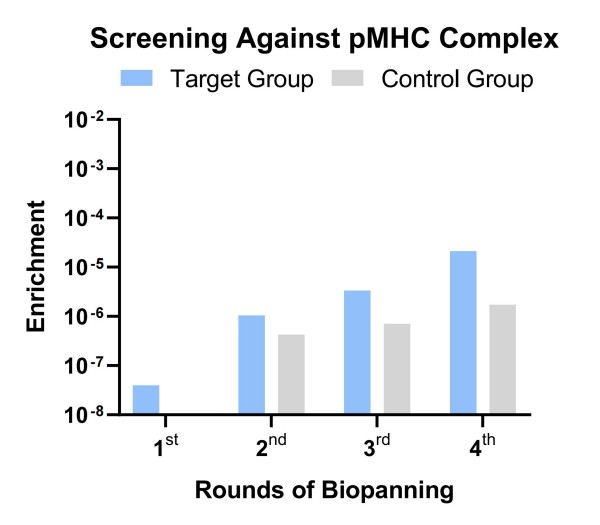
To ensure that the observed selectivity was intrinsic to the antibody's paratope and not an artifact of multivalent phage avidity, the lead clones were expressed as soluble proteins in the E. coli periplasm. 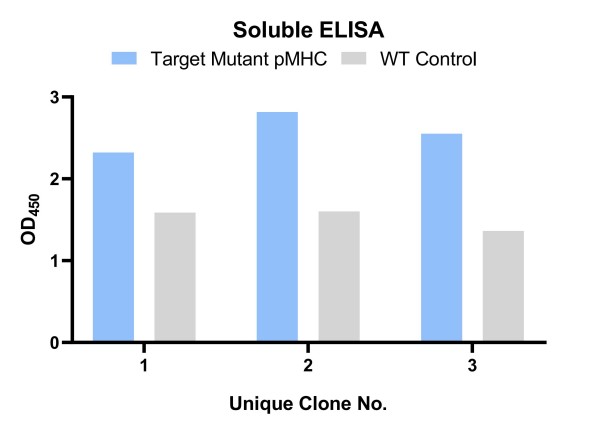
The lead scFv candidates were transitioned into a eukaryotic expression system for conversion into full-length human IgG1 antibodies, facilitating downstream therapeutic evaluation. 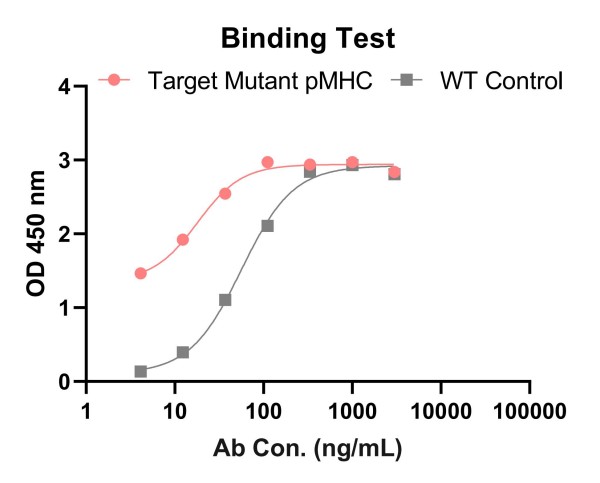
|
|||
| Technical Support |
|
|||
 Targeted Immunosuppression
Our screening platform is optimized to find functional blockers and modulators, not just binders, enabling precise control of immune pathways.
Low Immunogenicity by Design
By utilizing fully human libraries and validated frameworks, we minimize the risk of ADA responses which is essential for lifelong transplant therapies.
Functional-First Decisions
Integrated functional assays ensure that selected leads have the biological potency required for in vivo efficacy.
Library–Screening Synergy
Our 1011 diversity libraries paired with competitive panning yield high-affinity candidates even against difficult, conserved receptors.
Weeks, Not Months
Our engineered workflow bypasses immunization, delivering functional IgG leads in a fraction of the time required for hybridoma methods.
Radical Transparency
You receive full sequence data, functional datasets, and raw files, empowering your team to make data-driven decisions.
Ready to move fast? Creative Biolabs will scope your target, advise on best library and protocol, and get screening up and running as soon as possible.
All listed services and products are For Research Use Only. Do Not use in any diagnostic or therapeutic applications.