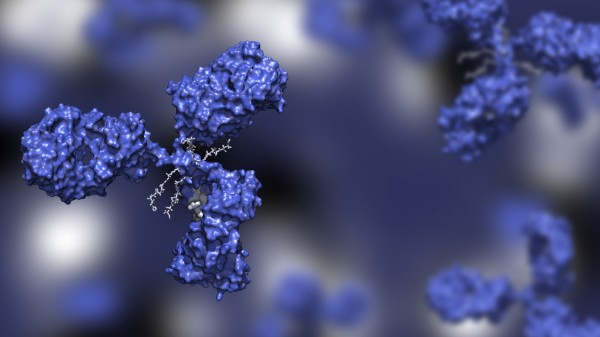
Creative Biolabs is offering the most comprehensive services for antibody development projects. With strict regulation and effective execution, we are dedicated to providing the most valuable solutions to complete your projects.
HighlightsCreative Biolabs is offering the most comprehensive services for antibody development projects. With strict regulation and effective execution, we are dedicated to providing the most valuable solutions to complete your projects.
HighlightsCreative Biolabs has established a broad range of platforms for developing novel antibodies or equivalents. These cutting-edge technologies enable our scientists to meet your demands from different aspects and tailor the most appropriate solution that contributes to the success of your projects.
HighlightsWith deep understanding in antibody-related realms and extensive project experience, Creative Biolabs offers a variety of references to help you learn more about our capacities and achievements, including infographic, flyer, case study, peer-reviewed publications, and all kinds of knowledge that can assist your projects. You are also welcome to contact us directly for more specific solutions.
HighlightsGet a real taste of Creative Biolabs, one of the most professional custom service providers in the world. We are committed to providing highly customized comprehensive solutions with the best quality to advance your projects.
HighlightsOvercome the persistent hurdles of high sequence homology and immune tolerance that often derail traditional antibody discovery. At Creative Biolabs, we provide a strategic shortcut to functional excellence by leveraging our massive premade antibody libraries. By combining surgical screening precision with early-stage functional validation, we deliver high-affinity, clinical-ready candidates in a fraction of the traditional timeline.
Inflammatory mediators, ranging from pleiotropic cytokines to complex chemokine receptors, present a unique set of biological hurdles. These include high sequence homology between species, rapid protein turnover, and the absolute requirement for potent functional neutralization. Traditional immunization often struggles to break immune tolerance or yield effective blocking antibodies against these conserved targets.
Creative Biolabs overcomes these limitations by utilizing hyper-diverse premade human libraries with a complexity of 1011 variants. By employing mechanism-centric screening, we bypass the constraints of in vivo systems to deliver high-affinity, developable antagonists and specific binders. Our platform is designed to provide preclinical-ready candidates in weeks rather than months.

Homology modeling; selection of bioactive cytokines/receptors; decoy strategy for isoform specificity; planning for soluble vs. membrane targets.
Up to 4-5 rounds of competitive panning; receptor-blocking elution to favor antagonists; high-stringency washing; depletion of non-specific binders.
High-throughput validation; cross-reactivity profiling against homologous cytokines/receptors; early non-specific binding triage.

Cell-based receptor blocking assays; reporter gene assays for signaling inhibition; epitope binning to ensure diverse mechanisms.

NGS-driven clonotype clustering; in silico liability screens; framework optimization paths.
Mini-panel IgG expression; biophysical profiling (solubility, thermal stability, pH stability).
Our libraries are engineered for developability, featuring proven frameworks and massive diversity to capture rare, high-potency binders against difficult inflammatory targets. Find the options below to find the best match for your specific inflammation disease target.
| Antibody Library ID | Display Technology | Library Format | Library Size |
|
HuScL-6 ☆Highly Recommended |
pIII-fusion, Phagemid Phage Display | Naïve scFv | 2.1×10¹¹ |
| HuScL-3S | pIII-fusion, Phagemid Phage Display | Semi-synthetic scFv | >1.0×10¹¹ |
| HuFabL-4 | pIII-fusion, Phagemid Phage Display | Naïve Fab | 1.9×10¹⁰ |
| HuFabssL-1 | pIII-fusion, Phagemid Phage Display | Naïve & synthetic Fab | 1.8×10¹⁰ |
| Discovery of Species Cross-Reactive Antibodies Against a Critical Pro-inflammatory Biomarker | |
| Objective | In the therapeutic landscape of chronic inflammatory disorders and systemic fibrosis, certain secreted glycoproteins (such as specific Galectin-binding proteins) have emerged as pivotal targets due to their role in driving pro-inflammatory cytokine cascades. A significant challenge in drug discovery for these targets is the requirement for leads that maintain high clinical relevance (Human target) while exhibiting robust species cross-reactivity (Mouse ortholog) to facilitate in vivo efficacy and safety validation in murine models. This case study highlights our success in utilizing a Premade Synthetic Human Antibody Library to isolate high-affinity candidates with defined species-binding profiles, supported by technical consultancy. |
| Strategic Approach |
To meet these dual objectives, our team implemented a Target-Driven Screening with Parallel Diversity Identification strategy using our Premade Synthetic Human Antibody Library. 1. Pre-discovery Support We conducted an in-depth bioinformatics alignment of the human and murine protein sequences, identifying conserved domains to evaluate the feasibility of cross-reactive discovery. We also provided guidance on antigen quality control, ensuring the proteins maintained native glycosylation patterns. 2. Selection Strategy
|
| Key Results & Validation Data |
1. Robust Library Enrichment The selection process demonstrated a clear increase in phage recovery across successive rounds, indicating successful library convergence toward high-affinity epitopes on the pro-inflammatory target. 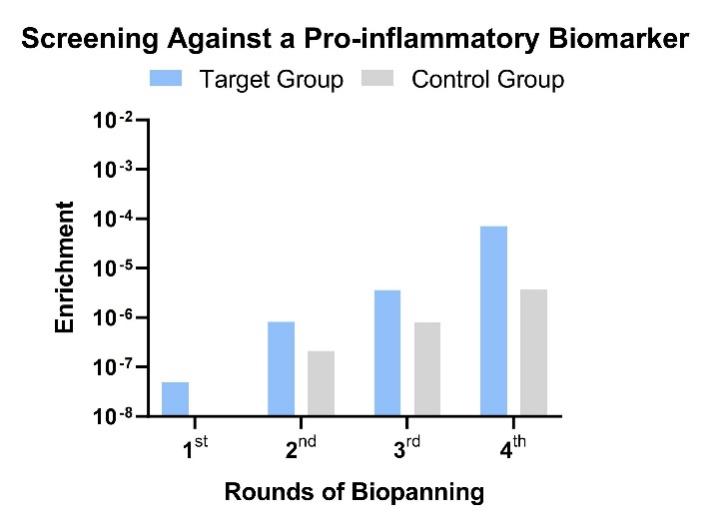 Figure 7. Enrichment Profile Against Human Target. The chart illustrates the significant increase in the Output/Input ratio over three rounds of panning, confirming the efficient recovery of target-specific binders from the synthetic library. 2. Primary Monoclonal Identification (Phage ELISA) Large-scale monoclonal screening of the enriched pool revealed a diverse repertoire of binders with distinct species-binding characteristics. 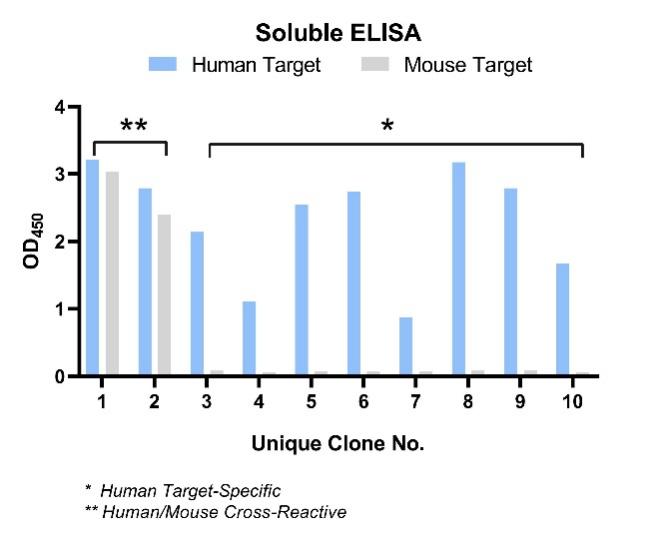 Figure 8. Monoclonal Specificity Profiling via Phage ELISA. Primary screening categorized the enriched repertoire into two distinct populations: cross-reactive clones with high-affinity binding to both human and murine orthologs, and human-specific clones with no detectable cross-reactivity. This divergence enables precise candidate selection tailored to specific preclinical or clinical objectives. 3. Functional Validation of Soluble Binders Following small-scale expression in full-length IgG format, the biochemical potency and species-binding profiles of the lead candidates were rigorously verified. 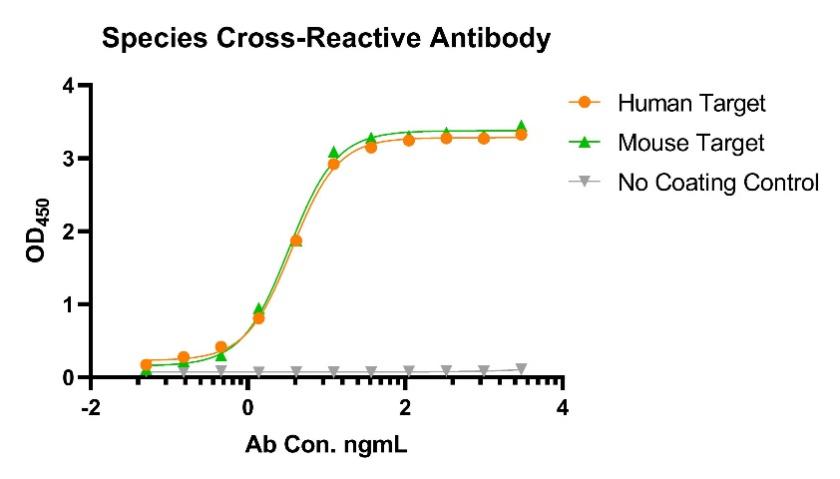 Figure 9. Validation of Cross-Reactive Potential via Binding ELISA. Comparative binding assays confirm that the lead cross-reactive clone maintains high-level, equilibrated affinity for both human and murine orthologs in its soluble IgG form, validating its suitability for in vivo murine modeling. |
| Technical Support |
|
 Hyper-Diverse 1011 Human Antibody Repertoires
We leverage proprietary, fully human phage display libraries with a massive complexity of 1011 variants. In the context of inflammatory diseases, this immense diversity is critical for:
Bypassing Immune Tolerance & Homology Constraints
Many inflammatory mediators (e.g., TNF-family ligands, interleukins) exhibit high sequence conservation across species, often leading to poor immunogenicity or "self-antigen" suppression in animal models.
Precision Engineering for Complex Membrane Targets
Inflammation is often driven by complex membrane proteins, such as GPCRs (Chemokine Receptors) and multi-pass ion channels. Our platform excels where others struggle:
Function-First: A Strategic Filtration Engine
We don't just find binders; we discover biological modulators. Our screening process acts as a strategic filtration engine tailored for anti-inflammatory efficacy: We integrate competitive elution and blockade-verified panning to prioritize clones that actively interrupt ligand-receptor interactions. By focusing on functional antagonism rather than simple surface binding, we deliver leads characterized by their potent ability to suppress inflammatory signaling pathways.
Ready to move fast? Creative Biolabs will scope your target, advise on best library and protocol, and get screening up and running as soon as possible.
All listed services and products are For Research Use Only. Do Not use in any diagnostic or therapeutic applications.