Creative Biolabs is offering the most comprehensive services for antibody development projects. With strict regulation and effective execution, we are dedicated to providing the most valuable solutions to complete your projects.
HighlightsCreative Biolabs is offering the most comprehensive services for antibody development projects. With strict regulation and effective execution, we are dedicated to providing the most valuable solutions to complete your projects.
HighlightsCreative Biolabs has established a broad range of platforms for developing novel antibodies or equivalents. These cutting-edge technologies enable our scientists to meet your demands from different aspects and tailor the most appropriate solution that contributes to the success of your projects.
HighlightsWith deep understanding in antibody-related realms and extensive project experience, Creative Biolabs offers a variety of references to help you learn more about our capacities and achievements, including infographic, flyer, case study, peer-reviewed publications, and all kinds of knowledge that can assist your projects. You are also welcome to contact us directly for more specific solutions.
HighlightsGet a real taste of Creative Biolabs, one of the most professional custom service providers in the world. We are committed to providing highly customized comprehensive solutions with the best quality to advance your projects.
HighlightsHaving successfully delivered leads for a wide array of novel and conventional targets, we combine our proven expertise with high-diversity premade libraries to accelerate your R&D. We don't believe in one-size-fits-all; instead, we optimize every discovery campaign to align with your target's unique profile, ensuring high-efficiency binding and superior developability across any disease area.
When facing compressed timelines and complex biological targets, Creative Biolabs provides a decisive advantage. We combine one of the industry's largest collections of premade human antibody libraries with a proven track record of unlocking novel and challenging disease targets. We believe every therapeutic target requires a bespoke approach; therefore, we don't just screen but also strategize. By integrating our deep understanding of disease biology with customized development roadmaps, we transform your specific clinical requirements into robust, high-affinity, and highly developable lead candidates ready for the next stage of innovation.
Covering a Wide Range of Targets
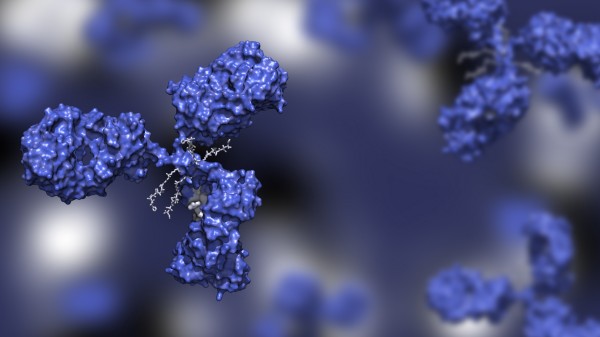
Anti-tumor-specific Target Antibody Discovery
Designed for the discovery of therapeutic antibodies against various cancer-associated antigens, including tumor-associated antigens (TAAs), neoantigens, and more.
Anti-infectious disease-specific Antibody Discovery
Designed for the discovery of antibodies against specific targets related to infectious diseases, including viruses, bacteria, and fungi, focusing on pathogen-specific epitopes and immune evasion mechanisms.
Anti-inflammation disease-specific Antibody Discovery
Designed for the discovery of antibodies that target specific mediators and pathways involved in chronic inflammatory diseases, such as pro-inflammatory cytokines, receptors, and signaling pathways implicated in diseases like rheumatoid arthritis, inflammatory bowel disease (IBD), and more.
Anti-autoimmune disorder-specific Antibody Discovery
Designed for the discovery of antibodies that target specific autoantigens and immune dysregulation mechanisms involved in autoimmune diseases, such as lupus, multiple sclerosis (MS), type 1 diabetes, and more.
Anti-allograft rejection-specific Antibody Discovery
Designed for the discovery of antibodies that can modulate immune responses to prevent or treat allograft rejection in transplant medicine.
Target assessment; antigen format optimization; decoy/competitor planning
Competitive and subtractive panning; increasing stringency
High-throughput validation; early polyspecificity triage
Cell-based functional assays; epitope binning
NGS-driven clustering
Mini-panel IgG expression; biophysics profiling
Fully technical report; next-step options
Our libraries are the cornerstone of our discovery engine, built on robust, developability-optimized frameworks.
| Antibody Library ID | Display Technology | Library Format | Library Size |
|
HuScL-6 ☆Highly Recommended |
pIII-fusion, Phagemid Phage Display | Naïve scFv | 2.1×10¹¹ |
| HuScL-3S | pIII-fusion, Phagemid Phage Display | Semi-synthetic scFv | >1.0×10¹¹ |
| HuFabL-4 | pIII-fusion, Phagemid Phage Display | Naïve Fab | 1.9×10¹⁰ |
| HuFabssL-1 | pIII-fusion, Phagemid Phage Display | Naïve & synthetic Fab | 1.8×10¹⁰ |
| Dual-Strategy Discovery of Antibodies Targeting Linear Epitopes and Native Conformations of a Transmembrane Regulator | |||||
| Objective |
In neuro-immunology and oncology research, targeting specific functional domains of transmembrane proteins is essential for deciphering intracellular signaling. This project aimed to discover high-affinity human scFv antibodies against a Type I transmembrane protein (Target X). The client required antibodies with three distinct binding profiles:
|
||||
| Our Strategy |
Leveraging our high-diversity Premade Human scFv Library, we implemented a multi-track selection strategy:
|
||||
| Results & Validation |
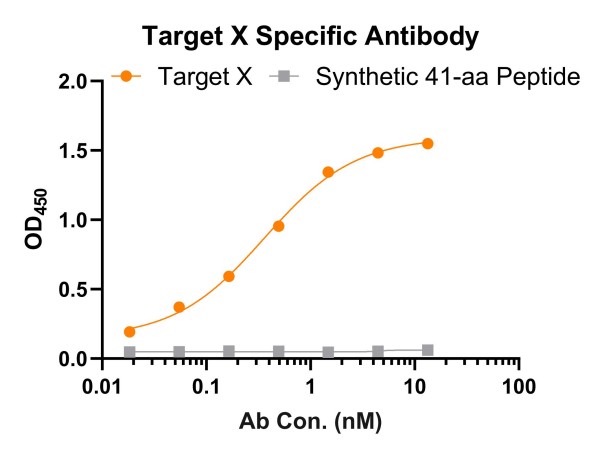
Successful Enrichment & Specificity
|
||||
|
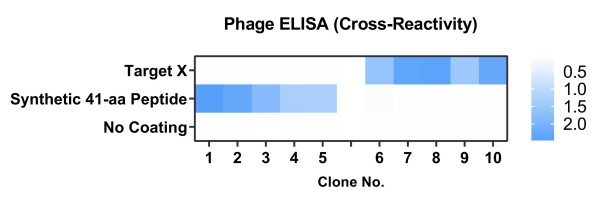
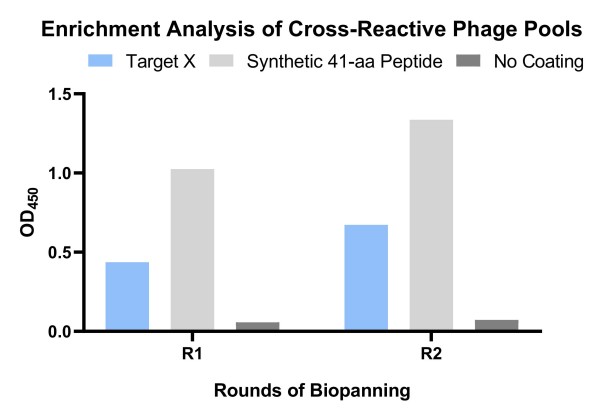
Identification of Cross-Reactive Leads Through intersectional screening, we achieved significant enrichment of dual-binding candidates.
|
|||||
| Technical Highlights & Support |
|
||||
Find additional antibody discovery services tailored to your specific needs.
 Library–Screening Synergy
Our 1e10-1e11 diversity libraries plus multi-parameter panning yield diverse, high-specificity binders primed for function not just affinity.
Functional-First Decisions
Integrated cell-based assays and epitope binning ensure MoA-relevant leads that translate in vivo.
Radical Transparency
End-to-end data access (including NGS clustering and rank lists) enables confident, audit-ready decisions.
QA-Backed Rigor
Reproducible biophysical panels and standardized frameworks improve stability and manufacturability from day one.
Weeks, Not Months
Streamlined enrichment-to-IgG conversion pipelines compress hit-to-lead timelines without sacrificing rigor.
At Creative Biolabs, we specialize in transforming your antibody discovery needs into actionable, high-quality leads. We invite you to connect with our experts to design a custom strategy based on your target and discovery goals.
Please include the following details in your inquiry:
All listed services and products are For Research Use Only. Do Not use in any diagnostic or therapeutic applications.