Creative Biolabs is offering the most comprehensive services for antibody development projects. With strict regulation and effective execution, we are dedicated to providing the most valuable solutions to complete your projects.
HighlightsCreative Biolabs is offering the most comprehensive services for antibody development projects. With strict regulation and effective execution, we are dedicated to providing the most valuable solutions to complete your projects.
HighlightsCreative Biolabs has established a broad range of platforms for developing novel antibodies or equivalents. These cutting-edge technologies enable our scientists to meet your demands from different aspects and tailor the most appropriate solution that contributes to the success of your projects.
HighlightsWith deep understanding in antibody-related realms and extensive project experience, Creative Biolabs offers a variety of references to help you learn more about our capacities and achievements, including infographic, flyer, case study, peer-reviewed publications, and all kinds of knowledge that can assist your projects. You are also welcome to contact us directly for more specific solutions.
HighlightsGet a real taste of Creative Biolabs, one of the most professional custom service providers in the world. We are committed to providing highly customized comprehensive solutions with the best quality to advance your projects.
HighlightsDeveloping therapies for autoimmune disorders requires navigating a minefield: targets are often "self" proteins, requiring antibodies that can break tolerance, achieve high affinity to compete with endogenous ligands, and remain non-immunogenic for chronic dosing. Creative Biolabs combines massive premade antibody libraries (up to 1011 diversity) with specialized screening strategies engineered to identify rare, functional modulators of the immune system.
Autoimmune drug discovery faces a unique paradox where you must target the host's own proteins with high potency while avoiding off-target toxicity. Conventional immunization often fails due to natural immune tolerance mechanisms. Creative Biolabs' Premade Antibody Library Service bypasses the host immune system entirely. By leveraging our massive synthetic and naïve antibody libraries paired with high-stringency functional screening, we identify high-affinity antagonists and signaling modulators that conventional methods cannot reach. This strategic approach delivers developable, clinic-ready candidates in weeks rather than months.
At Creative Biolabs, our phage and yeast display platforms are tuned to traverse the vastness of our premier libraries with surgical precision. We employ tolerance-breaking panning strategies, such as alternating antigen formats and stringent washing, to isolate rare clones that bind effectively to self-antigens. We integrate functional assays early in the process. We screen not just for binding but for the specific ability to block cytokine receptors or engage inhibitory checkpoints, ensuring we deliver potent therapeutic leads instead of simple binders.
Proven strategies to isolate binders against highly conserved "self" antigens.
Direct selection for antagonism (blocking) or agonism (inhibitory pathways).
Fully human frameworks optimized for safety in chronic autoimmune indications.
Strategy-driven selection for surrogate evaluation in animal models.
Ensures targeting of pathogenic epitopes while avoiding healthy tissue cross-reactivity.
Overcomes natural immune silence to find rare binders against self-antigens.
Eliminates sticky binders early.
Identifies candidates that actively modulate the disease pathway, not just bind the target.

NGS-driven clonotype clustering.
Mini-panel IgG expression and validation
Jump to the ideal starting point for your autoimmune program:
| Antibody Library ID | Display Technology | Library Format | Library Size |
|
HuScL-6 ☆Highly Recommended |
pIII-fusion, Phagemid Phage Display | Naïve scFv | 2.1×10¹¹ |
| HuScL-3S | pIII-fusion, Phagemid Phage Display | Semi-synthetic scFv | >1.0×10¹¹ |
| HuFabL-4 | pIII-fusion, Phagemid Phage Display | Naïve Fab | 1.9×10¹⁰ |
| HuFabssL-1 | pIII-fusion, Phagemid Phage Display | Naïve & synthetic Fab | 1.8×10¹⁰ |
| High-Precision Antibody Discovery for Highly Homologous Autoimmune Targets | |||
| Background | In the treatment of autoimmune disorders such as Systemic Lupus Erythematosus (SLE), targeting specific immune cell receptors is vital. However, many of these receptors belong to families with extreme structural similarity. A prime example is a specific Fc-gamma Receptor Isoform (Target B), which must be targeted without cross-reacting with its closely related Isoform A. Mis-targeting can lead to severe off-target effects, such as the unintended activation or depletion of incorrect leukocyte populations. | ||
| Challenge |
The "Needle in a Haystack" Epitope Discovery The Target Protein (Isoform B) and its Control Homolog (Isoform A) share >96% amino acid sequence identity. The differentiating epitopes are limited to only a few residues. Standard screening typically yields backbone binders that recognize the conserved regions shared by both proteins. To succeed, the screening process must be sensitive enough to detect rare clones with exclusive specificity for the remaining 4% of divergent residues. |
||
| Our Solution |
We leveraged our proprietary Premade Human scFv Library and implemented a rigorous multi-stage subtractive strategy:
|
||
| Key Results & Validation Data |
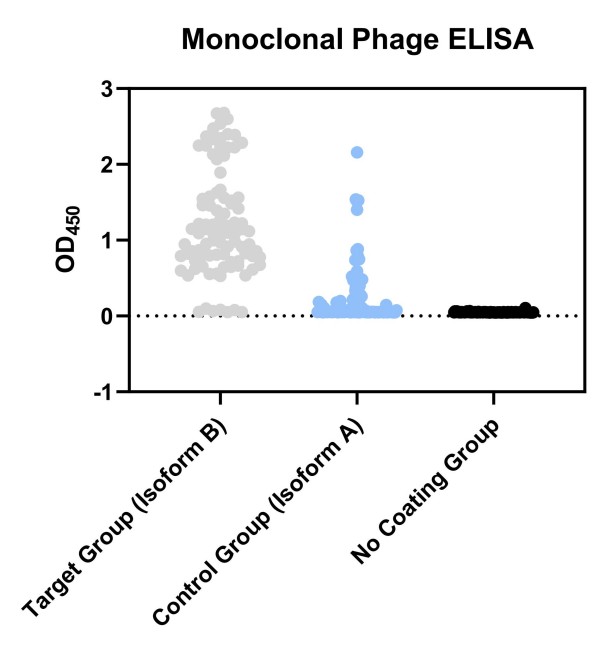
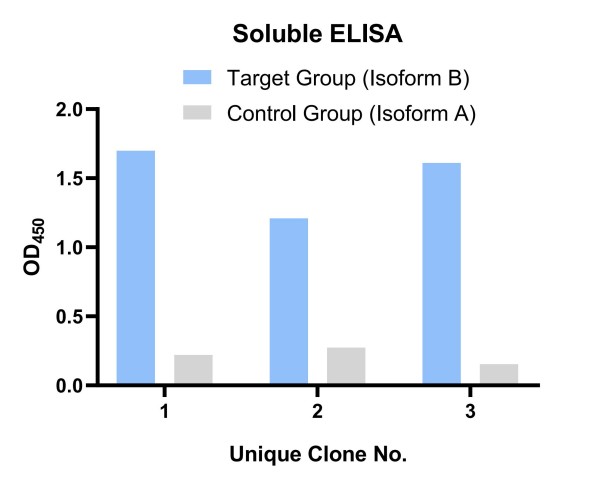
1. Successful Library Enrichment The selection process demonstrated exponential enrichment. By the fifth round, the output-to-input ratio showed a clear convergence toward target-specific binders, overcoming the high background of the control homolog. 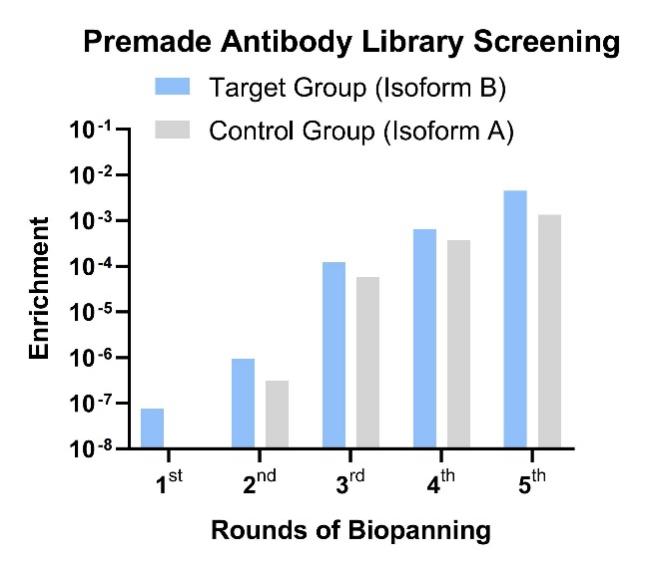 Figure 7. Enrichment Kinetics Against High-Homology Targets. The recovery profile across 5 rounds of panning illustrates the effectiveness of the subtractive strategy in enriching rare binders despite the presence of 96% sequence identity with the control. 2. Multi-Stage Monoclonal Identification Hundreds of clones were screened via high-throughput Monoclonal Phage ELISA followed by Soluble ELISA validation to ensure the specificity was maintained in both formats.
|
||
| Post-Discovery Technical Support |
Format Engineering: We assisted the client in evaluating which format (scFv vs. IgG) best suited their specific autoimmune MOA (e.g., blocking immune complex binding vs. receptor modulation). Developability Profiling: We provided CDR stability analysis to ensure the leads were suitable for long-term clinical formulation. |
||
 Breaking Tolerance Strategy
Our panning protocols are engineered to overcome immune tolerance, successfully isolating binders against conserved "self" antigens that immunization fails to find.
Functional-First Decisions
We don't just find binders; we integrate cell-based antagonism/agonism assays early to ensure leads modulate the disease pathway effectively.
Low Immunogenicity by Design
Our libraries utilize validated antibody frameworks, reducing the risk of ADA responses in chronic therapy settings.
Library-Screening Synergy
Combining 1011 diversity with expert functional triage yields high-specificity binders that distinguish pathogenic targets from healthy tissue.
Weeks, Not Months
Our streamlined enrichment-to-IgG conversion pipeline bypasses the months-long immunization process, accelerating speed-to-lead.
Radical Transparency
You receive full sequence data and project report, enabling confident decisions for your studies.
Ready to move fast? Creative Biolabs will scope your target, advise on best library and protocol, and get screening up and running as soon as possible.
All listed services and products are For Research Use Only. Do Not use in any diagnostic or therapeutic applications.