
CRISPR based Screening Solutions
CRISPR-based screening is a cutting-edge, high-throughput approach that uses CRISPR-Cas systems to systematically explore gene function by modulating gene expression at the genomic level. This approach is increasingly recognized as a powerful tool for functional genomics, allowing scientists to uncover genes essential for cell survival, drug resistance, immune modulation, or disease progression. To support these advanced research needs, Creative Biolabs provides a full suite of CRISPR-based screening services, with optimized platform for both commercial and custom library screens, adaptable to a wide range of cell types and phenotypic readouts.
Introduction
CRISPR based screening has become an essential strategy for uncovering functional genes, regulatory pathways, and disease-associated mechanisms in modern gene therapy research. By combining programmable genome perturbation with scalable phenotype readouts, CRISPR screening enables researchers to systematically identify genes that influence cell survival, therapeutic response, vector entry, transgene expression, immune activation, differentiation, metabolism, apoptosis, and disease progression.
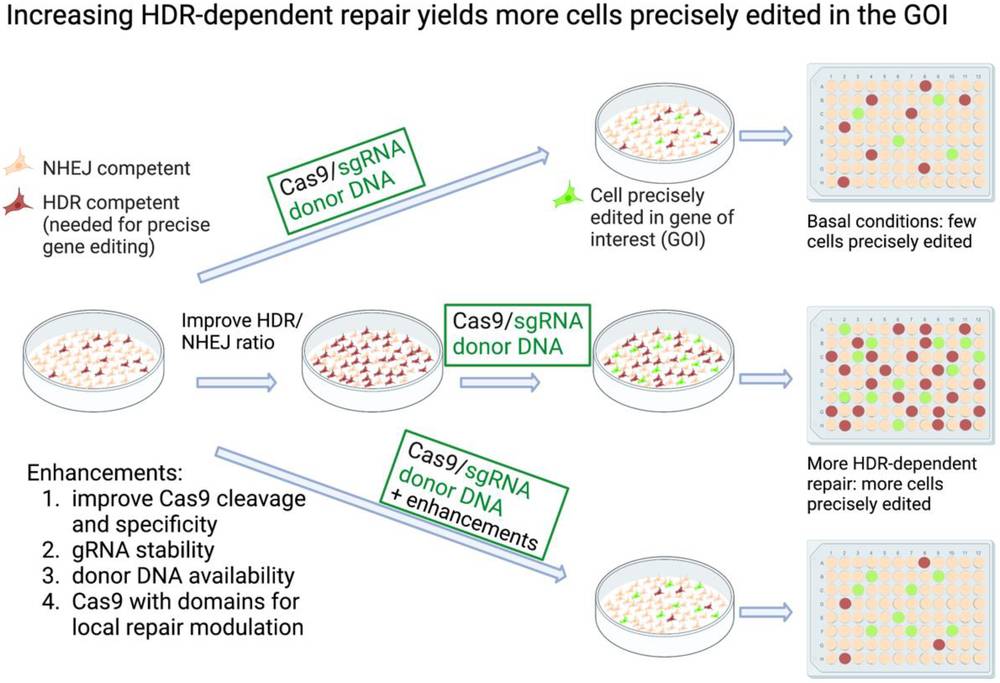 Figure 1. Increasing HDR-dependent repair improves yield of CRISPR knock-in cells. Knock-in HDR-dependent mutagenesis at a gene of interest (GOI).1
Why CRISPR Screening Matters for Gene Therapy Research
- Functional Gene Discovery for Gene Therapy
Gene therapy development requires a clear understanding of which genes regulate disease biology, therapeutic response, transgene expression, vector entry, immune sensing, DNA repair, apoptosis, mitochondrial function, and treatment resistance. CRISPR-based screening enables researchers to explore these questions in a scalable, phenotype-driven manner and identify genes that directly influence key therapeutic outcomes.
- Flexible CRISPR Screening Modalities
Different CRISPR screening formats can be selected according to project goals. CRISPR knockout screening helps identify genes required for survival, resistance, or sensitivity. CRISPRa screening reveals genes whose activation improves or alters a target phenotype. CRISPRi screening supports tunable repression of essential or dosage-sensitive genes, while single-cell CRISPR screening connects genetic perturbations with transcriptomic changes and cell-state transitions.
What We Can Do
With the rapid rise of CRISPR-based screening as a gold-standard tool in functional genomics, drug discovery, and precision medicine, researchers worldwide are turning to this technology for its unparalleled precision, flexibility, and scalability. At Creative Biolabs, we offer a well-established CRISPR screening platform powered by advanced technologies and a highly experienced scientific team. Our solutions are designed to meet the various demands, delivering reliable, reproducible, and high-throughput results across a wide range of biological systems. We provide comprehensive end-to-end CRISPR screening services, including:
CRISPR Screening Service Selection Guide
| Project Goal | Recommended Strategy | Best-Fit Service | Typical Outcome |
|---|---|---|---|
| Identify phenotype-driving genes across the genome | Genome-wide loss-of-function screen | Genome-Wide CRISPR Screening | Ranked genes associated with survival, resistance, sensitivity, or phenotype change |
| Discover genes whose upregulation alters a phenotype | Gain-of-function activation screen | CRISPRa Screening | Activated genes that enhance, rescue, or suppress the phenotype |
| Study essential genes or reversible repression | Transcriptional repression screen | CRISPRi Screening | Dosage-sensitive regulators and knockdown-associated phenotypes |
| Resolve heterogeneous cell-state changes | Perturb-seq or single-cell CRISPR format | Single-Cell CRISPR Screening | Guide-linked transcriptomic states and mechanistic signatures |
| Focus on a pathway, disease module, or client-defined gene set | Custom focused-library screen | Custom CRISPR Screening | Interpretable, project-specific hit list for efficient validation |
Our CRISPR Screening Platform
Creative Biolabs provides a flexible CRISPR screening platform that can be adapted to different research objectives, including knockout screening, CRISPRa screening, CRISPRi screening, pooled screening, focused-library screening, reporter-based sorting, drug-selection screening, FACS-based screening, pathway-specific screening, non-coding RNA screening, and single-cell CRISPR screening.
| Support Area | Related Service | How It Supports CRISPR Screening |
|---|---|---|
| Cell model preparation | CRISPR assisted Cell Line Development | Establishes edited or screening-ready cellular models |
| Cas9 system construction | Cas9 Overexpressing Cell Line Development | Provides stable Cas9-expressing cells for CRISPR knockout screening |
| CRISPRa model preparation | dCas9-VPR Overexpressing Cell Line Development | Supports transcriptional activation screening |
| CRISPRi model preparation | dCas9-KRAB Overexpressing Cell Line Development | Supports transcriptional repression screening |
| Vector construction | Viral Vector Construction through CRISPR | Enables efficient delivery of CRISPR components or screening libraries |
| Guide RNA preparation | gRNA Cloning through CRISPR | Supports guide RNA cloning for targeted or pooled screening |
Core CRISPR Screening Formats
01 Genome-Wide CRISPR Knockout Screening
Genome-wide CRISPR knockout screening enables unbiased discovery of genes associated with survival, resistance, sensitivity, immune response, vector response, or disease-related phenotypes. It is suitable for identifying functional genes and potential therapeutic targets across the genome.
02 CRISPRa Screening
CRISPRa screening activates endogenous genes to reveal which gene upregulation can alter, rescue, or enhance a target phenotype. It is useful for gain-of-function studies, pathway activation, and resistance mechanism discovery.
03 CRISPRi Screening
CRISPRi screening represses gene expression without permanent DNA cutting, making it suitable for essential genes, dosage-sensitive pathways, and reversible gene regulation studies.
04 Single-Cell CRISPR Screening
Single-cell CRISPR screening connects genetic perturbations with transcriptomic changes at the single-cell level. It is ideal for heterogeneous cell populations, immune models, differentiation studies, and cell-state analysis.
05 Custom CRISPR Screening
Custom CRISPR screening uses focused libraries designed around specific pathways, gene families, disease models, or client-defined targets, providing a more efficient strategy for targeted functional discovery and validation.
Applications of CRISPR based Screening Solutions
Creative Biolabs' CRISPR screening services can be applied to a wide range of gene therapy and functional genomics research projects. Typical applications include:
- Target discovery and prioritization
- Disease mechanism mapping
- Vector biology and delivery-related studies
- Immune response and interferon pathway screening
- Cancer and cell survival studies
- Non-coding rna functional discovery
- Pathway-focused validation
Our CRISPR Screening Workflow
| Workflow Stage | QC Focus | Representative Deliverables |
|---|---|---|
| Project design | Screen feasibility, phenotype window, and assay suitability | Study design summary and recommended screening strategy |
| System preparation | Cell health, editing system activity, transduction efficiency, selection tolerance | Validated model plan and optimization record |
| Library and delivery | Library representation, guide coverage, and delivery consistency | Library information, delivery parameters, and QC summary |
| Screen execution | Replicate consistency, bottleneck avoidance, and phenotype robustness | Collected samples and sequencing-ready materials |
| Sequencing and analysis | Read quality, mapping rate, control behavior, replicate correlation | Ranked hits, pathway insights, figures, and final report |
| Validation planning | Biological relevance and reproducibility | Prioritized validation list and suggested next-step experiments |
What You Can Receive
Depending on project scope, clients can receive a complete CRISPR screening package that includes screening strategy consultation, recommended CRISPR modality, cell model preparation plan, library design or selection, delivery optimization, screening execution, next-generation sequencing, bioinformatics analysis, ranked candidate gene list, pathway-level interpretation, QC documentation, and validation recommendations. For custom projects, deliverables can be adapted to include client-specified gene lists, special assay formats, additional time points, custom plots, or downstream confirmation experiments.
Typical deliverables may include:
- Project design summary and screening strategy recommendation
- sgRNA library information and control design
- Cell transduction, selection, and screening records
- Sample collection and sequencing plan
- Sequencing and mapping metrics
- Guide-level and gene-level scoring results
- Enriched and depleted hit tables
- Pathway and functional category interpretation
- Comparison across treatment groups or screening arms
- Visualization figures and ranked candidate lists
- Prioritized validation recommendations
- Final technical report
Why Choose Creative Biolabs
Gene Therapy-Focused Screening Design
Creative Biolabs understands that CRISPR screening for gene therapy research is not simply a library delivery project. The screen must be designed around the biological question, cell model, delivery system, phenotype, and downstream development objective. Our scientists help clients build a screening plan that is technically feasible and biologically informative.
Multiple CRISPR Modalities
We support CRISPR knockout, CRISPR activation, CRISPR interference, custom focused libraries, and single-cell CRISPR readouts. This enables clients to choose the most appropriate perturbation strategy rather than forcing every question into a single screening format.
Customizable Screening Scope
Clients can choose genome-wide discovery, pathway-focused screening, gene family screening, functional category screening, client-defined candidate lists, or non-coding RNA screening. This flexibility helps balance discovery depth, budget, timeline, and interpretability.
Decision-Ready Data Interpretation
Our goal is to help clients understand what the screening results mean. We provide ranked candidates, QC metrics, pathway interpretation, phenotype-linked insights, and validation recommendations so that clients can make informed next-step decisions.
Frequently Asked Questions
Q: Should I choose CRISPRko, CRISPRa, or CRISPRi?
A: CRISPRko is appropriate when permanent gene disruption is desired. CRISPRa is best for identifying genes whose activation changes a phenotype. CRISPRi is useful when reversible repression or partial loss of function is preferred, especially for essential genes or regulatory studies. Creative Biolabs can help select the most suitable modality based on your biological question, cell model, phenotype, and downstream validation plan.
Q: Can you work with difficult or sensitive cell models?
A: Many screening projects involve challenging cells. We evaluate growth characteristics, delivery feasibility, selection tolerance, phenotype window, and library coverage before recommending a final strategy. When needed, we can support stable Cas9 or dCas9 system development and delivery optimization before screening.
Q: Do I need a genome-wide CRISPR screen?
A: Not always. A genome-wide screen is powerful for unbiased discovery, but focused libraries can be more efficient when the project already centers on a pathway, disease mechanism, gene family, functional category, or candidate list. Creative Biolabs offers both broad and focused screening options.
Q: Can you design a custom CRISPR library?
A: Yes. Through Custom CRISPR Screening, Library Design through CRISPR, and gRNA Cloning through CRISPR, we can help design libraries for specific genes, pathways, non-coding RNAs, regulatory regions, or client-provided targets.
Q: What readouts can be used?
A: Common readouts include cell viability, proliferation, drug resistance, reporter activity, surface marker expression, fluorescence sorting, pathway activation, differentiation state, immune response, sequencing-based guide abundance, and single-cell transcriptomic readouts. The best readout depends on the biological question and the strength of the phenotype window.
Ready to Start Your CRISPR Screening Project?
If you are planning a functional genomics study, target discovery campaign, gene therapy mechanism project, or focused validation screen, Creative Biolabs can help convert your research objective into a practical CRISPR screening workflow. Contact us with your cell model, phenotype, and study goal, and our scientific team will recommend a screening strategy, library format, delivery approach, and analysis plan tailored to your project.
Reference
- Reuven N, Shaul Y. Selecting for CRISPR-edited knock-in cells. International journal of molecular sciences, 2022, 23(19): 11919. https://doi.org/10.3390/ijms231911919 Distributed under Open Access license CC BY 4.0, without modification.
