We apply a unified strategy that integrates biological sampling, sequencing, and chromosomal instability interpretation to ensure data consistency and biological relevance throughout the workflow.
Chromosomal Instability & Copy Number Variation Analysis Service
Are you currently facing challenges such as interpreting complex copy number profiles, understanding chromosomal instability across heterogeneous tumor samples, or linking large-scale genomic alterations to cancer phenotypes? Creative Biolabs' chromosomal instability & copy number variation analysis service helps you systematically characterize genome-wide copy number changes and instability patterns through robust CNV profiling, chromosomal instability burden assessment, and biologically oriented interpretation, enabling clearer insights into tumor evolution and functional consequences.
Overview What We Can Offer Workflow Required Materials Highlights Publication Customer Reviews FAQs Related Services
Overview
Chromosomal instability and copy number variation are pervasive features of cancer genomes, driving tumor initiation, progression, and heterogeneity. Large-scale cancer genome studies have demonstrated that CNV burden, heterogeneity, and characteristic copy number patterns reflect distinct instability processes with biological and prognostic relevance. Quantitative CNV analysis therefore provides more than structural information—it offers insight into genome dynamics and tumor behavior. Creative Biolabs integrates standardized CNV detection with instability-oriented interpretation to support reliable oncology research conclusions.
Creative Biolabs applies a multi-dimensional strategy to chromosomal instability and CNV analysis.
Integrated Sample-to-Insight Design
Genome-Wide CNV Resolution
Copy number alterations are analyzed at genome-wide, chromosomal arm, and focal-region levels to capture both broad instability and gene-level events.
Chromosomal Instability Quantification
Chromosomal instability is assessed using burden- and heterogeneity-oriented metrics, enabling objective comparison across samples and experimental groups.
Biology-Oriented Contextualization
CNV and chromosomal instability features are interpreted within cancer-relevant genomic regions and functional contexts to support mechanism-driven research conclusions.
Accelerate Innovation with Creative Biolabs – Start Your Consultation Today
What We Can Offer
End-to-End CNV & chromosomal instability Profiling
We provide complete chromosomal instability and copy number variation analysis starting from biological samples through sequencing and downstream interpretation.
Sample Processing and Sequencing Support
Tumor and research samples are processed using standardized workflows to generate high-quality data suitable for reliable CNV inference
Genome-Wide CNV Detection and Segmentation
Comprehensive identification of copy number gains and losses across the genome, with accurate segmentation of chromosomal regions.
Chromosomal Instability Burden and Heterogeneity Metrics
Quantitative assessment of global instability levels and intra-sample CNV diversity to support tumor evolution and heterogeneity studies.
Gene- and Region-Level Annotation
Copy number alterations are mapped to cancer-relevant genes, chromosomal arms, and functional genomic regions to enhance biological interpretation.
Workflow
Sample Submission and Quality Assessment
Clients provide biological samples, which are evaluated for integrity and suitability prior to sequencing.
Library Preparation and Sequencing
Samples undergo standardized library preparation and sequencing to generate high-quality data optimized for CNV detection.
Copy Number Signal Processing
Sequencing data are normalized and processed to minimize technical bias and ensure accurate copy number inference.
Genome Segmentation and CNV Calling
The genome is segmented into regions of consistent copy number state, identifying gains, losses, and large-scale alterations.
Chromosomal Instability Quantification
Global instability burden, segment distribution, and heterogeneity metrics are calculated to characterize chromosomal instability status.
Annotation, Interpretation, and Reporting
CNV and chromosomal instability results are annotated to genes and regions, interpreted in biological context, and delivered in a comprehensive report.
Required Starting Materials
- Tumor tissue, cell pellets, or extracted DNA suitable for genomic sequencing.
- Basic sample background information such as cancer type or experimental model.
- Defined research goals related to chromosomal instability or CNV-driven mechanisms.
Highlights
Robust End-to-End CNV Profiling
Our service delivers reliable chromosomal instability and copy number variation profiling through an integrated workflow that spans sample processing, sequencing, and downstream analysis, ensuring consistency and data integrity from start to finish.
Quantitative Chromosomal Instability Assessment
Chromosomal instability is evaluated using objective burden and heterogeneity metrics, enabling accurate comparison across samples and supporting studies of tumor evolution, genome dynamics, and structural complexity.

Biology-Oriented CNV Interpretation
Copy number alterations are interpreted within cancer-relevant genomic and functional contexts, allowing researchers to move beyond structural descriptions toward biologically meaningful insights.
Support for Tumor Heterogeneity Studies
The analytical framework is designed to capture both broad chromosomal alterations and focal events, facilitating investigation of intratumoral diversity and clonal architecture.
Flexible Application Across Research Models
Applicable to cell lines, animal models, and tumor-derived samples, the service adapts to exploratory discovery and hypothesis-driven oncology research.
Discover the Creative Biolabs Advantage – Contact Us for a Customized Quote
Publication
Single-cell transcriptomic analysis has revealed a direct relationship between chromosome copy number and gene expression levels in cancer cells with chromosomal instability. Gains or losses of whole chromosomes result in proportional increases or decreases in the expression of genes located on those chromosomes, demonstrating a clear gene dosage effect. This phenomenon shows that large-scale copy number alterations broadly reshape cellular transcriptional programs rather than affecting isolated genes. In cancer stem–like populations, such expression scaling enhances intratumoral heterogeneity and supports adaptive phenotypes linked to survival and stress tolerance. These observations underscore the importance of chromosomal instability and copy number variation analysis for connecting genome architecture changes with functional consequences. By capturing how structural alterations translate into transcriptional imbalance, CNV-focused analysis provides essential insight into how genome instability drives tumor behavior and phenotypic diversity.
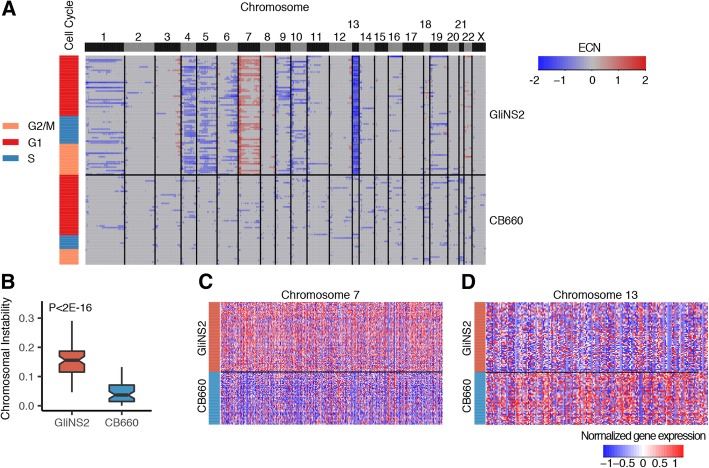 Fig.1 Gene expression correlates directly with chromosome copy number.1
Customer Reviews
- Improved clarity of CNV landscapes using Creative Biolabs' chromosomal instability & copy number variation analysis service has significantly facilitated our tumor heterogeneity studies. Ongoing research, Mar*** Lin.
- Reliable chromosomal instability burden assessment using Creative Biolabs' chromosomal instability & copy number variation analysis service has strengthened our interpretation of genome instability across cancer models. Long-term collaboration, Ste*** Wong.
- Gene-level CNV interpretation using Creative Biolabs' chromosomal instability & copy number variation analysis service has improved confidence in linking structural changes to functional outcomes. Multi-project usage, Dan*** Hu.
FAQs
Can this service distinguish focal CNVs from large-scale chromosomal alterations?
Yes, both focal and broad CNVs are identified and interpreted at appropriate resolution.
Is the analysis suitable for heterogeneous tumor samples?
The workflow includes heterogeneity-aware metrics that support analysis of mixed cell populations.
Can CNV data be compared across multiple samples or cohorts?
Yes, standardized metrics allow comparative analysis across samples and experimental groups.
How are CNV results linked to biological relevance?
CNVs are annotated to genes, chromosomal regions, and known cancer-related features.
Related Services
DNA Damage Response Defect Analysis
We provide DNA damage response defect analysis services to evaluate pathway-level impairments in DNA repair, checkpoint control, and stress response mechanisms that drive mutation accumulation and genome instability.
Learn More →Telomere Dysfunction & ALT Mechanism Profiling
We provide telomere dysfunction and alternative lengthening of telomeres profiling services to investigate telomere maintenance abnormalities and their contribution to chromosomal instability in tumor systems.
Learn More →Creative Biolabs' chromosomal instability & copy number variation analysis service provides a structured and biologically grounded approach to understanding genome architecture changes in cancer research. By integrating robust CNV detection with chromosomal instability interpretation, we help researchers generate clearer insights and stronger experimental direction.
Contact our team to discuss how chromosomal instability & copy number variation analysis can support your research objectives.
Reference
- Zhao, Yanding et al. "Single-cell RNA sequencing reveals the impact of chromosomal instability on glioblastoma cancer stem cells." BMC medical genomics vol. 12,1 79. 31 May. 2019. Distributed under Open Access license CC BY 4.0, without modification. https://doi.org/10.1186/s12920-019-0532-5
 Download our brochure
Loading case studies...
Online Inquiry