DDR defects are assessed across sensing, signaling, and repair layers to capture functional impairment rather than isolated gene changes.
DNA Damage Response Defect Analysis Service
Are you currently facing challenges such as unclear DNA repair pathway status, difficulty interpreting genome instability mechanisms, or limited insight into how DNA damage response (DDR) defects shape cancer behavior? Creative Biolabs' DDR defect analysis service helps you systematically characterize repair and checkpoint deficiencies through integrated experimental assays and pathway-level analysis, enabling clearer mechanistic understanding and informed research decisions in oncology studies.
Overview What We Can Offer Workflow Required Materials Highlights Publication Customer Reviews FAQs Related Services
Overview
The DDR is a complex network that detects DNA lesions, coordinates repair, and enforces cell-cycle control. Defects in DDR pathways contribute directly to mutation accumulation, chromosomal instability, and tumor evolution. Research across solid and hematologic malignancies has shown that DDR defects are context-dependent, mechanistically diverse, and biologically actionable. Comprehensive DDR defect analysis, therefore requires pathway-aware evaluation rather than single-marker testing. Creative Biolabs provides structured DDR analysis to support reliable interpretation of genome maintenance failures in cancer research.
We utilize a suite of comprehensive strategies for our DDR defect analysis service, specifically employing:
Pathway-Oriented DDR Evaluation
Multi-Marker Defect Assessment
Orthogonal biomarkers and readouts are combined to improve specificity and mechanistic resolution.
Context-Aware Interpretation
DDR findings are interpreted in relation to tissue type, replication stress status, and experimental model characteristics.
Integration with Genome Instability Features
DDR defects are analyzed alongside mutation burden and structural instability to support coherent biological conclusions.
Accelerate Innovation with Creative Biolabs – Start Your Consultation Today
What We Can Offer
Comprehensive DDR Pathway Profiling
Systematic evaluation of key DNA damage sensing, signaling, and repair pathways to identify functional deficiencies affecting genome maintenance.
Checkpoint and Signaling Assessment
Detailed analysis of DDR checkpoint activation and regulatory signaling linked to cell-cycle control and damage tolerance.
Repair Capacity Evaluation
Functional assessment of DNA repair efficiency and pathway utilization to determine compromised repair mechanisms in cancer models.
Defect Pattern Interpretation
Identification and interpretation of recurring DDR defect patterns associated with genome instability and altered cellular behavior.
Integrated Experimental and Analytical Workflow
Coordinated management of biological samples, experimental assays, and downstream data analysis to ensure consistency and reproducibility.
Contextual Genome Instability Integration
DDR findings are evaluated alongside mutation burden, chromosomal instability, or replication stress features to strengthen biological conclusions.
Workflow
Project Consultation and Study Design
Research objectives, sample types, and DDR pathways of interest are aligned to define a tailored analysis strategy.
Sample Submission and Quality Review
Client-provided samples are evaluated for integrity and suitability prior to experimental processing.
Experimental DDR Assays
DDR-related signaling, repair activity, and checkpoint responses are experimentally assessed using standardized workflows.
Data Processing and Quantification
Raw assay outputs are processed to generate reliable, quantitative DDR metrics.
Pathway-Level Integration
Results are integrated across DDR components to identify functional defects and response patterns.
Contextual Interpretation
DDR findings are interpreted alongside genome instability and replication stress context.
Required Starting Materials
- Tumor tissues, cultured cells, or extracted nucleic acids suitable for DDR assays.
- Sample background information such as cancer type or experimental conditions.
- Defined research questions related to DNA repair or checkpoint dysfunction.
Highlights
Comprehensive DDR Pathway Coverage
Our service evaluates DNA damage sensing, signaling, and repair components to provide a complete view of DDR integrity.
Mechanism-Oriented Defect Identification
DDR impairments are defined at the pathway and functional level, improving biological relevance compared with isolated marker analysis.

Contextual and Integrated Interpretation
DDR defects are interpreted together with replication stress and genome instability features, supporting coherent and biologically grounded insight.
Support for Complex Cancer Systems
The workflow is designed to accommodate variability inherent to heterogeneous tumor-derived samples and experimental oncology models.
Discover the Creative Biolabs Advantage – Contact Us for a Customized Quote
Publication
In response to DNA damage, cells activate a coordinated checkpoint network that pauses progression through critical phases of the cell cycle to allow time for repair. Damage sensors such as the ATM and ATR kinases detect DNA lesions or replication stress and initiate signaling cascades that engage effector kinases including CHK1 and CHK2. These kinases act upstream of regulatory proteins that inhibit cyclin-dependent kinases, transiently arresting the cell cycle at G1/S, intra-S, or G2/M transitions until repair is complete. This checkpoint activation prevents propagation of damaged DNA, stabilizes genome integrity, and directs cells toward repair pathways or programmed cell death when damage is irreparable. Quantifying the activity of these checkpoint pathways and their regulatory components provides insight into how DNA damage response defects influence cancer cell survival and treatment sensitivity.
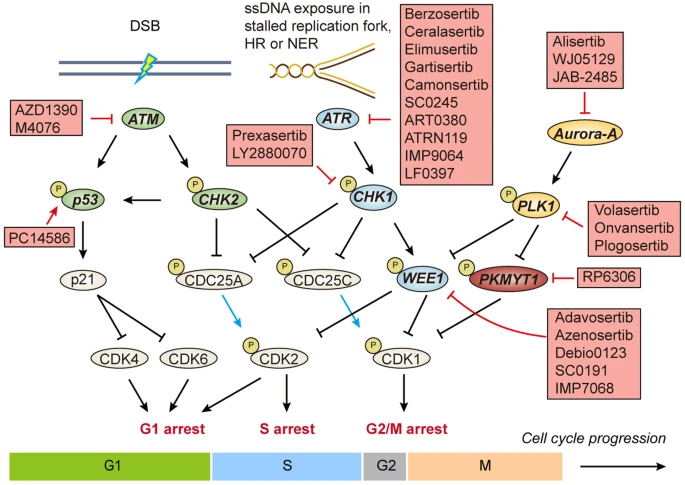 Fig.1 The presence of DNA damage is necessary to activate DNA damage checkpoints. 1
Customer Reviews
- Improved clarity of DNA repair pathway status using Creative Biolabs' DNA damage response defect analysis service has significantly facilitated our genome instability research. -Ongoing study, Li*** Zhang.
- Reliable DDR defect interpretation using Creative Biolabs' DNA damage response defect analysis service has strengthened confidence in our functional oncology experiments. -Long-term collaboration, Mar*** Evans.
- Pathway-level DDR insights using Creative Biolabs' DNA damage response defect analysis service have improved our understanding of repair deficiencies across cancer models. -Multi-project usage, Dan*** Ruiz.
FAQs
Can this service distinguish different types of DDR defects?
Yes, pathway-oriented analysis enables differentiation between sensing defects, signaling abnormalities, and impaired repair mechanisms.
Is this service suitable for heterogeneous tumor samples?
The workflow accounts for biological variability and supports interpretation across mixed or heterogeneous cancer systems.
Can DDR defects be analyzed together with other genome instability features?
DDR results can be integrated with mutation, copy number variation, or replication stress analyses for a more complete genome instability profile.
Does the service support mechanistic hypothesis development?
Findings are reported with pathway-level context to guide downstream functional validation and experimental design.
Related Services
Gene Mutation Profiling & Driver Mutation Detection Service
A comprehensive service for systematic identification and prioritization of biologically meaningful gene mutations, enabling accurate distinction between true oncogenic drivers and background passenger alterations across cancer genomes.
Learn More →Chromosomal Instability & Copy Number Variation Analysis Service
A specialized service for comprehensive characterization of genome-wide copy number gains, losses, and chromosomal imbalance to assess structural instability and its role in tumor evolution.
Learn More →Creative Biolabs' DDR defect analysis service provides a structured and biologically grounded approach to characterizing DNA repair and checkpoint dysfunction in cancer research. By integrating experimental assessment with pathway-level interpretation, we help researchers generate actionable insights into genome maintenance mechanisms.
Contact our team to discuss how DDR defect analysis can support your research objectives.
Reference
- Li, Qi et al. "A new wave of innovations within the DNA damage response." Signal transduction and targeted therapy vol. 8,1 338. 8 Sep. 2023. Distributed under Open Access license CC BY 4.0, without modification. https://doi.org/10.1038/s41392-023-01548-8
 Download our brochure
Loading case studies...
Online Inquiry