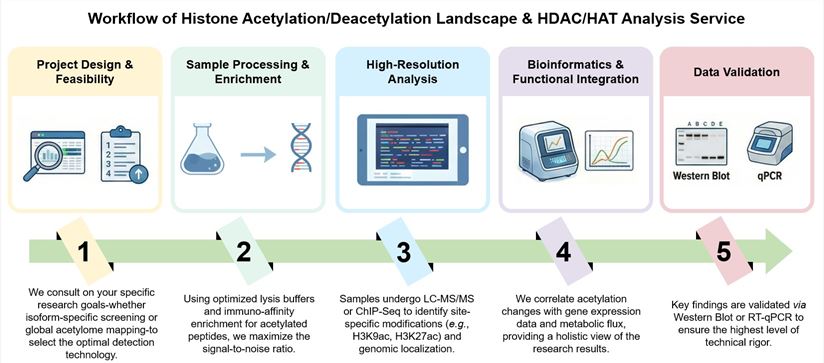
We provide bespoke experimental frameworks that adapt to unique project requirements, spanning from initial wide-scale discovery phases to the high-precision validation of targeted isoform-specific modifications within complex biological systems.
Histone Acetylation/Deacetylation Landscape & HDAC/HAT Analysis Service
Creative Biolabs offers a comprehensive, end-to-end analytical framework for the precise quantification of epigenetic modifications within various research models. By integrating site-specific mapping of lysine acetylation with rigorous enzymatic activity assays for all primary HDAC and HAT classes, this platform facilitates the acquisition of granular genomic localization data. Through collaborative engagement, researchers may obtain profound mechanistic insights into the nuances of gene regulation and protein stability, thereby enabling the systematic identification of novel research targets and the optimization of chemical probes with high technical fidelity and reproducible empirical outcomes.
Introduction What We Can Offer Workflow Why Creative Biolabs Customer Reviews FAQs Related Services Contact Us
Decoding the Dynamic Histone Acetylation Landscape for Oncology Research
Histone acetylation is a fundamental post-translational modification that modulates chromatin accessibility through the reciprocal enzymatic actions of HATs and HDACs. This dynamic process functions as an essential environmental sensor, intimately coupled to cellular metabolic status via Acetyl-CoA availability. By leveraging contemporary scientific literature regarding high-fidelity biomarkers like H3K9ac and H3K18ac, Creative Biolabs provides a technologically advanced platform designed to facilitate rigorous, innovative research discovery and provide granular mechanistic insights into epigenetic flux.
For an in-depth analysis of how our services can be tailored to your specific project needs, request a consultation.
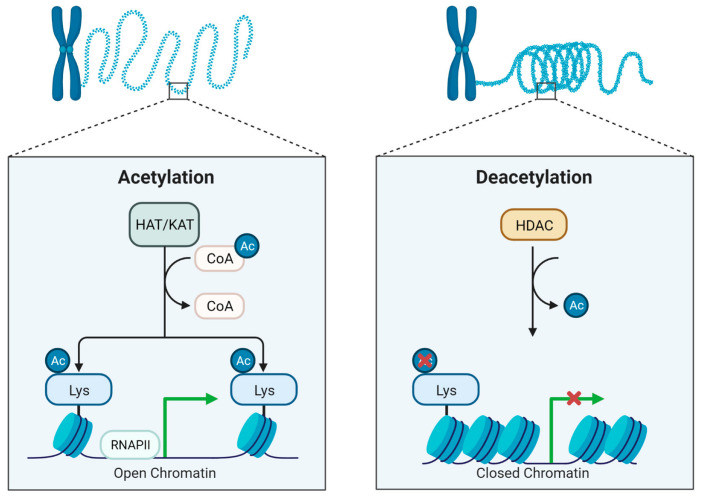 Fig.1 Biochemical and functional aspects of histone acetylation/deacetylation. 1
What We Can Offer
Customized Epigenetic Profiling
High-Resolution LC-MS/MS
Leveraging state-of-the-art mass spectrometry, our platform facilitates the sensitive identification and quantification of both novel and canonical acetylation sites, ensuring unparalleled accuracy in characterizing the dynamic landscape of histone modifications.
Comprehensive Isotype Screening
Our methodology ensures exhaustive characterization of Class I-IV HDACs and varied HAT families, including MYST and p300/CBP, utilizing specialized proprietary substrates to deliver deep insights into enzymatic activity.
Integration of Quality-by-Design (QbD)
We implement rigorous Quality-by-Design principles and advanced process analytical techniques to minimize variability, ensuring that every epigenetic assay adheres to the highest standards of technical reproducibility and scientific excellence.
Histone Acetylation/Deacetylation Landscape & HDAC/HAT Analysis Service at Creative Biolabs
Highlights
Pioneering Epigenetic Expertise
As a leader in chromatin biology, Creative Biolabs delivers unmatched technical sensitivity and sophisticated context-aware interpretation, ensuring that every data point is analyzed with profound scientific rigor and actionable insight.
Mechanistic Regulatory Insights
We transcend basic data generation by identifying the specific molecular regulators essential to your project, providing a profound understanding of the biological pathways influenced by your lead compounds.

Optimized Low-Input Detection
Our analytical platforms are specifically engineered to detect subtle modifications within low-abundance research samples, ensuring high-quality results even when biological material is significantly limited or difficult to obtain.
Complex Interaction Mapping
Extensive expertise in multi-protein structures, such as the NuRD and SIN3 complexes, allows us to provide a comprehensive view of HDAC activity and recruitment within native cellular environments.
Interested parties are invited to leverage the specialized analytical capabilities of Creative Biolabs - Request a professional quotation.
Customer Reviews
-
Actionable MoA Data
Using Creative Biolabs' HDAC complex analysis in our research has significantly improved our ability to distinguish between Class I and Class IIa effects. Their interpretation of the NuRD complex recruitment was vital for our last publication. - Prof. Ma***k L. -
Metabolic Integration
The utilization of Creative Biolabs' Acetyl-CoA correlation analysis has facilitated substantial advancements in our investigations into metabolic reprogramming; furthermore, this approach provided critical mechanistic insights that were largely unattainable through conventional proteomic methodologies. - Dr. Ka***a J.
FAQs
Can your service distinguish between different HDAC isoforms in a complex environment?
Yes. Our assays utilize isoform-specific substrates and complex-capture technology to determine the exact inhibitory profile within cellular NuRD or CoREST complexes.
How do you address the influence of Acetyl-CoA levels on the results?
We offer optional metabolic co-profiling to correlate Acetyl-CoA and Lactate levels with the observed acetylation landscape, providing a context-aware interpretation of your research data.
Related Services
PRC2 Mark Mapping
This platform facilitates high-resolution mapping of H3K27me3 marks, providing critical data on PRC2-mediated gene silencing and the mechanistic regulation of repressive chromatin states in research models.
Learn More →Chromatin Remodeling Complex Profiling
We provide quantitative characterization of ATP-dependent remodeling activities, mapping the genomic positioning and structural transitions of core complexes to determine their functional impact on transcriptional accessibility.
Learn More →How to Contact Us
Creative Biolabs functions as a strategic primary partner in elucidating the intricate complexities governing the histone acetylation landscape. From discovery-phase mass spectrometry mapping to high-resolution isoform-specific activity profiling, the organization provides the requisite technical precision and analytical expertise to transform complex epigenetic data into substantive research breakthroughs.
Please contact the technical team for further information and initiate a comprehensive project consultation.
Reference
- Manou, Maria et al. "Role of Histone Deacetylases in the Pathogenesis of Salivary Gland Tumors and Therapeutic Targeting Options." International journal of molecular sciences vol. 24,12 10038. 12 Jun. 2023. Distributed under an Open Access license CC BY 4.0, without modification. https://doi.org/10.3390/ijms241210038
 Download our brochure
Loading case studies...
Online Inquiry