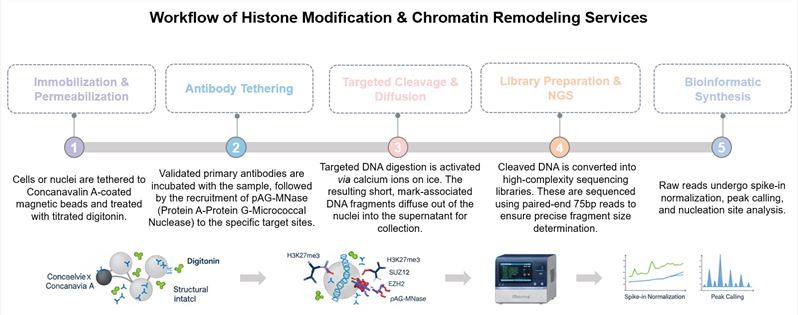
We provide a comprehensive, end-to-end solution that handles every stage from the initial preparation of cell components to advanced genomic sequencing and the final detailed interpretation of biological data.
Polycomb Repressive Complex 2 (PRC2) Mark Mapping Service
The PRC2 mark mapping service offered by Creative Biolabs constitutes an exhaustive analytical solution for investigators aiming to elucidate the intricate mechanisms governing polycomb-mediated epigenetic silencing. By delivering high-resolution, quantitative genomic profiles of H3K27me3 occupancy and PRC2 subunit distribution, the platform facilitates a rigorous interrogation of the chromatin landscape. Through strategic collaboration with Creative Biolabs, researchers leverage sophisticated methodologies designed to identify critical nucleation sites and transient allosteric activation states; such insights are instrumental for deepening the understanding of ligand-target interactions, identifying robust mechanism-of-action biomarkers, and streamlining the selection of preclinical leads through high-precision epigenetic characterization.
Introduction What We Can Offer Workflow Why Creative Biolabs Customer Reviews FAQs Related Services Contact Us
Decoding PRC2 Dynamics via Epigenomic Mapping Services
The polycomb repressive complex 2 (PRC2) acts as a specialized multi-protein holoenzyme responsible for depositing H3K27me3 marks, a critical epigenetic signature for gene silencing. Modern research highlights that PRC2 recruitment initiates at discrete nucleation sites and subsequently propagates through complex allosteric feedback mechanisms. By integrating these structural insights, Creative Biolabs' service facilitates a rigorous assessment of chromatin states. Our platform resolves the complex's dual-lobe architecture and characterizes its antagonism with remodeling complexes, enabling investigators to navigate epigenetic regulation with technical precision.
Prospective collaborators are invited to explore specialized support options - Request a Technical Consultation.
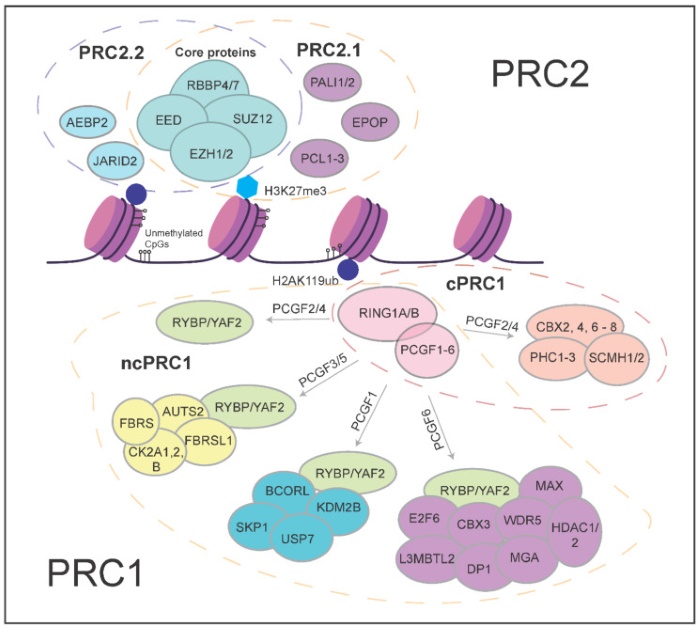 Fig.1 Schematic overview of PRC2 group proteins. 1
What We Can Offer
Integrated Epigenetic Mapping
Customized Protocol Development
Our team creates specialized experimental frameworks designed to accommodate highly specific sample types, ensuring that even rare cell populations or complex lab-grown tissues receive optimized and accurate processing.
Validated Allosteric Sensing Models
We utilize proprietary screening tools to observe how internal structural shifts regulate activity, which is vital for researchers testing innovative molecules that influence protein behavior through non-traditional binding sites.
Absolute Quantification Standards
By including reliable internal biological references, we enable the precise measurement of changes across different groups, ensuring that subtle variations in genomic marks are captured with high confidence.
PRC2 Mark Mapping Service at Creative Biolabs
Highlights
Integrated Structural Insight
Our organization leads the industry by combining deep structural biological knowledge with extensive screening capabilities, ensuring that every project benefits from a sophisticated understanding of complex molecular interactions and architectures.
Allosteric Activity Monitoring
Our proprietary platform is engineered to observe the dynamic structural shifts that drive gene suppression, specifically tracking how internal protein movements facilitate the expansive distribution of repressive marks across the genome.

Validated Antibody Performance
We distinguish ourselves from typical providers by offering extensive evidence for every biological tool we utilize, ensuring that the detection of genomic signatures is supported by rigorous and credible data.
Sophisticated Modeling Architecture
To ensure accurate interpretation of genomic data, we employ advanced structural models that account for the unique multi-lobed shape of the protein, providing a much clearer view of complex occupancy patterns.
To leverage the technical proficiencies of Creative Biolabs for your research objectives, we invite you to get a quote today.
Customer Reviews
-
Enhanced Target Validation
Using Creative Biolabs' PRC2 mark mapping service in our research has significantly facilitated the identification of off-target H3K27me3 gains during EZH2 inhibitor treatment, allowing us to refine our lead compound's specificity compared to standard alternatives. - Dr. A***n S. -
Resolution of Bivalent Domains
The ability to distinguish between poising and silencing using Creative Biolabs' spike-in normalized mapping significantly improved our understanding of stem cell differentiation. The precision in mapping broad domains was far superior to our previous in-house ChIP protocols. - Prof. M***e L.
FAQs
How does your service differentiate between different enzymatic activities?
We utilize subunit-specific mapping to distinguish between initial chemical modifications and subsequent structural changes in the genetic architecture, providing a holistic view of how gene suppression is successfully established and maintained.
Is your platform compatible with small research samples?
Yes, our optimized workflow is specifically engineered to handle very low input amounts, delivering exceptionally high-quality genomic results from limited cell populations typically found in specialized early-stage laboratory studies.
Related Services
Genome-scale In Vivo Screening Service
This service utilizes advanced high-throughput libraries to perform systematic genomic evaluations, identifying critical regulatory nodes and functional pathways that influence disease progression and therapeutic response in complex biological systems.
Learn More →DNA Epigenetic Therapeutic Development Service
This specialized service focuses on targeting modifications such as DNA methylation to develop novel therapeutic strategies, providing comprehensive preclinical support for identifying and validating small molecules that modulate gene expression patterns.
Learn More →How to Contact Us
Creative Biolabs offers a comprehensive structural and functional characterization of H3K27me3 occupancy. By elucidating de novo nucleation sites and quantifying allosteric propagation, the service provides the requisite biological intelligence to facilitate the advancement of epigenetic drug discovery programs.
Specialists remain available to provide comprehensive support regarding technical specifications and detailed project architecture. Please contact us.
Reference
- Loh, Chet H, and Gert Jan C Veenstra. "The Role of Polycomb Proteins in Cell Lineage Commitment and Embryonic Development." Epigenomes vol. 6,3 23. 12 Aug. 2022. Distributed under an Open Access license CC BY 4.0, without modification. https://doi.org/10.3390/epigenomes6030023
 Download our brochure
Loading case studies...
Online Inquiry