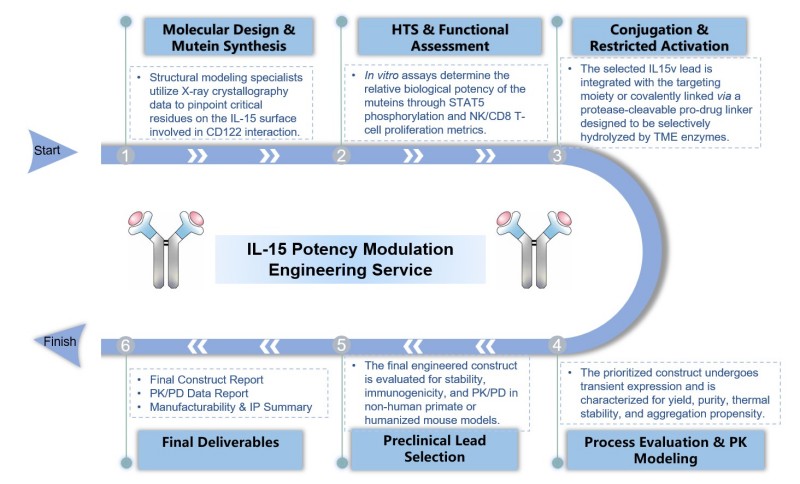
A comprehensive one-stop service is offered, encompassing the initial in silico design of the mutein and its integration with the client's preferred scaffold (Fc or scFv), thereby streamlining both upstream and downstream process development.
IL-15 Potency Modulation Engineering Service
Creative Biolabs provides custom-engineered IL-15 muteins and integrated fusion scaffolds that possess inherently superior molecular properties compared to first-generation cytokine assets. Clients can expect to gain a research molecule with a maximized potential therapeutic index, characterized by dramatically reduced systemic toxicity (CRS/vascular leak) and enhanced tumor-specific potency. Our complete deliverables package-including optimized sequences, expression vectors, full biophysical and in vitro potency data-lays the essential foundation for robust preclinical development.
Introduction What We Can Offer Workflow Why Creative Biolabs Customer Reviews FAQs Related Services Contact Us
Introduction of IL-15 Potency Modulation Engineering
IL-15 is a cytokine vital for NK and CD8+ T cell survival and proliferation, making it a powerful tool for cancer immunotherapy research. However, its therapeutic application is hampered by a short half-life and severe systemic toxicity arising from non-specific immune activation. Creative Biolabs' IL-15 potency modulation engineering service solves this by employing rational design-specifically, affinity-modulating muteins and targeted fusion scaffolds-to optimize the molecule's activity. This approach is validated by successful preclinical programs like N-803 and P22339, ensuring the development of potent yet safe bioconstructs.
To explore collaborative opportunities, a consultation may be requested.
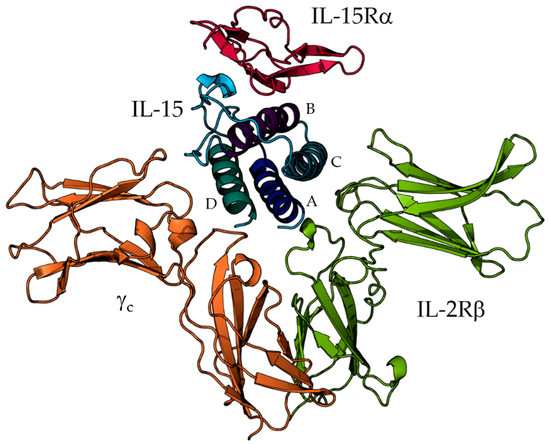 Fig.1 Structure of IL-15 in the full (IL-15/IL-15Rα/IL-2Rβ/γc) form. 1
What We Can Offer
Integrated Fusion Design
Guaranteed Mutein Stability and Purity
The process incorporates rigorous, well-established quality-by-design (QbD) principles and sophisticated quality control instrumentation to ensure the stability of the engineered protein and the requisite purity of the resulting gram-scale material.
Flexible Manufacturing Options
Protein expression and purification procedures are executed in batch, fed-batch, or continuous mode, allowing for the optimization of culture parameters to maximize the yield of the specific, complex fusion protein.
Development Documentation
All associated documentation and operational procedures, including those concerning strain origin and cell bank stability, undergo stringent assessment and approval by a qualified quality assurance service, generating essential data for subsequent regulatory submission preparation.
IL-15 Potency Modulation Engineering Service at Creative Biolabs
Why Choose Us?
| Core Advantages | Unique Features |
|---|---|
| Mechanism-Driven Potency Tuning | The methodology avoids merely masking IL-15; rather, it actively reduces its affinity for the off-target CD122 receptor via precise mutein design, ensuring systemic deactivation while preserving TME potency. |
| Integrated Scaffold Design | IL-15 variants are expertly integrated into Fc fusions, NK cell engagers, or TAA-targeting antibodies, leveraging two decades of protein engineering experience. |
| Superior Safety Profiles | The ability to design a pro-drug (Pro-C) mechanism offers a safety profile unmatched by first-generation, systemically active superagonists. |
To leverage the Creative Biolabs advantage, please request a formal quotation.
Customer Reviews
-
Maximized Therapeutic Index
Utilization of Creative Biolabs' IL-15 potency modulation engineering service in our research has significantly improved the safety profile of our lead molecule by strategically reducing CD122 affinity, enabling the attainment of a substantially higher therapeutic dose window than previously considered possible. - J. L*en -
Robust Immunocytokine Design
The integration of the IL-15 mutein into our scFv-Fc construct was executed seamlessly. Creative Biolabs' rational design for the linker and fusion sites dramatically expedited the downstream biophysical analysis and scale-up, resulting in a time saving of at least four months of optimization. - S. P*en.
FAQs
Q: Can you integrate the IL-15 mutein into my existing antibody or TAA-targeting scFv?
A: Affirmatively. The cell-specific cytokine delivery (CSCD) platform is purpose-built to address this specific requirement. Optimized linkers and fusion sites are designed to ensure the antibody maintains full target binding while the engineered IL-15 retains its superagonist function. This dual-targeting methodology offers superior tumor selectivity.
Q: What is the advantage of a pro-drug cytokine activation strategy?
A: The Pro-C strategy affords the highest available safety margin. By ensuring the IL-15 remains inactive until it is specifically cleaved by TME-resident proteases (e.g., MMPs), near-zero systemic toxicity is guaranteed. This conditional activation constitutes a superior safeguard for programs demanding aggressive, high-potency dosing.
Related Services
Biophysical Characterization
Comprehensive structural and functional analysis using state-of-the-art platforms to confirm construct homogeneity, thermal stability, aggregation propensity, and kinetic binding affinities for all receptor subunits.
Learn More →scFv Generation and Optimization
Our platform for generating high-affinity single-chain variable fragments (scFv) for integration into the IL-15 Immunocytokine targeting moiety.
Learn More →How to Contact Us
By leveraging strategies that include potency reduction, Rα fusion, and tumor targeting, Creative Biolabs enables the development of powerful NK and CD8+ T cell research assets with a significantly improved therapeutic index, validated by leading industry research. To discuss your specific immunotherapy project, including TAA selection, affinity targets, and research development strategy, please reach out to our team.
Reference
- Sousa, Rui P et al. "Mechanistic and Structural Insights on the IL-15 System through Molecular Dynamics Simulations." Molecules (Basel, Switzerland) vol. 24,18 3261. 6 Sep. 2019. Distributed under an Open Access license CC BY 4.0, without modification. https://doi.org/10.3390/molecules24183261
 Download our brochure
Loading case studies...
Online Inquiry