We utilize highly promiscuous biotinylation enzymes to capture transient or low-affinity co-repressors, overcoming the major limitation of conventional pull-down methods and uncovering genuinely novel research targets.
MBD/MeCP2 mediated Repression Complex Mapping Service
Creative Biolabs constitutes a definitive methodological approach for the resolution of complexity inherent in methylation-mediated gene silencing mechanisms. We deliver an unparalleled, unbiased identification of the entire protein complex recruited by Methyl-CpG-Binding Domain (MBD) proteins, such as MeCP2. Consequently, clients are positioned to obtain novel, high-confidence protein targets and the requisite mechanistic data necessary for distinguishing between normal and pathologically altered regulatory states, thereby significantly accelerating the initial phases of specific research compound development.
Introduction What We Can Offer Workflow Why Creative Biolabs Customer Reviews FAQs Related Services Contact Us
Introduction of MBD/MeCP2-Mediated Repression Complex Mapping Service
DNA methylation at CpG dinucleotides is a fundamental mechanism of transcriptional silencing, primarily mediated by MBD proteins, such as MeCP2. This methodology addresses the challenge presented by the methylation mark's complexity, which arises from up to fifteen chemical combinations due to TET enzyme activity. The service yields an unbiased, high-resolution inventory of the corepressor complexes recruited by these MBD proteins, thereby advancing epigenetic profiling toward definitive mechanistic discovery.
For an in-depth analysis of how our services can be tailored to your specific project needs, request a consultation.
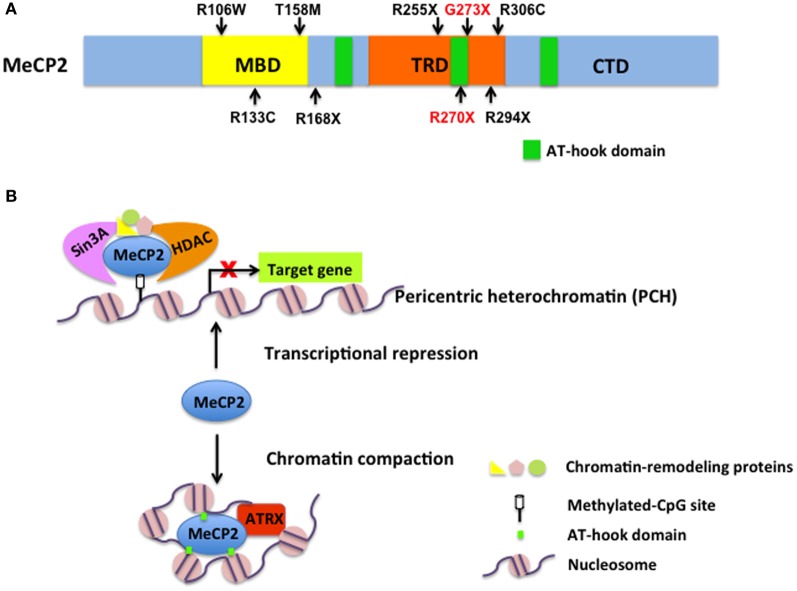 Fig.1 MeCP2 structure and function in gene regulation and chromatin remodeling. 1
What We Can Offer
Unbiased Discovery of Transient Partners
Resolution of Complex Epigenetic States
Our protocols are optimized to address the challenge of differential binding across the fifteen possible combinations of modified CpGs, ensuring accurate read-out of the full regulatory landscape.
Tailored Cell Model Development
We provide full support for custom cell model engineering, including the development of stable or inducible cell lines with MBD gene tagging in client-provided or commercial cell backgrounds.
Locus-Specific Data Validation
We offer optional service extensions to validate protein occupancy at multiple, specific genomic loci of interest (e.g., specific promoter regions, enhancer elements), confirming locus-specific complex composition.
MBD/MeCP2 mediated Repression Complex Mapping Service at Creative Biolabs
Highlights
Novel Methodological Integration
The service represents a sophisticated convergence of distinct technologies, transcending mere incremental changes to established protocols. This novel integration is specifically engineered to address and surpass inherent deficiencies observed in traditional epigenetic analytical methods.
Overcoming Analytical Limitations
By design, the platform rigorously addresses the historical constraints of classic epigenetic analysis, which often fails to capture transient or complex molecular interactions. This systematic approach ensures the comprehensive discovery of relevant biological mechanisms.

Guaranteed High-Resolution Data
A foundational commitment to producing data of exceptionally high fidelity and resolution underpins the entire service delivery. This precise molecular mapping is essential for establishing robust and statistically reliable findings in complex biological systems.
Strategic Research Confidence
The provision of highly validated, granular mechanistic data empowers critical, high-stakes research and development decision-making processes. This level of confidence is indispensable for the precise prioritization of early-stage therapeutic research candidates.
To fully understand the Creative Biolabs advantage, we invite you to get a quote today.
Customer Reviews
-
MeCP2 Mutant Validation
The high-resolution mapping facilitated our MeCP2 mutant study by providing molecular evidence of altered interaction profiles. This was crucial for our grant application, as the data directly supported the hypothesis that RTT mechanisms stem from a shift in MeCP2's ability to "read" the diverse modified CpG landscape, moving beyond simple loss-of-function models. - Dr. A. P. Ja***nes -
Locus-Specific Specificity
We used this service to map the MBD1 complex at two different promoter sites. The results clearly showed that the recruited complex components were locus-specific, confirming the power of the in situ proximity labeling approach to differentiate complex composition at the single-gene level. This is a clear advantage over bulk protein interaction studies. - Prof. B. M. Da***son.
FAQs
Can this service differentiate between wild-type and research-associated MeCP2 mutants?
Yes. Research shows that MeCP2 mutants exhibit altered binding profiles for specific modified CpG combinations. Our PL-MS approach is sensitive enough to detect how these mutations change the pattern of recruited co-repressors, providing molecular targets for research to selectively inhibit the altered function of the mutant protein.
What type of samples can Creative Biolabs accept for this mapping service?
We accept a wide range of samples, including primary cell cultures and established cell lines (with stable or inducible tagging options). We can optimize for low cell counts typical of complex biological models. The main requirement is high-quality input DNA and/or a viable cell model for genetic tagging.
Related Services
Whole-Genome/Reduced-Representation DNA Methylation Mapping
Provides the gold standard, single-base resolution map of your entire methylome. Use this to identify the initial set of differentially methylated regions (DMRs) that your MBD complex mapping service will then investigate mechanistically.
Learn More →DNA Epigenetic Modification targeting Therapeutic Development
We utilize sophisticated animal models and primary patient-derived xenografts to rigorously assess the in vivo efficacy, pharmacokinetics, and safety of novel small molecules targeting MBD-complex components identified by our service.
Learn More →How to Contact Us
Creative Biolabs delivers the definitive molecular blueprint of gene silencing, thereby facilitating the transition of research from correlative observation to mechanistic causation. This capability, underpinned by two decades of epigenetic specialization, is instrumental in accelerating the therapeutic research pipeline. The engagement of our expert team is invited for further inquiries and detailed project consultation. Please contact us.
Reference
- Xu, Xin, and Lucas Pozzo-Miller. "A novel DNA-binding feature of MeCP2 contributes to Rett syndrome." Frontiers in cellular neuroscience vol. 7 64. 9 May. 2013. Distributed under an Open Access license CC BY 4.0, without modification. https://doi.org/10.3389/fncel.2013.00064
 Download our brochure
Loading case studies...
Online Inquiry