Signature attribution is performed using rigorously tested computational approaches designed to minimize overfitting and false-positive assignments.
Mutational Signature Attribution Analysis Service
Creative Biolabs' mutational signature attribution analysis service helps you accurately quantify and interpret mutational signatures through validated computational frameworks, benchmark-aware attribution strategies, and biology-oriented interpretation, enabling clearer insight into genome evolution and research-driven decision-making in oncology.
Overview What We Can Offer Workflow Required Materials Highlights Publication Customer Reviews FAQs Related Services
Overview
Cancer genomes accumulate mutations from diverse endogenous and exogenous processes, each leaving characteristic mutational signatures. Advances in large-scale sequencing have enabled the definition of reference signature catalogs, while attribution methods quantify the contribution of each signature within individual samples. Recent research highlights that accurate attribution depends on method selection, mutation burden, and context-aware interpretation. Creative Biolabs integrates robust attribution workflows with quality safeguards to support reliable, research-focused mutational signature analysis. Creative Biolabs applies a benchmark-aware and context-driven strategy to ensure accurate and interpretable mutational signature attribution.
Validated Attribution Frameworks
Multi-Mutation Class Support
Single base substitutions, doublet substitutions, and small insertion–deletion patterns are analyzed to capture diverse mutational processes.
Catalog-Aware Safeguards
Reference signature selection and filtering are carefully managed to reduce misattribution from incomplete or inappropriate catalogs.
Confidence and Robustness Evaluation
Attribution stability and uncertainty are assessed to support confident biological interpretation.
Accelerate Innovation with Creative Biolabs – Start Your Consultation Today
What We Can Offer
Comprehensive Mutational Signature Attribution
Accurate quantification of mutational signature activities within individual samples using validated, benchmark-aware attribution workflows.
Multi-Class Mutation Analysis
Integrated analysis of single base substitutions, doublet substitutions, and small insertion–deletion patterns to capture a broader range of mutational processes.
Quality-Controlled Attribution Framework
Implementation of mutation-count thresholds, catalog filtering, and consistency checks to reduce spurious or overfitted signature assignments.
Sample- and Cohort-Level Comparison
Standardized outputs that enable robust comparison of signature activities across samples, experimental conditions, and research cohorts.
Workflow
Project Consultation and Objective Alignment
Research goals, sample context, and mutation data type are reviewed to define an appropriate attribution strategy.
Data Intake and Quality Assessment
Mutation catalogs are evaluated for coverage, mutation count, and suitability for attribution analysis.
Reference Signature Selection
Relevant signature catalogs are selected and curated based on tumor context and study design.
Signature Attribution and Quantification
Validated computational methods are applied to estimate signature activities per sample.
Robustness and Consistency Evaluation
Attribution stability is assessed to identify reliable versus uncertain signature contributions.
Comparative and Contextual Analysis
Signature activities are compared across samples and interpreted alongside genome instability features.
Required Starting Materials
- Somatic mutation lists derived from sequencing data.
- Sample metadata such as tumor type or experimental condition.
- Defined research objectives related to mutational processes or genome evolution
Highlights
Benchmark-Aware Signature Attribution
Our workflows incorporate insights from large-scale benchmarking studies to enhance attribution accuracy and reduce methodological bias.
Context-Driven Interpretation
Signature activities are interpreted within tumor type, mutation burden, and genome instability context rather than treated as isolated numerical results.

Support for Multiple Mutation Classes
Analysis extends beyond single base substitutions, enabling a more comprehensive view of mutational processes shaping cancer genomes.
Robust Comparative Utility
Standardized and reproducible outputs support reliable comparison across samples, conditions, and cohorts.
Discover the Creative Biolabs Advantage – Contact Us for a Customized Quote
Publication
Homologous recombination defect–associated mutational signatures illustrate how impaired DNA repair processes shape cancer genomes across pediatric malignancies. Increased activity of these signatures reflects the accumulation of characteristic mutation patterns arising from compromised repair of DNA double-strand breaks. The distribution and intensity of homologous recombination–related signatures vary among cancer types, underscoring disease-specific differences in repair pathway disruption and genome maintenance capacity. This variability indicates that homologous recombination defects represent distinct molecular states influenced by tumor lineage and developmental context. Profiling the activity of these signatures enables deeper understanding of how DNA repair deficiencies contribute to mutation burden, genome instability, and tumor evolution. By quantitatively linking mutational patterns to underlying repair defects, homologous recombination signature analysis provides a robust framework for investigating genome maintenance mechanisms in cancer biology.
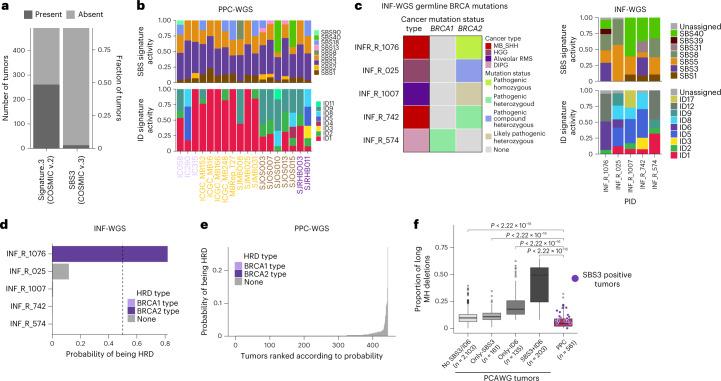 Fig.1 Homologous recombination defect signatures activity in pediatric cancers. 1
Customer Reviews
- Improved clarity of mutational processes using Creative Biolabs' mutational signature attribution analysis service has significantly facilitated our tumor evolution studies. -Ongoing research, Lin*** Moore.
- Reliable signature quantification using Creative Biolabs' mutational signature attribution analysis service has strengthened confidence in our comparative genomics analyses. -Long-term collaboration, Ste*** Nguyen.
- Context-aware signature interpretation using Creative Biolabs' mutational signature attribution analysis service has improved hypothesis generation in our cancer genome projects. -Multi-project usage, Dav*** Allen.
FAQs
Can this service identify which mutational processes are active in a tumor sample?
Yes, signature attribution quantifies the contribution of known mutational processes within individual samples.
Is the analysis reliable for samples with low mutation counts?
Quality thresholds are applied, and limitations are clearly reported to avoid over-interpretation.
Can results be compared across different cancer types?
Yes, standardized outputs support comparison when interpreted in an appropriate biological context.
Related Services
Telomere Dysfunction & ALT Mechanism Profiling Service
A dedicated service for analyzing telomere maintenance abnormalities and alternative lengthening mechanisms contributing to chromosomal instability and tumor cell persistence.
Learn More →Phenotypic Consequence Mapping Service
A functional analysis service that correlates genomic instability features with cellular phenotypes to support mechanism-driven oncology research.
Learn More →Creative Biolabs' mutational signature attribution analysis service provides a rigorous and interpretable framework for understanding the mutational processes shaping cancer genomes. By combining validated attribution methods with context-aware interpretation, we help researchers extract meaningful biological insight from complex mutation data.
Contact our team to discuss how mutational signature attribution analysis can support your research objectives.
Reference
- Thatikonda, Venu et al. "Comprehensive analysis of mutational signatures reveals distinct patterns and molecular processes across 27 pediatric cancers." Nature cancer vol. 4,2 (2023): 276-289. Distributed under Open Access license CC BY 4.0, without modification. https://doi.org/10.1038/s43018-022-00509-4
 Download our brochure
Loading case studies...
Online Inquiry