We profile heterogeneous tumor cell populations to identify co-existing cellular states that may contribute differently to survival and treatment response.
Phenotypic Consequence Mapping Service for Tumor Evolution & Therapy Resistance
Creative Biolabs' phenotypic consequence mapping service for tumor evolution & therapy resistance enables you to identify evolving cellular states, resistance-driving trajectories, and adaptive fitness advantages through integrated single-cell phenotyping, controlled perturbation strategies, and evolutionary trajectory analysis.
Overview What We Can Offer Workflow Required Materials Highlights Publication Customer Reviews FAQs Related Services
Overview
Tumor evolution and therapy resistance are now recognized as dynamic, state-driven processes shaped by phenotypic plasticity and selective pressure. Accumulating evidence shows that non-genetic adaptation, transient drug-tolerant states, and reversible phenotypic programs frequently precede stable resistance. Phenotypic consequence mapping provides a systematic framework to connect these evolving cellular states with treatment outcomes, strengthening mechanistic understanding and improving translational decision-making. Our phenotypic consequence mapping strategy is designed to systematically capture how tumors adapt under therapeutic pressure and translate these dynamics into actionable insights. It is built around the following core components:
Capturing Phenotypic Diversity
Tracking State Transitions
By analyzing temporal changes, we map how cells shift between phenotypic states during treatment, revealing adaptive trajectories linked to resistance.
Distinguishing Plasticity from Stability
Our approach differentiates transient, reversible adaptive responses from stable resistant phenotypes, helping prioritize biologically meaningful targets.
Linking Phenotype to Fitness
We connect phenotypic states with survival, persistence, and competitive advantage to determine which adaptations truly drive resistance.
Accelerate Innovation with Creative Biolabs – Start Your Consultation Today
What We Can Offer
Integrated Experimental Design
We develop customized study designs that align tumor models, treatment conditions, and phenotypic readouts with your specific scientific and therapeutic objectives, ensuring relevance at every stage.
High-Resolution Phenotypic Profiling
Our service delivers detailed phenotypic data that captures cellular heterogeneity, adaptive responses, and dynamic state changes across multiple treatment timepoints.
Evolutionary Trajectory Analysis
We reconstruct adaptive and selective pathways to reveal how resistant populations emerge, expand, and dominate under sustained therapeutic pressure.
Workflow
Model Preparation & Baseline Profiling
Tumor cell lines, organoids, or primary samples are profiled to establish baseline heterogeneity, cellular states, and adaptive potential.
Treatment Perturbation & Stress Modeling
Therapeutic agents or environmental stressors are applied under controlled conditions to simulate clinically relevant selection pressures.
Single-Cell Phenotypic Profiling
High-resolution phenotypic data are collected across multiple timepoints, capturing state diversity, transitions, and adaptive responses.
Lineage & State Transition Analysis
Cellular trajectories and expansion patterns are reconstructed to associate phenotypic changes with survival, persistence, and competitive fitness.
Consequence Mapping & Interpretation
Adaptive states are systematically linked to resistance outcomes, highlighting key phenotypic drivers and potential intervention points.
Required Starting Materials
- Defined tumor model, such as an established cancer cell line, patient-derived organoid, or xenograft-derived cells
- Information on therapeutic agents, dosing strategies, or treatment sequences to be evaluated
- Clear research objectives, for example, resistance mechanism identification or therapy optimization
Highlights
Dynamic Resistance Insight
We uncover early adaptive states and transition pathways that often arise before overt resistance is detectable, supporting proactive intervention strategies.
Translational Relevance
Our outputs are structured to directly inform drug discovery, combination therapy development, and resistance mitigation programs.

Flexible Study Architecture
The service accommodates diverse tumor models, therapeutic modalities, and research phases, maintaining consistency and data quality across projects.
Clear, Interpretable Deliverables
Clients receive structured reports with intuitive visualizations, biological interpretation, and strategic recommendations rather than unprocessed datasets.
Discover the Creative Biolabs Advantage – Contact Us for a Customized Quote
Publication
Genes-first and phenotypes-first resistance frameworks illustrate why phenotypic consequence mapping is critical in hematological malignancies. BTK inhibitor failure can emerge through multiple evolutionary routes, including selection of pre-existing pathway mutations, expansion of non-genetic adaptive states such as signaling rewiring or metabolic shifts, or a combined path where phenotypic reservoirs enable subsequent genetic fixation. Phenotypic consequence mapping links these routes to measurable cell-state features by tracking adaptive phenotypes over time and associating them with survival advantage. This approach reveals vulnerabilities that mutation-focused analyses often miss, including state-dependent pathways and compensatory programs. By capturing early adaptive reservoirs before stable resistance dominates, it supports rational combination strategies, informed treatment sequencing, and biomarker development that reflects tumor evolution rather than static endpoints.
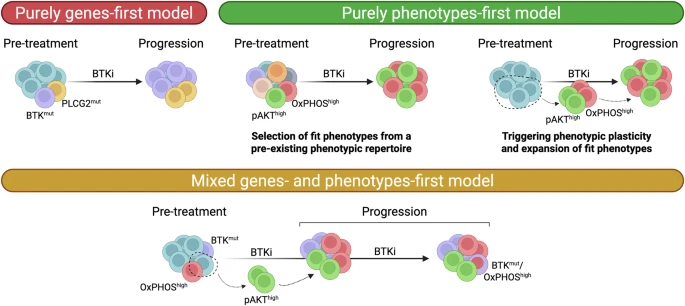 Fig.1 Molecular mechanisms of resistance to BTK inhibitors in blood cancers follow three distinct pathways. 1
Customer Reviews
-
Uncovering Drug-Tolerant States
Using Creative Biolabs' phenotypic consequence mapping service for tumor evolution & therapy resistance in our research has significantly improved our understanding of transient drug-tolerant populations that were previously undetectable with standard assays. -20 months, Dav*** -
Early Resistance Detection
Using Creative Biolabs' phenotypic consequence mapping service for tumor evolution & therapy resistance in our research has facilitated early identification of adaptive trajectories that later dominated resistant populations, allowing earlier intervention planning. -2.5 years, Lin***
FAQs
What types of tumor models are compatible with this service?
The service supports commonly used cancer cell lines, patient-derived organoids, and other relevant preclinical tumor models.
Can this service identify resistance without genetic mutations?
Yes, it is particularly effective at revealing non-genetic adaptive states and phenotypic programs that contribute to resistance.
Is this approach suitable for evaluating sequential or combination therapies?
Yes, phenotypic consequence mapping is well-suited for studying how different treatment sequences influence adaptive trajectories.
How actionable are the results for therapeutic development teams?
Results are delivered with clear biological interpretation, enabling teams to translate findings into testable hypotheses and development strategies.
Related Services
Telomere Dysfunction & ALT Mechanism Profiling Service
A dedicated service for analyzing telomere maintenance abnormalities and alternative lengthening mechanisms contributing to chromosomal instability and tumor cell persistence.
Learn More →Mutational Signature Attribution Analysis Service
An interpretive service that links observed mutation patterns to underlying biological processes and mutagenic mechanisms shaping cancer genome evolution.
Learn More →Creative Biolabs delivers integrated solutions centered on the phenotypic consequence mapping service for tumor evolution & therapy Resistance, helping researchers anticipate tumor adaptation and design more durable therapeutic strategies.
Contact our team to discuss how phenotypic consequence mapping can help you anticipate tumor evolution, identify resistance-driving cellular states, and design therapeutic strategies with improved long-term durability.
Reference
- Tamellini, Edoardo et al. "Genes-first and phenotypes-first paths to treatment resistance in hematological malignancies." Cell death & disease vol. 16,1 819. 10 Nov. 2025. Distributed under Open Access license CC BY 4.0, without modification. https://doi.org/10.1038/s41419-025-08127-5
 Download our brochure
Loading case studies...
Online Inquiry