Polygenic Risk Score-Environment Interaction Analysis Service
Creative Biolabs' service transforms static genetic predictions into dynamic, systems-level actionable insights. We dismantle limitations in legacy polygenic risk score (PRS) models by accurately capturing how specific environmental exposure factors (E) significantly amplify or mitigate underlying PRS predisposition to a specific phenotype. Our clients receive highly granular, statistically validated prediction models that support critical strategic decisions in target molecule validation and complex phenotype optimization, ensuring resources are targeted to the sub-population segments most likely to show a desired intervention response.
The Critical Flaw in Legacy PRS Modeling
Traditional PRS assume fixed genetic risk, often leading to underpowered prediction models when interaction terms are simply added. The core statistical limitations encountered include the cancellation of effects, where antagonistic and synergistic interactions within the PRS mask true biological signals. Furthermore, missing interaction-only loci—variants with powerful interaction effects but negligible main effects—are filtered out, causing significant information loss. Finally, dilution of signal occurs because using an overall PRS includes many irrelevant variants, substantially weakening the statistical power to detect true polygenic risk score-environment (PRS-E) interaction signals. This results in inaccurate risk stratification and wasted resources.
Specific Deliverables & Solutions
Stratified Target Molecule Identification
Our analysis pinpoints specific subject sub-populations where a genetic pathway's effect is significantly amplified or silenced by a known environmental exposure, providing validated functional targets for precision intervention and optimized resource allocation.
Intervention Efficacy Optimization
We enable the stratification of study subjects into defined "high-response" and "low-response" groups based on their interaction PRS (iPRS)/pathway PRS (pPRS) scores and their exposure profile, which leads directly to higher efficacy endpoints and reduced study costs.
Systemic Optimization Strategy
We develop highly granular, environmentally aware phenotype prediction models that can advise on targeted environmental modifications (e.g., changes in nutrient concentration, specific compound removal) to effectively mitigate specific pPRS-related risks or optimize desired traits.
Contact Creative Biolabs today to explore a tailored strategy for maximizing your predictive models.
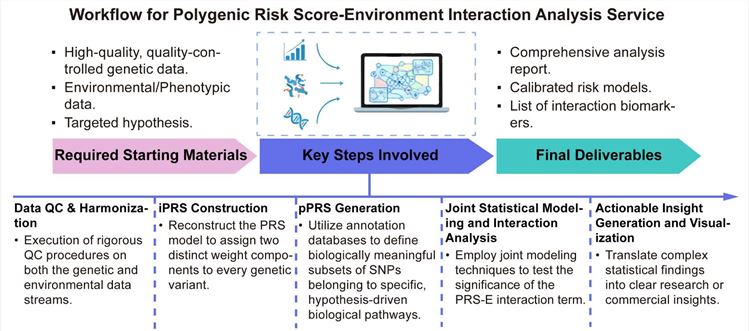
Workflow: From Raw Data to Actionable Risk Model
Our comprehensive workflow is designed to be statistically rigorous, providing clients with full clarity and transparency throughout the PRS-E analysis process. We ensure the transition from raw data to a final, actionable prediction model is efficient and fully documented.
Publication
This study introduces pPRS to improve detection of gene-environment interactions. By focusing on biologically relevant SNPs, pPRS offers greater power than standard PRS. In a colorectal cancer analysis, a significant pPRS × NSAIDs interaction was found within the TGF-β/GRHR pathway, revealing stronger protective effects for individuals with high genetic risk. This approach enhances biological insight and supports precision prevention strategies.
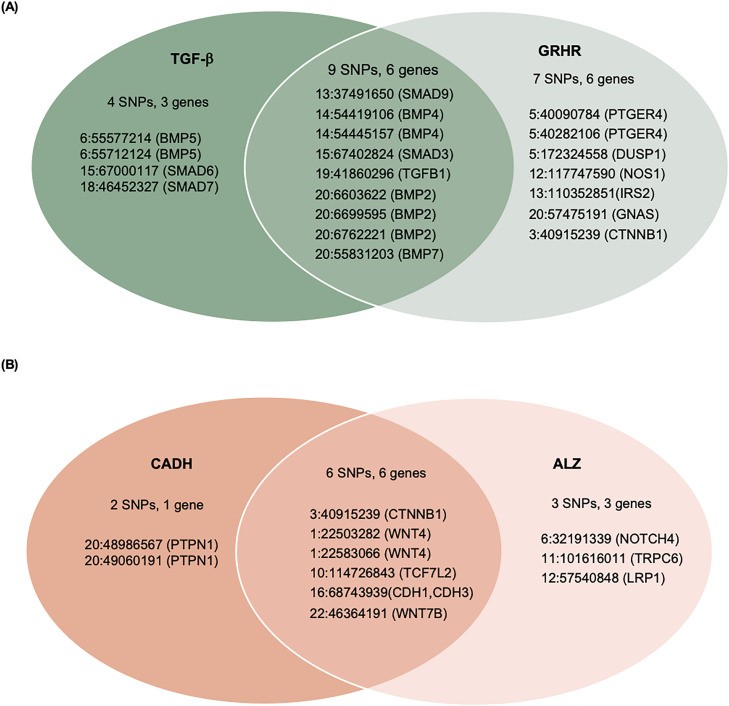 Fig.1 CRC-associated SNPs are enriched in specific pathways. 1
Why Choose Us?
Creative Biolabs is the industry leader in high-dimensional risk modeling, solving the statistical and biological problems that undermine standard PRS analysis. Our proprietary dual-strategy approach guarantees the highest achievable statistical power and biological relevance. We specialize in the critical integration of complex systemic exposure metrics (SEM), enabling robust models optimized for diverse biological systems. This includes the combined power of iPRS (for statistical rigor against opposing genetic effects) and pPRS (for maximum biological power against specific pathways), ensuring a comprehensive view of G × E interactions. Furthermore, we leverage advanced joint modeling techniques to accurately account for gene-environment correlation (GE), a confounding factor that simplistic PRS models fail to address.
This unique combination of expertise sets your project up for success. To understand how our proprietary methodology can refine your next large-scale intervention study, schedule a technical discussion today.
FAQs
Why can't I just use a standard PRS model and add an interaction term myself?
Standard PRS models suffer from cancellation of effects due to additive variant assumptions. Our proprietary iPRS method overcomes this by weighting variants on both main and interaction effects, delivering significantly higher statistical power for G × E analysis.
Is your service only compatible with common phenotypes or can it be used for rare traits?
The pPRS maximizes signal-to-noise ratio by focusing on a small subset of biologically relevant genes/pathways, significantly increasing power to detect G × E interactions, especially in rare traits or smaller cohorts.
How do you handle complex or highly variable environmental data like SEM?
We expertly handle high-dimensional, correlated data using robust imputation and advanced joint modeling (e.g., logistic-normal regression) to accurately integrate SEM indices, ensuring unbiased PRS × SEM interaction effects.
Customer Review
-
Pathway-Specific Insight
The targeted pPRS approach cut through the statistical noise of the overall genetic risk score, revealing a highly significant interaction with irradiation exposure that was completely masked in our previous, bulk analysis model. - Chr*** L -
Superior Risk Stratification
The iPRS provided much sharper risk curves than our traditional PRS, especially when accounting for years of high exposure to system stressors, allowing us to focus our limited resources much more effectively. – Sam*** Z
Related Services
To fully leverage the power of your genomic data and accelerate your precision modeling initiatives, Creative Biolabs offers several complementary services that integrate seamlessly with the PRS-E analysis:
Multi-omic Analyses
Multi-omics is an effective approach for understanding the complex flow of molecular information in gut microbiota-host interactions.
Learn More →Target Discovery & Validation Services
Creative Biolabs offers target discovery and validation services combining genomics and cell analysis to quickly identify novel and established therapeutic agents (proteins, nucleic acids, lipids) in various biological matrices for diseases like cancer.
Learn More →How to Contact Creative Biolabs
Our expert team of statistical geneticists and bioinformaticians is ready to analyze your cohort data and unlock the hidden, actionable insights buried within the gene-environment interplay. We look forward to discussing your project's unique requirements.
Contact Our Team for More Information and to Discuss Your Project.
Reference
- Gauderman, W. J., et al. "Pathway polygenic risk scores (pPRS) for the analysis of gene-environment interaction." PLoS Genet 21.8 (2025): e1011543. Distributed under Open Access license CC BY 4.0, without modification. https://doi.org/10.1371/journal.pgen.1011543
 Download our brochure