Radiation & UV induced Damage Detection Service
Genotoxicity testing requires more than simple damage quantification; it demands a clear understanding of the cellular fate governed by the DNA damage response (DDR). Creative Biolabs' comprehensive service delivers the mechanistic insights necessary for confident regulatory filings, providing data that moves beyond basic endpoints to assess kinetics, dosage dependency, and pathway engagement. Our approach is designed to resolve ambiguities and provide a holistic safety profile for novel compounds and cosmetic ingredients.
The Complex Threat: Understanding Genomic Lesions
Radiation damage is not monolithic, manifesting as distinct cytotoxic lesions requiring specialized detection. UV-induced photoproducts—the signature of sunlight damage—include highly prevalent cyclobutane-pyrimidine dimers (CPDs) and the more structurally distorting 6-4 photoproducts (6-4PPs). We use quantitative PCR and immunoassays for precise quantification of these nucleotide excision repair (NER) pathway challenges, alongside measuring reactive oxygen species (ROS)-induced secondary damage like 8-hydroxy-2'-deoxyguanosine (8-OHdG). For ionizing radiation (IR) damage, our focus is on quantifying the highly mutagenic, acute genomic catastrophes: DNA double-strand breaks (DSBs), often via γ-H2AX foci analysis, and DNA single-strand breaks (SSBs).
Specific Deliverables and Predictive Solutions
We provide actionable intelligence across three critical dimensions:
Quantifying Damage and Repair Kinetics
We use highly sensitive assays to differentiate and quantify lesions: CPDs, 6-4PPs (UV damage), 8-OHdG (oxidative stress), and DSBs (IR damage, via γ-H2AX foci). We track the decay rate, providing t1/2 repair kinetic data to assess repair efficacy.
Mapping the Mechanistic DDR Cascade
Our protocols analyze the phosphorylation and localization of key checkpoint kinases (ATM, ATR) to map the entire DDR signaling cascade. This deep profiling clarifies the mode of action for potential radio-sensitizers or radioprotectants.
Predicting the Downstream Cell Fate
We link the DDR signature to the ultimate cellular outcomes (survival, apoptosis, senescence, or differentiation) using flow cytometry and high-content imaging. This predictive analysis distinguishes between safe and undesirable cytotoxic responses for the preclinical context.
Ready to move beyond basic genotoxicity screening? Discover the depth of mechanistic insight Creative Biolabs can deliver for your project - Request a consultation today.
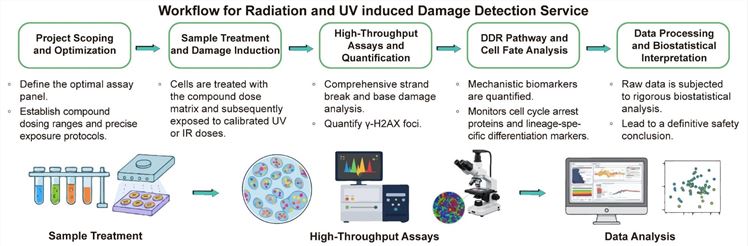
Workflow: Precision Steps for Definitive Genotoxicity Data
We provide a clear, efficient, and reproducible path from sample submission to final data interpretation, designed to integrate seamlessly with your development timeline and guarantee actionable results.
Publication
This study introduces a novel approach for detecting radiation-induced DNA damage using circular dichroism spectroscopy of cholesteric liquid-crystalline DNA dispersions (CLCD). It compares two irradiation strategies: exposing DNA before CLCD formation versus irradiating pre-assembled CLCD. The former method amplifies the optical signal, increasing sensitivity by over two orders of magnitude and enabling precise dosimetry across a wide dose range. This technique offers a sensitive tool for both radiation dose measurement and assessment of DNA integrity.
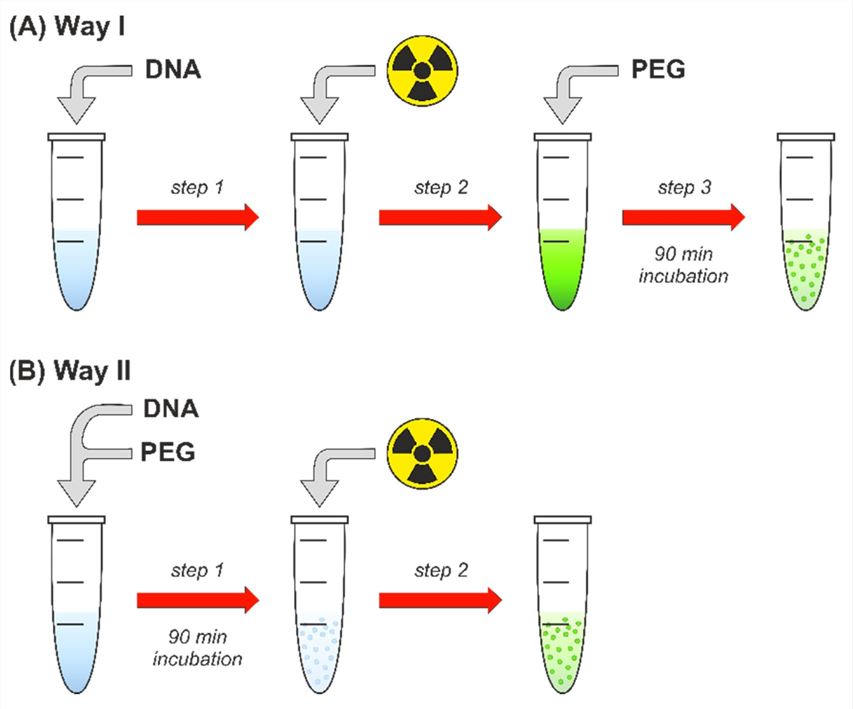 Fig.1 Schematic representation of the study framework for assessing radiation exposure. 1
Why Choose Us?
Creative Biolabs sets the benchmark for genomic safety assessment by integrating advanced micro-engineering and deep molecular biology. Our commitment to high-throughput screening (HTS) and mechanistic analysis maximizes predictive power. Key advantages include unprecedented reproducibility via the microfluidics platform, which drastically reduces assay variability, yielding high-fidelity data for regulatory submissions. We provide essential mechanistic clarity on cell fate, linking DDR activation to outcomes (senescence, apoptosis) to inform drug mechanism of action (MOA) and go/no-go decisions. Our optimized HTS efficiency, utilizing automated multi-color flow cytometry, accelerates the cost-effective screening of large compound libraries.
Experience the Creative Biolabs Advantage and secure your genomic integrity data - Get a Quote Today to initiate your project.
FAQs
Can you assist with the interpretation of DNA damage results in the context of cellular differentiation?
Yes. A key advantage of our service is the ability to link DDR activation to specific cellular fate decisions. We use multi-parameter analysis to see if the DDR response leads to growth arrest, apoptosis, or, critically, whether it forces the cells into a differentiation pathway.
What factors most influence the estimated timeframe for a DNA damage detection project?
The two main factors are the complexity of the repair kinetics requested, and the total number of lesion types required. The timeframe is reduced for simple, single-endpoint genotoxicity screening.
Which specific lesions can you differentiate and quantify for UV damage?
We provide gold-standard assays to quantify the two primary UV photoproducts: CPDs and 6-4PPs, using high-sensitivity ELISA or QPCR-based methods. We also quantify 8-OHdG, the key biomarker for oxidative damage often induced by UV-A exposure.
Customer Review
-
High Reproducibility
The results were exceptionally reproducible across multiple batches, something we struggled with using traditional gels. The repair kinetics they provided were instrumental for our lead compound selection. - Dr. Le*Ar -
Mechanistic Insight
We needed to know if our compound induced apoptosis or differentiation after IR. Creative Biolabs' multi-parameter flow cytometry comparing γ-H2AX foci and cell cycle status gave us the definitive answer. - Prof. Ja*Sh
Related Services
To comprehensively address your genomic stability research and drug safety requirements, Creative Biolabs recommends integrating your DNA damage detection project with these complementary services:
Tumor Metabolic Pathway Analysis Services
Creative Biolabs analyzes tumor metabolism pathways using multi-omic platforms and cellular metabolism assays to identify unique metabolic vulnerabilities for cancer treatment.
Learn More →Immune Cell Function Assay Services
Creative Biolabs offers comprehensive immune cell function assays to elucidate the capabilities and functional dynamics of T cells, B cells, and NK cells, providing critical insights for immunotherapy development.
Learn More →How to Contact Creative Biolabs
Ready to advance your genotoxicity assessment with unparalleled precision and speed? Contact our expert team today to discuss your project parameters, starting materials, and required deliverables. We are ready to customize an assay panel to meet the specific requirements of your research.
Reference
- Kolyvanova, Maria A., et al. "A principal approach to the detection of radiation-induced DNA damage by circular dichroism spectroscopy and its dosimetric application." Photonics. Vol. 9. No. 11. MDPI, 2022. Distributed under Open Access license CC BY 4.0, without modification. https://doi.org/10.3390/photonics9110787
 Download our brochure