Creative Biolabs delivers advanced large-molecule bioanalysis, specializing in PK/PD, immunogenicity, toxicokinetics, and biomarker studies. Our expertise ensures high-quality data to accelerate biological therapeutic development.
Learn More →Immune Cell Function Assay Services
Background Featured Services Technologies Workflow Publication Why Choose Us FAQs Customer Review Related Services Contact Us
Decoding Immune Complexity for Breakthrough Therapies
In the intricate landscape of immunology, understanding the functional capacity of immune cells is pivotal for advancing therapeutic strategies and disease management. Immune cells such as T cells, B cells, and natural killer (NK) cells play crucial roles in maintaining the body's defense mechanisms. However, their functional dynamics often remain a mystery, particularly in complex disease states. Creative Biolabs introduces our immune cells function assay, a comprehensive service designed to elucidate the capabilities of various immune cell subsets, providing critical insights into immune responses and aiding in the development of next-generation immunotherapies.
Service Overview
Creative Biolabs' immune cells function assay is a comprehensive platform that encompasses multiple specialized services to provide a thorough analysis of immune cell functionality:
Memory T Cell Assessment Service
This service focuses on evaluating the long-lived memory T cell populations crucial for sustained immunity. By analyzing markers such as CD45RO and CD62L, along with cytokine production profiles, this service offers detailed insights into the persistence and recall capacity of memory T cells, vital for vaccine development and immunotherapy optimization.
Mixed Lymphocyte Reaction (MLR)-based Dendritic Cell and T Cell Agonist Assay
This assay evaluates the interaction between dendritic cells and T cells, key to understanding immune activation and tolerance. By measuring the proliferative response of T cells upon co-culture with allogeneic dendritic cells, this service provides critical data on the potency of T-cell agonists and the efficacy of dendritic cell-based immunotherapies.
Identification, Quantification, and Comparison of Leukocyte Populations
Utilizing advanced flow cytometry, this service allows for the precise identification and quantification of diverse leukocyte populations, including T cells, B cells, NK cells, and monocytes. By comparing these populations across different conditions or treatments, researchers can gain valuable insights into immune modulation, enabling the optimization of therapeutic strategies.
Technologies
The immune cells function assay utilizes a variety of advanced techniques, including:
- Flow cytometry: For detailed analysis of cell surface markers, intracellular proteins, and cytokine production, allowing for the precise quantification of immune cell subpopulations and their functional states.
- ELISA: Used to quantify the levels of cytokines, chemokines, and other soluble factors secreted by immune cells during activation.
- Proliferation assays: Utilizing [3H]-thymidine incorporation or other staining methods to assess the proliferative capacity of immune cells in response to specific antigens or stimuli. Cytotoxicity Assays: Evaluating the ability of NK cells and cytotoxic T lymphocytes (CTLs) to kill target cells, typically using assays like chromium release, LDH release, or flow cytometry-based methods. T Cell Activation Assays: Monitoring the activation and expansion of T cells upon exposure to antigens, using techniques like intracellular cytokine staining (ICS) and CD69/CD25 expression analysis.
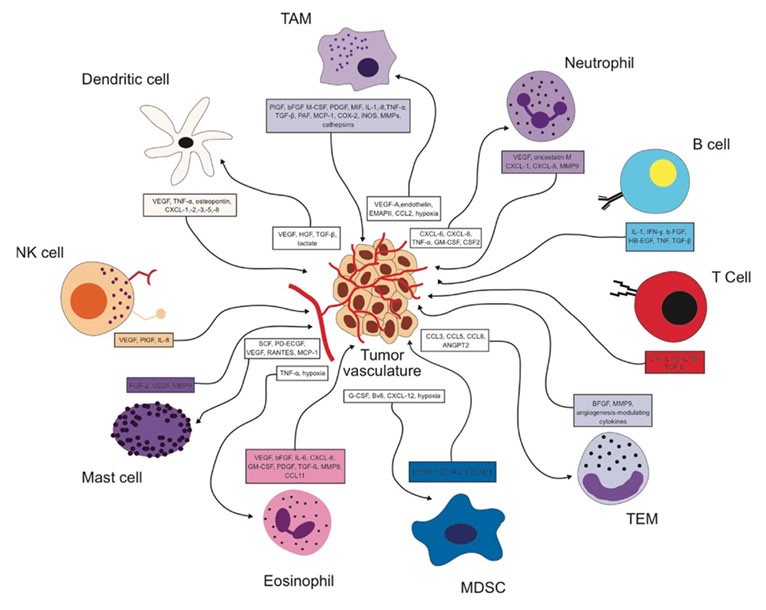 Fig.1 Reciprocal interactions between different immune cell types and the tumor vasculature in the tumor microenvironment.1, 3
We also offer a wide range of other in vitro immune cell function assays to support diverse research needs. Each assay is designed to provide detailed insights into immune cell behavior, enabling a deeper understanding of immune responses and therapeutic effects.
-
T Cell Targets and Activation
- T cell target and activation
- T cell proliferation
- Target expression profiling on T cell subsets
- Screening assay to enhance proliferation and survival (MLR)
- Regulation of differentiation and cytokine profiles
- Immune cell migration assay
- Antigen-specific recall response assay
- Screening for the ability to reverse T-cell exhaustion
- Suppression assay using regulatory T cells
- Mixed lymphocyte reaction (PBMC / T cell / DC, one-way or two-way)
- Immune checkpoint blocking assay
- Cytokine secretion profile (ELISA, ELISpot)
- T cell surface marker expression analysis (flow cytometry)
-
Macrophage and Dendritic Cell Targets
- Analysis of target expressions on subsets (still and active)
- Screening for M1 / M2 / MDSC regulation
- Screening for regulation of tumor conditional responses (phenotype and cytokine/chemokine production)
- Effect on antigen presentation
- Antibody-dependent cellular phagocytosis (ADCP)
-
NK cell target
- Target expression on NK cells
- Regulate activation and kill
- Antibody-dependent cellular cytotoxicity (ADCC)
-
B Cell Target
- Target expression profiling on B cell subsets (rest and activation)
- Regulatory antibody production
- Regulate antigen-presenting cell function and cytokine release
- BCR signaling (BTK, CARD11 / BCL10 / MALT1 complex)
-
Mast Cells and Basophils
- Degranulation and histamine release
- Cell migration and chemotaxis
Workflow for Comprehensive Immune Profiling
Our streamlined workflow at Creative Biolabs ensures comprehensive analysis and reliable results, suitable for visualization as a clear flowchart, guiding you through each stage of your project with transparency and precision:
Required Starting Materials: To initiate your project, clients typically provide test compounds (e.g., small molecules, biologics, cell therapies), target cells (e.g., tumor cell lines, primary immune cells), and detailed experimental objectives. Providing comprehensive information on your compounds, including their mechanism of action if known, and specific cell types of interest, allows our team at Creative Biolabs to design the most relevant and efficient assay strategy. This ensures our assays are precisely aligned with your research goals and yield the most impactful data.

Final Deliverables: Upon completion of our immune cell function assay services, you will receive a comprehensive study report (including detailed methodology, raw data, and thoroughly analyzed results), high-resolution data files (e.g., flow cytometry FCS files, plate reader data), and a summary presentation of key findings and recommendations. These deliverables are designed to be immediately useful for your research and development efforts.
Publication
STAP-STP is a novel transcriptome-based technology that quantifies signal transduction pathway (STP) activity in immune cells by analyzing mRNA. Researchers applied this method to public transcriptome data from resting/activated immune cells (T cells, B cells, NK cells, monocytes, macrophages, dendritic cells) and rheumatoid arthritis (RA) clinical samples. Each cell type showed distinct, reproducible STP activity profiles (SAPs) reflecting their functional states. Analysis revealed elevated TGFβ pathway activity in RA blood samples. The technology measures nine key STPs simultaneously, enabling quantitative assessment of immune cell functional states in both innate and adaptive immunity. Authors highlight STAP-STP's potential for diagnostics, studying immune dysfunction, and immunomodulatory drug development by providing comprehensive pathway activity profiles. This approach offers a new way to characterize immune cell activation states and identify disease-associated pathway alterations through transcriptomic analysis.
 Fig.2 Simplified cellular model with key signal transduction pathways.2, 3
Why Choose Us?
Immune cell function assay services are critical tools in modern biomedical research, offering dynamic insights into the physiological roles of immune cells. Creative Biolabs, a leader in this field, leverages its two decades of experience and cutting-edge technologies to provide unparalleled functional insights. By directly measuring cellular activities like proliferation, cytokine secretion, and cytotoxicity, these assays are essential for understanding immune responses and evaluating therapeutic efficacy. Creative Biolabs prides itself on delivering high-quality, reproducible data to accelerate research and development timelines.
Contact Our Team to Discuss Your Project
Frequently Asked Questions
Q1: What kind of quality control measures are in place for primary cell isolation?
A1: Creative Biolabs ensures high-quality primary cell isolation through rigorous viability, purity (flow cytometry), and functional testing—delivering reliable cells for reproducible experimental results.
Q2: Can I provide my cells or compounds for the assays?
A2: Creative Biolabs welcomes client-provided test compounds and cell lines. We ensure proper handling, storage, and preparation to maintain sample integrity and deliver accurate assay results for your research needs.
Q3: What types of immune cells can you work with for these assays?
A3: At Creative Biolabs, we work with a broad range of immune cells, including primary human and animal PBMCs, isolated T cells, B cells, NK cells, macrophages, dendritic cells, and various immune cell lines. Our capabilities extend to both healthy donor cells and patient-derived samples.
Customer Review
-
Exceptional Support for Complex Projects
Creative Biolabs delivered outstanding expertise in isolating rare immune cells and developing custom functional assays for our cytokine panel. Their high-quality data enabled confident publication of our findings. - Dr. Ce Wn
-
Cost-Effective and Time-Saving Solution
Creative Biolabs' immune cell function assays saved us time and costs versus in-house setup. Their efficient workflow delivered high-quality data on schedule, with detailed reports that streamlined our internal review process. - Jn Ds.
Related Services
To further support your research and development goals, Creative Biolabs offers a range of complementary services that can be seamlessly integrated with our immune cell function assay services, providing a holistic approach to your therapeutic development:
Large-Molecule Drug Bioanalysis Service
CAR-T Animal Model
Cellular therapy and gene therapy involve injecting cellular materials or modifying gene expression for therapeutic purposes. Creative Biolabs establishes appropriate animal models, including pharmacology and toxicology services, to support the development of CAR-T products.
Learn More →How to Contact Us
At Creative Biolabs, we understand that the intricacies of immune cell function are pivotal in driving the next wave of immunotherapies. Our immune cells function assay is meticulously designed to provide you with the comprehensive and actionable insights needed to push your research forward. Whether you're exploring immune memory, evaluating T cell activation, or analyzing leukocyte dynamics, our team is here to support your journey. Contact us today to discuss how we can tailor our services to meet the specific needs of your project, and together, let's unlock the full potential of your immune-based research.
References
- Stockmann, Christian, et al. "The impact of the immune system on tumor: angiogenesis and vascular remodeling." Frontiers in Oncology 4 (2014): 69. DOI: https://doi.org/10.3389/fonc.2014.00069
- Bouwman, W., et al. "Quantitative characterization of immune cells by measuring cellular signal transduction pathway activity." Scientific Reports 14.1 (2024): 24487. DOI: https://doi.org/10.1038/s41598-024-75666-w
- Distributed under Open Access license CC BY 4.0, without modification.
 Download our brochure
Loading case studies...
Online Inquiry