Receptor Dimerization Antibody & Fragment Engineering Service
Are you encountering challenges in optimizing antibody specificity, managing receptor interactions, or achieving precise signaling modulation in your research? Receptor dimerization antibody & fragment engineering service at Creative Biolabs empowers you to gain greater control over receptor function and improve therapeutic efficacy through the design of bispecific antibodies and engineered fragments. Using cutting-edge protein engineering technologies, we enable the creation of customized therapeutic antibodies that selectively control receptor dimerization, leading to more effective and precise research outcomes.
Overview
Receptor dimerization plays a critical role in cell signaling and has become a key target for cancer immunotherapy and immune modulation. By selectively inducing or inhibiting receptor dimerization, it's possible to fine-tune immune responses and alter cellular signaling pathways. Recent advances in antibody and fragment engineering have led to the creation of bispecific antibodies and small engineered fragments that can manipulate receptor pairing with high precision, offering enhanced selectivity, lower toxicity, and better efficacy. Creative Biolabs applies these cutting-edge techniques to engineer receptor dimerization tools that can improve therapeutic interventions.
Our approach to receptor dimerization engineering leverages the latest in protein design and functional screening:
-
Bispecific Antibody Engineering
We create bispecific antibodies that can bind to two different targets simultaneously, either inducing receptor dimerization or blocking unwanted interactions. -
Fragmentation for Targeted Dimerization
Small fragments (e.g., Fabs, scFvs) are engineered to specifically bind receptor subunits and modulate dimerization, providing a cost-effective and flexible alternative to full antibodies. -
Site-Specific Dimerization
Using hinge-region modifications or other engineering strategies, we guide the controlled pairing of receptor molecules, either enhancing or inhibiting receptor activity in a highly specific manner. -
In Vivo Validation
Our engineered molecules undergo rigorous validation through functional assays and in vivo models to confirm dimerization and downstream effects on cell signaling pathways. -
Modular Design
Our platform allows for easy adaptation of dimerization properties, enabling the creation of bispecifics, multispecifics, and even dimerized fragments for a variety of applications. -
Customization
Depending on the therapeutic area, we can customize the dimerization approach to either enhance receptor activation (agonist) or block unwanted signaling (antagonist), catering to the specific needs of your project.
Discover How We Can Help – Request a Consultation.
What We Can Offer
Custom Bispecific Antibody Design
We design and produce bispecific antibodies that simultaneously bind two different receptor epitopes, inducing or inhibiting receptor dimerization with precision.
Fragment-Based Receptor Dimerization
Small, functional antibody fragments (Fabs, scFvs, VHHs) engineered to target and control receptor pairings.
Receptor-Specific Engineering
Using cutting-edge techniques like hinge-region engineering, we provide receptor-specific dimerization modulation, allowing for precise control over signal pathways.
Modular and Scalable Solutions
Our platform supports scalable production, ensuring that your engineered molecules can be produced in bulk for preclinical or clinical use.
Functional and In Vivo Validation
We perform extensive testing to confirm the functionality of receptor dimerization, including binding assays, signaling studies, and in vivo experiments.
Workflow
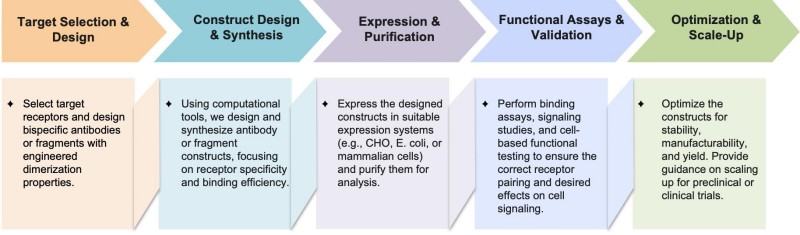
Required Starting Materials
- Receptor sequence or structural information (homology models or cryo-EM data).
- Functional assay specifications (desired activation/inhibition pathways).
- Analytical requirements for validation (binding assays, in vivo testing).
Highlights
Precision Engineering
Our approach allows for highly specific control over receptor dimerization, offering more selective therapeutic interventions.
Modular & Scalable
Customizable designs and scalable production make it easy to integrate our engineered molecules into your research or clinical pipeline.

Rapid Development
Through our streamlined design and validation processes, we deliver results faster than traditional antibody engineering approaches.
Targeted Therapeutics
By controlling receptor dimerization, we enhance the precision and efficacy of therapeutic antibodies, reducing off-target effects and improving clinical outcomes.
Discover the Creative Biolabs Advantage – Contact Us for a Customized Quote.
Publication
Binding of the growth factor FGF1 to the extracellular D2 and D3 domains of the receptor FGFR1 drives receptor dimerization, initiating the internalization process. In parallel, a bivalent antibody construct engaging the D1 domain of FGFR1 also induces dimer formation, bypassing ligand binding. Crucially, in both scenarios the dimerization of FGFR1 is sufficient to trigger uptake of the receptor into the cell, and this occurs even when the receptor's kinase activity is rendered inactive. Thus, the spatial juxtaposition of two FGFR1 monomers — whether via natural ligand or engineered antibody — acts as the key initiating event for endocytosis. By inducing FGFR1 dimer formation, the antibody mimics the effect of the ligand in promoting internalisation, highlighting dimerization rather than downstream kinase activation as the essential driver of receptor uptake.
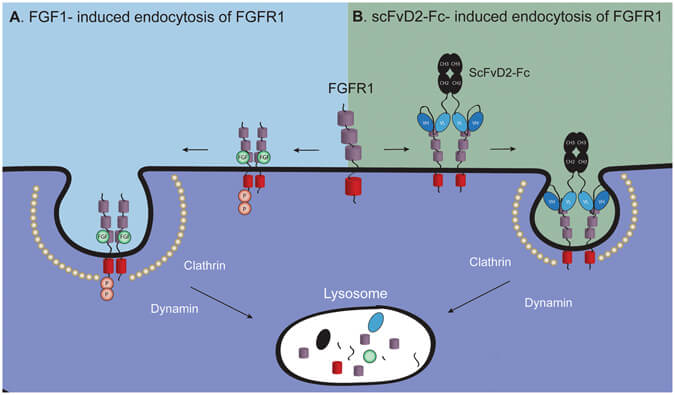 Fig.1 The model for the endocytosis of FGFR1 induced by growth factors and bivalent antibodies. 1
Customer Reviews
- "Using Creative Biolabs' dimerization engineering service, we successfully developed bispecific antibodies that improved our immuno-oncology program's tumor targeting and reduced systemic side effects." – Dr T**, Cancer Researcher.
- "The engineered antibody fragments we received from Creative Biolabs allowed us to modulate receptor activity with much higher specificity, greatly advancing our autoimmune research." – Dr J**, Immunology Specialist.
- "Creative Biolabs' team provided us with a fully validated bispecific antibody that worked seamlessly in our therapeutic model, making it an invaluable tool for our drug development process." – Prof L**, Biotech R&D Director.
FAQs
Q: What advantages do receptor dimerization fragments offer compared to full antibodies?
A: Fragments, such as scFvs or VHHs, are smaller and easier to produce, offering better tissue penetration and faster clearance while maintaining high specificity.
Q: Can receptor dimerization engineering be used to block signaling pathways?
A: Yes, by designing bispecifics or fragments that selectively interfere with receptor pairing, we can block specific signaling pathways involved in diseases like cancer or autoimmune disorders.
Q: How does Creative Biolabs ensure the functionality of dimerized antibodies and fragments?
A: We perform rigorous binding assays, signaling studies, and in vivo validation to confirm that our engineered molecules perform as expected before delivery.
Q: What are the scalability options for these engineered molecules?
A: We optimize the constructs for high yield and stability, enabling scalable production for preclinical use.
Related Services
Single Domain Antibody Mimetic Engineering Service
This service designs small, stable antibody mimetics that replicate the binding specificity of traditional antibodies. These engineered mimetics are versatile, cost-effective, and ideal for therapeutic and diagnostic applications.
Learn More →De Novo Designed Protein Mimetic Engineering Service
We generate custom protein mimetics using computational design to mimic natural proteins' structure and function. These engineered proteins are tailored for specific binding, activity, and stability, enhancing drug discovery and therapeutic development.
Learn More →Creative Biolabs' receptor dimerization antibody & fragment engineering service enables you to precisely modulate receptor function, paving the way for more effective therapies and targeted interventions. Our customized engineering solutions deliver high specificity, optimized functionality, and scalable production to support your project from start to finish. Contact Our Team for More Information and to Discuss Your Receptor Dimerization Engineering Project.
Reference
- Opaliński, Łukasz et al. "Antibody-induced dimerization of FGFR1 promotes receptor endocytosis independently of its kinase activity." Scientific reports vol. 7,1 7121. 2 Aug. 2017. Distributed under Open Access license CC BY 4.0, without modification. https://doi.org/10.1038/s41598-017-07479-z
 Download our brochure