Optional, integrated RNA-Seq provides a functional readout. It assesses cis- and trans-effects to confirm that the observed genetic loss is biologically significant on cellular pathways.
Tumor Suppressor Gene Loss & Inactivation Analysis Service
The tumor suppressor gene loss & inactivation analysis service by Creative Biolabs provides a definitive, multi-omic molecular audit of your oncology samples. We move beyond simple genetic screens to pinpoint the exact mechanism of TSG failure (genomic, epigenetic, or functional) and its severity (zygosity). Clients gain unparalleled precision in target validation, the ability to accurately define research cohorts based on validated functional classes, and the confidence to drive forward drug development and preclinical validation efforts with minimized risk and maximized scientific insight.
Introduction What We Can Offer Workflow Why Creative Biolabs Customer Reviews FAQs Related Services Contact Us
Systems-Level Analysis for TSG Inactivation Profiling
Tumor suppressor genes (TSGs) function as intrinsic cellular mechanisms to prevent uncontrolled proliferation; consequently, their inactivation represents a requisite step for oncogenic transformation. This inactivation is governed by highly complex molecular events extending beyond simple point mutations, including Loss of Heterozygosity (LOH) and epigenetic silencing. These events often cluster by the TSG's functional classification. Scientific investigation confirms that the magnitude of inactivation, particularly biallelic dependence and resultant cis- and trans-transcriptional effects, is a robust predictive indicator. The comprehensive, multi-omic perspective provided by Creative Biolabs is therefore essential for accurately mapping these critical loss-of-function events.
For an in-depth analysis of how our services can be tailored to your specific project needs, request a consultation.
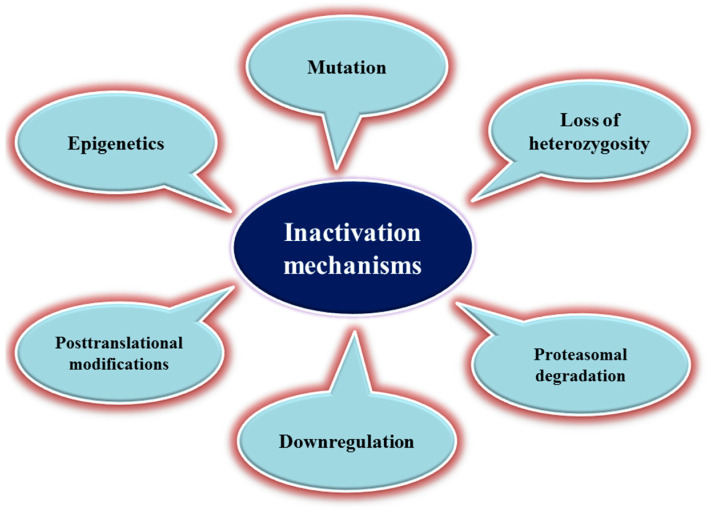 Fig.1 The different mechanisms of tumor-suppressor gene inactivation. 1
What We Can Offer
Functional Transcriptional Validation
Customized Service Tiers
We offer flexible service structures with customized TSG panels. This allows for highly efficient resource allocation based precisely on your unique research hypothesis or specific cancer types.
Rigorous Quality Control
We enforce strict verification procedures for detecting low-frequency variants. This minimizes false negatives and ensures high data quality across complex samples, including those with low tumor fraction.
The Role of Tumor Suppressor Gene Loss & Inactivation Analysis Service in Project Advancement
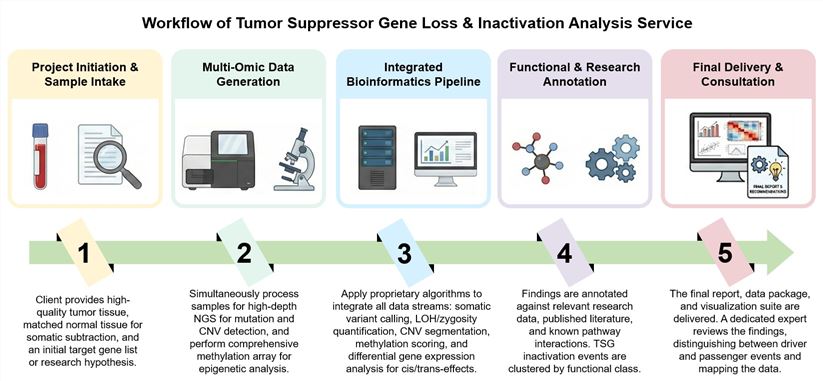
Why Choose Us?
| Key Advantages | Unique Features |
|---|---|
| Transcriptional Impact Analysis | The integration of RNA-Seq allows us to measure the functional consequence of genetic loss, identifying specific cis- and trans-effects on signaling pathways. This confirms that the observed genetic event has a measurable functional signature. |
| Functional Classification Validation | Our reports classify TSG inactivation events based on the consensus functional classes, a framework validated in pan-cancer studies to be more predictive than simple cancer lineage categorization. |
| Superior Data Depth | Our use of HD-NGS ensures accurate detection of subclonal, low-frequency somatic mutations, even in samples with low tumor purity (LOH detection requires high confidence). |
To fully understand the Creative Biolabs advantage, we invite you to get a quote today.
Customer Reviews
-
Functional Confirmation
The integration of RNA-Seq data via the Creative Biolabs service substantially advanced our pathway modeling capabilities, invaluable for establishing the mechanism of action of our inhibitor, a significant improvement over reliance solely on primary genomic data. - S. K**r -
Post-Genomic Guidance
Using Creative Biolabs' service was critical for cost management. Their report showed several TSGs were wild-type for mutation and methylation, confidently directing our limited resources toward expensive IHC and ubiquitination studies to prove protein mislocalization as the primary functional loss mechanism. - Prof. K. P****z.
FAQs
How does your service distinguish between a structural loss and a functional loss?
Our multi-omic approach first rules out structural loss and epigenetic silencing (methylation). If a gene is structurally intact but a therapeutic vulnerability is suspected, our report highlights the need for downstream functional assays, providing confidence that the functional loss is the primary mechanism.
Can your analysis support the rationale for PARP inhibitor compound studies?
Absolutely. PARP inhibitor efficacy is largely dependent on deficiencies in the homologous recombination repair (HRR) pathway, often caused by the loss of caretaker TSGs. Our service precisely quantifies the LOH and deletion status of these genes, providing the definitive molecular evidence required to select model systems or cohorts best suited for synthetic lethality strategies.
Related Services
Oncogene-Mediated Drug Resistance Analysis
This specialized service provides comprehensive molecular profiling to elucidate acquired resistance mechanisms to targeted agents. Analysis includes deep sequencing for identifying secondary drug-resistant mutations and transcriptional profiling to detect the activation of bypass signaling pathways or gene amplification events.
Learn More →Tumor Profiling for Personalized Cancer Treatment
This integrated, pan-cancer analysis service delivers a holistic molecular report encompassing both oncogene activation and tumor suppressor gene inactivation landscapes. CTMP utilizes a multi-platform approach to categorize somatic alterations against current clinical and research evidence.
Learn More →How to Contact Us
Creative Biolabs delivers the highest resolution, multi-modal molecular analysis available, moving far beyond standard sequencing to capture the full complexity of TSG silencing. We integrate structural, epigenetic, zygosity, and transcriptional data to provide the definitive blueprint for cancer pathogenesis, enabling highly effective cohort definition and drug development.
To initiate a discussion regarding project scope and alignment with research or drug development objectives, please contact our expert team.
Reference
- Rajabi, Sadegh et al. "Looking at Thyroid Cancer from the Tumor-Suppressor Genes Point of View." Cancers vol. 14,10 2461. 17 May. 2022. Distributed under an Open Access license CC BY 4.0, without modification. https://doi.org/10.3390/cancers14102461
 Download our brochure
Loading case studies...
Online Inquiry