Ubiquitin/SUMO mediated Cell Cycle Control Analysis Service
Creative Biolabs provides high-resolution mapping of the "PTM code", where ubiquitin and SUMO act as molecular switches for protein degradation and relocation. We resolve the "SUMO Enigma" by identifying how minute modifications trigger massive physiological shifts. Our expertise highlights SUMO-targeted ubiquitin ligases (STUbLs), like RNF4, which bridge these systems during DNA replication stress and mitotic checkpoints. We deliver the biochemical evidence required for target validation and novel degrader development.
The Critical Intersection of Ubiquitin and SUMO in Cell Cycle Governance
Creative Biolabs maps the Ubiquitin-SUMO crosstalk governing irreversible phase transitions. We analyze APC/C and SCF complexes, monitoring Cyclin degradation kinetics and CKI regulation (p21/p27). Our platform resolves the "SUMO Enigma" by tracking low-abundance modifications on BRCA1 and PCNA that ensure replication integrity. By profiling STUbLs like RNF4, we elucidate how SUMO-Targeted Ubiquitin Ligases bridge signaling circuits to stabilize TOP2A or facilitate Ki-67 nucleolar recruitment. This high-resolution mapping identifies oncogenic imbalances, providing critical biochemical evidence for target validation and drug discovery.
Comprehensive Analysis Offerings
Our service portfolio is built upon deep technical knowledge of the Metaphase-to-Anaphase transition and S-phase integrity. We offer:
APC/C Complex Assembly Analysis
We investigate the PTM-driven assembly of the anaphase-promoting complex/cyclosome. Specifically, we analyze the SUMOylation of the APC4 subunit, which is a prerequisite for stable complex formation and the subsequent recruitment of co-activators like Cdc20.
STUbL Substrate Profiling
Identification of substrates for RNF4 and RNF111, identifying how these ligases maintain genome stability by clearing SUMOylated proteins from stalled replication forks.
PIAS E3 Ligase Mapping
Specialized analysis of the PIAS family (PIAS1–4) in governing proliferation markers such as Ki-67 and TOP2A, particularly in triple-negative breast cancer (TNBC) models.
Transform Your Mechanistic Insights into Therapeutic Leads — Inquire About Our Specialized Assay Offerings
Analytical Workflow
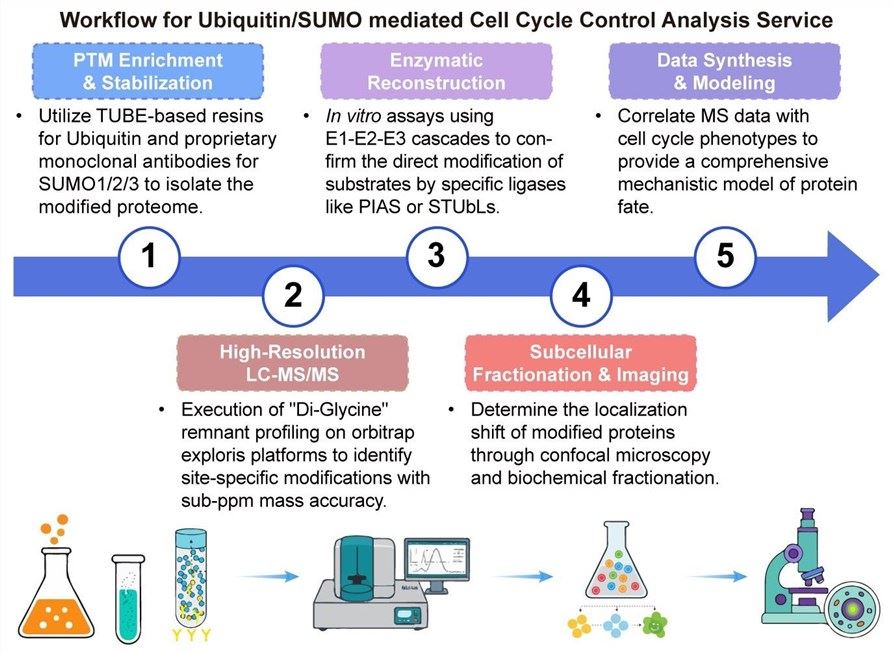
To ensure the highest data integrity, Creative Biolabs follows a rigorous, phase-gated workflow optimized for the detection of labile and low-abundance modifications.
Publication
This study uncovers that SUMO1-mediated modification (SUMOylation) of CDK6 at lysine 216 stabilizes the kinase by blocking its ubiquitination at lysine 147. This modification, initiated during mitosis via CDK1-phosphorylated UBC9, persists into the G1 phase to drive the G1/S transition. The research identifies this SUMO1-CDK6 conjugation as a critical mechanism promoting glioblastoma cell cycle progression and tumorigenesis, suggesting its pathway as a potential therapeutic target.
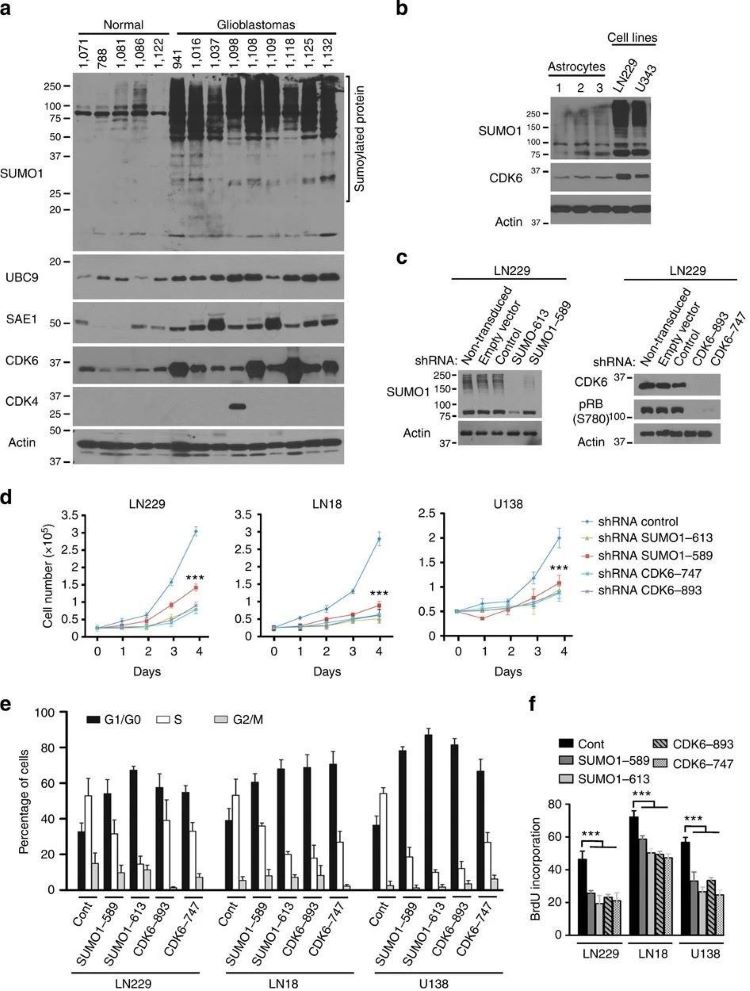 Fig.1 SUMO1 conjugation promotes G1/S phase transition.1
Why Choose Us?
Partnering with Creative Biolabs provides specialized expertise in cell cycle governance, offering a platform uniquely optimized for high-risk oncology targets where standard proteomics often fail. We provide unmatched sensitivity through enrichment protocols that detect modifications on less than 1% of the total protein pool. Our methodologies are grounded in peer-reviewed science, including recent findings on APC4 SUMOylation and PIAS-mediated proliferation control. We deliver the rigorous biochemical data required for regulatory filings and patent applications, ensuring your drug discovery program is supported by high-fidelity evidence.
Experience the Creative Biolabs Advantage — Secure Your Project Quote Today
FAQs
How do you prevent the loss of SUMO/Ubiquitin signals during sample prep?
We incorporate a potent cocktail of SENP and DUB inhibitors during lysis, ensuring the PTM state is "frozen" at the time of collection.
Can your service map modifications on large, multi-subunit complexes like APC/C?
Yes, we specialize in the biochemical isolation of large complexes and can map PTMs across all individual subunits simultaneously.
Does your MS analysis distinguish between SUMO-1 and SUMO-2/3?
We utilize isoform-specific enrichment and MS-fragmentation patterns to differentiate between these modifiers.
Customer Review
-
Enhanced PCNA Mapping
Using Creative Biolabs' analysis in our replication stress research has significantly facilitated our understanding of how SUMO-Ubiquitin crosstalk prevents fork collapse. - Dr. A***n L -
Reliable APC/C Profiling
We struggled with the low abundance of APC4 SUMOylation for years. Creative Biolabs' specialized protocols allowed us to finally visualize the priming events required for mitotic exit. - Prof. S***el K
Related Services
Anti-Cancer Resistance Inhibitor Discovery Solutions
Creative Biolabs utilizes high-throughput screening and multidrug-resistant strains to discover inhibitors that overcome cancer resistance mechanisms. We provide rigorous in vitro and in vivo testing to deliver effective, specific anticancer therapies.
Learn More →Cellular Kinase Target Engagement Assay Service
Creative Biolabs provides cellular kinase target engagement assays using BRET-based methodologies. We deliver quantitative data on intracellular potency, selectivity, and binding kinetics to de-risk drug development programs.
Learn More →How to Contact Creative Biolabs
Creative Biolabs remains your dedicated partner in navigating the complexities of Ubiquitin and SUMO signaling to unlock the next generation of cell cycle therapeutics.
Contact our scientific team today to receive a detailed technical proposal for your project.
Reference
- Bellail, A. C., J. J. Olson, and C. Hao. "SUMO1 modification stabilizes CDK6 protein and drives the cell cycle and glioblastoma progression." Nat Commun 5 (2014): 4234. Distributed under Open Access license CC BY 4.0, without modification. https://doi.org/10.1038/ncomms5234
 Download our brochure