Creative Biolabs is offering the most comprehensive services for antibody development projects. With strict regulation and effective execution, we are dedicated to providing the most valuable solutions to complete your projects.
HighlightsCreative Biolabs is offering the most comprehensive services for antibody development projects. With strict regulation and effective execution, we are dedicated to providing the most valuable solutions to complete your projects.
HighlightsCreative Biolabs has established a broad range of platforms for developing novel antibodies or equivalents. These cutting-edge technologies enable our scientists to meet your demands from different aspects and tailor the most appropriate solution that contributes to the success of your projects.
HighlightsWith deep understanding in antibody-related realms and extensive project experience, Creative Biolabs offers a variety of references to help you learn more about our capacities and achievements, including infographic, flyer, case study, peer-reviewed publications, and all kinds of knowledge that can assist your projects. You are also welcome to contact us directly for more specific solutions.
HighlightsGet a real taste of Creative Biolabs, one of the most professional custom service providers in the world. We are committed to providing highly customized comprehensive solutions with the best quality to advance your projects.
HighlightsThe epitope or antigenic determinant represents the specific surface area of an antigen like a protein or polysaccharide which antibodies and receptors from B-cells and T-cells identify and attach to. Epitopes serve as crucial molecular features which trigger immune responses and define the specificity during antibody-antigen binding interactions.
Understanding the precise location and structure of an epitope is crucial for:
Epitope mapping yields essential data throughout the biologics R&D pipeline which includes monoclonal antibodies and vaccines.
Several methodologies exist for epitope mapping, each with its strengths and limitations.
Table 1. Comparison of Common Epitope Mapping Techniques
| Technique | Principle | Resolution | Epitope Type | Throughput | Key Advantage | Key Limitation |
| Peptide Scanning (e.g., ELISA, SPOT) | Binding to overlapping synthetic peptides | Low-Medium | Linear | High | Simple, high-throughput | Misses conformational epitopes |
| X-ray Crystallography | High-resolution structure of Ab-Ag complex | Atomic | Conformational | Low | Gold standard for structure | Requires crystallization, static |
| Cryo-Electron Microscopy (Cryo-EM) | High-resolution structure of Ab-Ag complex | Near-atomic | Conformational | Low-Medium | Handles large complexes, no crystals | Technically demanding, costly |
| Site-Directed Mutagenesis | Assessing binding changes upon mutation | Residue-level | Both | Medium | Functional validation | Laborious, indirect |
| HDX-MS | Measuring solvent accessibility changes upon binding | Peptide-level | Conformational | Medium | Solution-phase, dynamic info | Indirect, requires MS expertise |
| NMR Spectroscopy | Detecting chemical shift perturbations upon binding | Residue-level | Conformational | Low | Solution-phase, dynamic info | Size limitations, complex spectra |
HDX-MS is a powerful biophysical technique that measures the rate at which backbone amide hydrogens in a protein exchange with deuterium atoms when the protein is incubated in deuterated buffer. This exchange rate is highly sensitive to the local structural environment of each amide hydrogen.
The fundamental principle relies on the fact that backbone amide hydrogens involved in stable hydrogen bonds (e.g., in α-helices, β-sheets) or buried within the protein core are protected from exchange with the solvent. Conversely, hydrogens in flexible loops or on the protein surface exchange more rapidly.
The exchange process involves:
By comparing the deuterium uptake pattern of a protein in different states (e.g., free vs. antibody-bound), one can infer changes in conformation, dynamics, or solvent accessibility.
HDX-MS epitope mapping operates on the principle that antibody attachment shields the antigen's epitope region from exchanging with the solvent. The binding of an antibody to its antigen results in decreased accessibility of the epitope interface's amide hydrogens to the deuterated solvent. Peptides from the epitope region demonstrate decreased deuterium uptake rate and/or extent relative to the unbound form of the antigen.
The analysis of deuterium uptake profiles between the antigen and its bound complex at different time points reveals regions with reduced uptake as potential epitopes or areas affected by antibody binding.
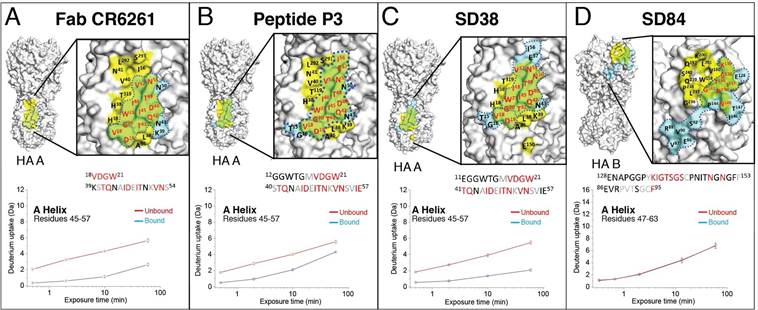 Fig. 1 HDX-MS accurately determines the epitope for each drug molecule and reveals distinct effects on the conformational dynamics of HA.1
Table 2. Typical HDX-MS Epitope Mapping Workflow
| Step | Description | Key Considerations |
| 1. Sample Preparation | Prepare high-purity antigen and antibody. Optimize buffer conditions. | Purity >95%, buffer compatibility (avoid primary amines), concentration accuracy. |
| 2. HDX Reaction | Incubate antigen alone and antigen-antibody complex in D₂O buffer for various time points (e.g., 10s to 4h). | Precise timing, temperature control (often automated), sufficient complex formation. |
| 3. Quenching | Rapidly lower pH (e.g., to 2.5 with formic acid) and temperature (e.g., to 0°C) to stop the exchange. | Speed and efficiency of quenching are critical to preserve the D-labeling pattern. |
| 4. Proteolysis | Digest the protein online using an immobilized acid protease (e.g., pepsin) under quench conditions. | High digestion efficiency, good sequence coverage, reproducible peptide generation. |
| 5. LC Separation | Separate peptides using UPLC (Ultra-Performance Liquid Chromatography) at low temperature. | Fast separation, high resolution, minimal back-exchange during separation. |
| 6. Mass Spectrometry | Analyze peptide masses using a high-resolution mass spectrometer. | Accurate mass measurement, high sensitivity, MS/MS for peptide identification. |
| 7. Data Analysis | Identify peptides, calculate deuterium uptake for each peptide in both states, perform statistical analysis. | Specialized software, statistical validation of differences. |
| 8. Epitope Assignment | Map protected peptides onto the antigen sequence/structure to define the putative epitope. | Consideration of significance thresholds, visualization on 3D structures if available. |
Data analysis is a critical step requiring specialized software and expertise. Key aspects include:
Table 3. Interpreting HDX-MS Data for Epitope Identification
| Observation | Interpretation | Implication for Epitope |
| Significant decrease in D-uptake upon binding | Reduced solvent accessibility or increased hydrogen bonding in this region. | Peptide likely part of or very close to the binding site. |
| Significant increase in D-uptake upon binding | Increased solvent accessibility or decreased hydrogen bonding (conformational change). | Peptide likely affected by allosteric conformational changes. |
| No significant change in D-uptake | Region's solvent accessibility is largely unaffected by antibody binding. | Peptide unlikely to be directly involved in the epitope. |
The HDX-MS process depends fundamentally on peptide mapping techniques. Post quenching the HDX reaction the protein requires digestion into smaller peptides for LC-MS analysis. The peptide map's quality determines how well epitope analysis achieves resolution and coverage. Effective peptide mapping requires:
Pepsin works well because it functions at low pH which matches quenching conditions yet other proteases or enzyme combinations might be necessary depending on the specific protein sequence.
Optimizing the digestion step in HDX-MS experiments requires specialized peptide mapping services which Creative Biolabs provides. This involves:
Robust peptide identification and analysis are foundational. Without accurately knowing which peptide corresponds to a measured mass shift, deuterium uptake cannot be assigned to specific protein regions. High-quality peptide analysis ensures:
Sample preparation for the peptide mapping component of HDX-MS mirrors the initial steps of the main experiment but focuses on generating the reference peptide list:
HDX-MS could probe protein structure and dynamics in solution provides unique insights into antibody-antigen interactions that are crucial for selecting and optimizing therapeutic antibodies, designing effective vaccines, and understanding complex biological mechanisms. At Creative Biolabs, we harness the power of HDX-MS, combined with our deep expertise in protein biochemistry and mass spectrometry, to deliver high-resolution epitope mapping data that accelerates our clients' R&D programs.
Learn more about Creative Biolabs' epitope mapping services:
All listed services and products are For Research Use Only. Do Not use in any diagnostic or therapeutic applications.