Creative Biolabs offers pharmacologic validation services to evaluate checkpoint inhibitors and anti-mitotic agents. We utilize high-content imaging and biochemical profiling to deliver precise, regulatory-ready data on target engagement and genomic stability.
Learn More →Cell Cycle Functional Validation Services
Creative Biolabs bridges the gap between sequencing and biological evidence by providing a rigorous framework to validate drug interactions with replication machinery. Instead of static population snapshots, we measure transition probabilities and phase durations to pinpoint precise therapeutic windows. Our platform resolves cellular heterogeneity by delivering kinetic data for small molecules and degraders. This high-resolution velocity analysis identifies vulnerabilities in hyper-proliferative cells, allowing for the optimization of dosing schedules based on real-time arrest kinetics.
Background Featured Services What We Can Offer Workflow Publication Why Choose Us FAQs Customer Review Related Services Contact Us
Introduction of Cell Cycle Functional Validation
The cell cycle serves as the master regulator of cellular homeostasis and disease progression; however, its transcriptomic signatures often heavily overlap with cell-type-specific identity markers. This "bleeding" of signals frequently leads to the misidentification of therapeutic targets in early-stage discovery. Modern drug development requires a sophisticated "disentangling" of activity gene expression programs from stable cellular identities to ensure target specificity. Creative Biolabs provides the specialized precision required to validate complex targets that traditional bulk assays often miss. By integrating high-resolution kinetic mapping with computational deconvolution, we ensure every lead is evaluated for its direct impact on cellular dynamics.
Our Featured Services
Pharmacologic Validation Service
Reporter & Readout Validation
Creative Biolabs offers specialized reporter and readout validation for cell cycle activity. We validate fluorescent biosensors and bioluminescence readouts to ensure precise, high-throughput monitoring of checkpoint dynamics and mitotic progression.
Learn More →Phenotypic Cell Cycle Progression & Apoptosis Profiling
Creative Biolabs offers phenotypic cell cycle and apoptosis profiling, integrating high-content imaging and flow cytometry. We quantify phase distribution and apoptotic markers to deliver actionable insights into drug-induced cytotoxicity and the mechanism of action.
Learn More →Orthogonal Molecular Assay
Creative Biolabs provides orthogonal molecular assay services to validate cell cycle programs. We integrate HCA, flow cytometry, and PTM mapping to deliver cross-verified, high-fidelity data for checkpoint inhibitor development and target validation.
Learn More →Comprehensive Offerings: Our Specialized Cell Cycle Validation Toolkit
To address the diverse needs of modern drug discovery pipelines, Creative Biolabs offers an integrated suite of assays and computational tools designed to provide a 360-degree view of cell cycle dynamics.
Dynamic Phase Transition Mapping
Utilizing advanced live-cell reporters, we track the progression of thousands of individual cells in real-time. This allows us to quantify phase duration asymmetry and detect transient arrest points that end-point assays miss.
High-Resolution Morphometric Profiling
Using in situ microscopy, we simultaneously analyze DNA content and over 50 physical parameters, including nuclear envelope integrity, spindle assembly, and cytoskeletal remodeling.
Transcriptomic Activity Deconvolution
Our proprietary computational pipeline uses matrix factorization to isolate cell cycle "activity programs" from stable "identity programs." This ensures that drug-induced metabolic or stress signatures are not confounded with genuine phase-specific effects.
Checkpoint Dependency & Vulnerability Screening
We perform specialized assays targeting surveillance pathways, evaluating the sensitivity of your leads against key signaling axes that govern replication integrity.
Custom Genetic Perturbation Platforms
We offer targeted knockdown or overexpression services to functionally validate the role of specific genes within a robust cell cycle signature.
Maximize your project's success with our precision toolkit - Inquire About Our Technology Access
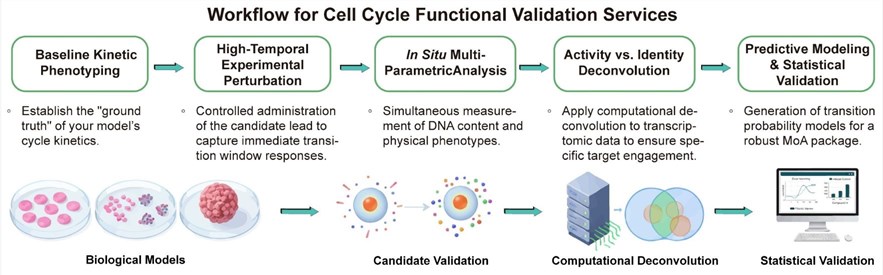
Workflow
To ensure the highest data integrity, our process is designed for maximum transparency and scientific rigor.
Publication
This review examines how growth factor-induced signaling, primarily through receptor tyrosine kinases like EGFR, regulates cell cycle progression. It details the crucial roles of the Ras/Erk and PI3K/Akt pathways in driving the cell cycle, with a particular focus on G1 phase mechanisms. The article also highlights significant gaps in understanding regarding the function of these signals during the S, G2, and M phases, summarizing current knowledge and controversies in the field.
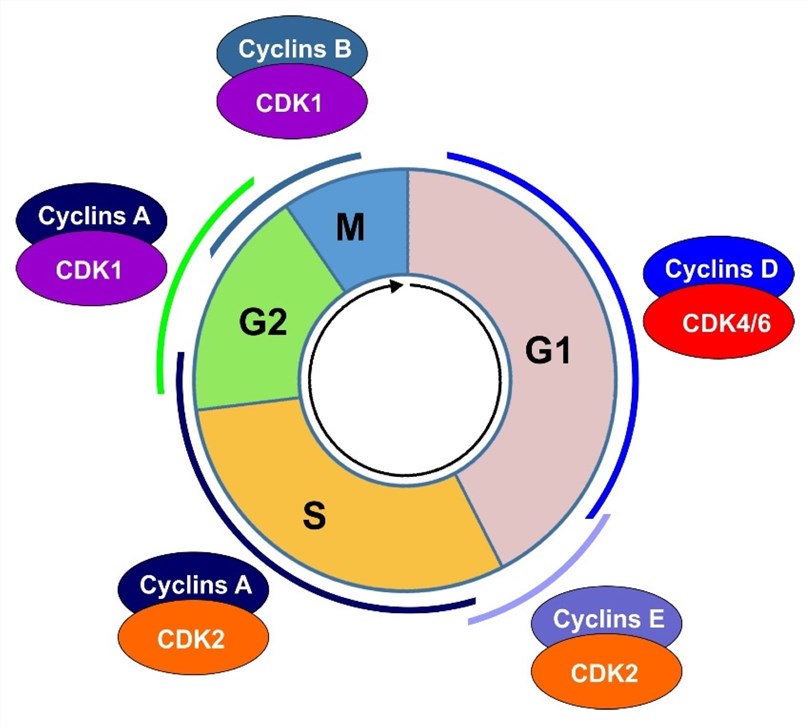 Fig.1 The Cyclin-Cdk complex as the core engine of cell cycle progression.1
Why Choose Us?
Choosing Creative Biolabs means partnering with a leader at the sophisticated intersection of mechanobiology and high-dimensional bioinformatics. We move beyond static, end-point snapshots by analyzing the "velocity" and "acceleration" of your drug's impact through high-temporal-resolution imaging. Our methodology, which integrates advanced matrix factorization deconvolution frameworks, allows us to identify "pure" biological markers by stripping away universal cell cycle machinery "noise." This is a critical advantage for maintaining the validity of your findings across varying proliferative states and heterogeneous cell populations. By quantifying asymmetric phase kinetics and transition probabilities, we offer a level of precision that traditional flow cytometry cannot achieve. We ensure that your research is supported by the highest standards of evidence, providing the clarity necessary to distinguish between drug-induced cytotoxic stress and true structural regulation.
Unlock the Creative Biolabs Advantage - Start Your Collaboration Today
FAQs
How does your microscopy assay compare to standard flow cytometry?
Unlike flow cytometry, in situ microscopy preserves spatial context and permits simultaneous measurement of physical phenotypes in adherent cells. This provides a more comprehensive understanding of drug-induced changes in structure.
How does computational deconvolution improve the lead validation process?
Deconvolution successfully separates "activity" (the cell cycle) from "identity" (the cell type). This prevents the misinterpretation of drug effects, ensuring that identified markers are truly specific to the therapeutic target.
Can you validate transition kinetics in complex primary samples?
Yes, we effectively apply our live-cell imaging and computational deconvolution platforms to primary cells and complex models. This allows for validation in environments that closely mimic actual biological disease states.
Customer Review
-
Improved MoA Clarity
Utilizing live-cell imaging provided exceptional clarity that standard flow methods simply could not match. We visualized exactly where our lead interfered with the cycle, significantly accelerating our early mechanism confirmation. - Dr. Ar*nd S -
Resolved Data Noise
The transcriptomic deconvolution service successfully revealed the true identity markers of our resistant cell sub-populations. These critical findings were previously masked by intense cycle-related noise in our data. - Prof. Ko*iar D
Related Services
Target Discovery & Validation Services
Creative Biolabs combines genomics with cell analysis to identify and validate novel therapeutic targets across various cancers, including kinases, receptors, and nucleic acids.
Learn More →Cell-based Antagonist Assay Services
Creative Biolabs utilizes high-content screening and sophisticated imaging to dissect antagonist-receptor interactions. We provide precise data on signaling pathways and downstream cellular events for drug discovery.
Learn More →How to Contact Creative Biolabs
Creative Biolabs offers a world-class platform for the functional validation of cell cycle targets. By combining high-temporal-resolution imaging with advanced transcriptomic deconvolution and in situ morphometry, we provide the clarity and mathematical rigor needed to move your therapeutic leads toward successful development.
Reach out to our team to discuss your next breakthrough - Contact Our Specialists
Reference
- Wang, Zhixiang. "Regulation of cell cycle progression by growth factor-induced cell signaling." Cells 10.12 (2021): 3327. Distributed under Open Access license CC BY 4.0, without modification. https://doi.org/10.3390/cells10123327
 Download our brochure
Loading case studies...
Online Inquiry