Creative Biolabs offers high-throughput reporter gene assays to quantify nuclear receptor activation and gene regulation. We accelerate drug discovery for metabolic and oncological diseases.
Learn More →Phenotypic Cell Cycle Progression & Apoptosis Profiling Service
Creative Biolabs delivers a mechanistic roadmap for lead compounds by precisely identifying the phase of cell cycle arrest and the specific pathway of programmed cell death. This resolution allows researchers to optimize dosing strategies and predict clinical efficacy long before entering human trials. Our profiling transcends simple viability counts; we analyze the kinetic interplay between checkpoint activation and executioner signaling. By understanding whether a compound acts via p53-mediated G1 arrest or triggers a G2/M "trap" leading to mitotic catastrophe, our clients can make informed go/no-go decisions.
Background What We Can Offer Workflow Publication Why Choose Us FAQs Customer Review Related Services Contact Us
The Nexus of Proliferation and Programmed Cell Death
The cell cycle and apoptosis are intrinsically linked processes that maintain tissue homeostasis, with their dysregulation being a hallmark of pathologies like cancer. Cell cycle progression is governed by an orchestrated sequence of cyclins, CDKs, and checkpoints (G1/S, G2/M). In parallel, programmed cell death acts as a critical "fail-safe" mechanism through intrinsic (mitochondrial) or extrinsic (death receptor) pathways to eliminate compromised cells. For therapeutic agents, discerning whether the primary mechanism is inducing a G2/M arrest (potentially leading to mitotic catastrophe) or triggering direct intrinsic apoptosis is fundamental for accurately defining their mechanism of action.
Advanced Multi-Parametric Solutions
Creative Biolabs offers an integrated suite of assays to dissect the molecular architecture of cell division and death. Our platform provides high-resolution data across several critical biological dimensions:
High-Resolution DNA Content & Mitotic Indexing
We utilize intercalating dyes (PI, 7-AAD, Hoechst) to distinguish between G0/G1, S, and G2/M phases. This is supplemented with phospho-histone H3 (pH3) staining to specifically identify cells in active mitosis, allowing for the detection of mitotic arrest or slippage.
Mitochondrial Health & Early Apoptotic Signaling
Our platform monitors mitochondrial membrane potential using JC-1, TMRM, or mitotracker dyes to detect the earliest signs of the intrinsic apoptotic pathway. This is integrated with Annexin V/PS externalization assays to identify cells transitioning into early-stage programmed death.
Proteolytic Cascade & Executioner Analysis
We quantify the activation of both initiator (Caspase 8, 9) and executioner (Caspase 3/7) caspases. This allows for the differentiation between extrinsic death receptor signaling and intrinsic mitochondrial stress pathways.
Nuclear Integrity & DNA Fragmentation
Through TUNEL assays and morphological assessment of nuclear eccentricity and fragmentation, we provide definitive evidence of late-stage apoptosis and genomic degradation.
Senescence & "Guardian of the Genome" Dynamics
We offer screening across p53-defined cell line panels (wild-type, mutant, and null) to evaluate the role of the p53/p21 axis in drug response. This includes SA-β-gal assays to distinguish permanent senescence from transient quiescence.
Explore Our Full Technology Suite - Request Technical Specifications
Service Workflow
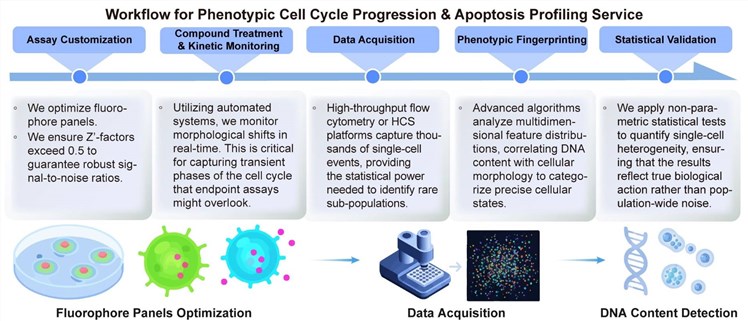
Our workflow is designed for transparency and scientific rigor, ensuring seamless integration with your existing processes.
Publication
This study develops a biomarker algorithm based on key G1–S and G2–M regulators (Mcm2, geminin, Aurora A, Plk1, H3S10ph) to profile cell-cycle states in breast cancer. It identifies three distinct phenotypes—out-of-cycle, G1-delayed/arrested, and actively cycling—with significant prognostic value. The actively cycling phenotype is strongly associated with high relapse risk, genomic instability, and aggressive subtypes (HER2+/triple-negative). This approach provides a novel, independent parameter for risk stratification and may inform personalized treatment selection with cell-cycle-phase-specific therapies.
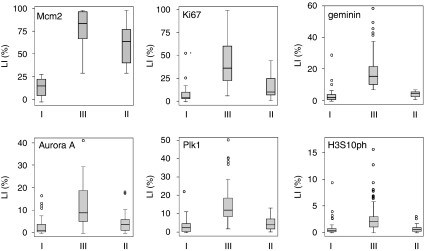 Fig.1 Distribution of cell-cycle biomarkers reveals three defined phenotypes.1
Why Choose Us?
Creative Biolabs stands at the forefront of cell biology with a commitment to industrial-grade standardization and computational excellence. We leverage a multi-disciplinary approach that combines high-throughput automation with deep biological expertise to ensure every project benefits from unparalleled data fidelity. We utilize advanced feature distribution analysis to quantify single-cell heterogeneity, a critical factor in understanding drug resistance. Unlike providers that rely on mean population values, our approach captures the "tails" of the distribution where drug escape often occurs, offering a more predictive model for clinical success. Backed by over 20 years of mastery, we provide published data-level analysis suitable for regulatory submissions and high-impact publications.
Experience the Creative Biolabs Advantage - Get a Quote Today
FAQs
How does Creative Biolabs ensure the reproducibility of phenotypic data?
We maintain rigorous assay standardization with automated image processing and maintain Z'-factor thresholds above 0.5 to ensure consistent results across all replicates.
Can your service distinguish between apoptosis and necrosis?
Yes. By utilizing Annexin V in combination with membrane-impermeant dyes like PI or 7-AAD, we can accurately differentiate between early apoptosis, late apoptosis, and primary necrosis.
Do you offer profiling in 3D culture or organoid systems?
Yes. Creative Biolabs has established protocols for 3D organoid profiling, which provides a more physiologically relevant environment for evaluating cell cycle kinetics.
Customer Review
-
High Sensitivity Detection
Using Creative Biolabs' profiling in our research has significantly improved our understanding of S-phase kinetics in p53-mutant lines. The depth of the multi-parametric data was exceptional. - Dr. A***n L -
Seamless Workflow
The transition from sending our compounds to receiving a full mechanistic analysis was flawless. Their high-content imaging data provided the exact visual proof we needed. - Prof. S***e R
Related Services
Cell-based Assay Service for Nuclear Receptor Screening
Cell-based Checkpoint Inhibitor Assay Service
Creative Biolabs provides cell-based assays to evaluate PD-1/PD-L1 and CTLA-4 interactions. We deliver precise immuno-modulation data to predict therapeutic efficacy.
Learn More →How to Contact Creative Biolabs
Creative Biolabs transforms complex biological responses into clear, high-quality data. Our phenotypic cell cycle progression and apoptosis profiling service provides the scientific depth required to propel your drug discovery program forward with confidence.
Contact our experts today to discuss your project requirements and receive a comprehensive technical proposal.
Reference
- Loddo, M., et al. "Cell-cycle-phase progression analysis identifies unique phenotypes of major prognostic and predictive significance in breast cancer." British journal of cancer 100.6 (2009): 959-970. Distributed under Open Access license CC BY 4.0, without modification. https://doi.org/10.1038/sj.bjc.6604924
 Download our brochure
Loading case studies...
Online Inquiry