Research goals, sample type, and analytical depth are aligned to establish a tailored mutation profiling strategy.
Gene Mutation Profiling & Driver Mutation Detection Service
Are you currently facing challenges such as distinguishing true oncogenic drivers from extensive passenger mutations, interpreting low-frequency variants in heterogeneous tumor samples, or translating complex mutation data into actionable biological conclusions? Creative Biolabs' gene mutation profiling & driver mutation detection service helps you accurately identify and prioritize biologically meaningful mutations through comprehensive somatic mutation analysis, clonality-aware interpretation, and functional relevance assessment, enabling more confident decision-making in oncology research.
Overview What We Can Offer Workflow Required Materials Highlights Publication Customer Reviews FAQs Related Services
Overview
Cancer genomes harbor thousands of somatic mutations, yet only a subset actively drives tumor initiation and progression. Large-scale cancer genome analyses have demonstrated that driver mutations may be clonal or subclonal, rare or context-dependent, requiring systematic profiling and prioritization. Advanced gene mutation profiling combined with driver detection strategies allows researchers to move beyond mutation catalogs toward mechanistic understanding. Creative Biolabs integrates statistically robust mutation analysis with biological interpretation to support reliable driver identification in oncology studies.
Creative Biolabs applies a structured and biology-driven strategy to gene mutation profiling and driver detection. Somatic variants are evaluated not only by occurrence but also by functional impact, clonality patterns, and pathway relevance. This multi-evidence approach ensures accurate separation of driver events from background variation. By integrating mutation burden, recurrence signals, and biological context, our strategy supports meaningful interpretation across diverse cancer types and experimental models.
Accelerate Innovation with Creative Biolabs – Start Your Consultation Today
What We Can Offer
Comprehensive Somatic Mutation Profiling
Systematic detection and annotation of single-nucleotide variants and small insertions or deletions across cancer genomes.
Driver Mutation Prioritization
Identification and ranking of candidate driver mutations based on functional relevance, recurrence patterns, and biological impact.
Clonality-Aware Interpretation
Assessment of clonal versus subclonal mutation distribution to support tumor evolution and heterogeneity analysis.
Pathway and Network Context Analysis
Mapping of driver mutations to oncogenic pathways to clarify functional consequences.
Workflow
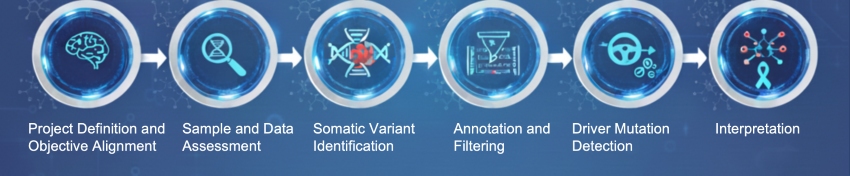
Project Definition and Objective Alignment
Sample and Data Assessment
Sequencing data quality, coverage, and experimental context are reviewed to ensure analytical reliability.
Somatic Variant Identification
High-confidence detection of somatic mutations using optimized analytical pipelines.
Functional Annotation and Filtering
Variants are annotated for predicted functional impact and filtered to remove likely non-relevant events.
Driver Mutation Detection
Candidate drivers are prioritized using recurrence patterns, clonality signals, and biological relevance.
Pathway and Contextual Interpretation
Driver mutations are mapped to signaling pathways and cancer-related processes.
Required Starting Materials
- Tumor-only or tumor–normal sample with basic quality metrics.
- Sample background information, such as cancer type or model system.
- Defined research objectives for driver identification or mechanism exploration.
Highlights
High-Confidence Driver Identification
By integrating functional impact prediction, recurrence assessment, and clonality-aware evaluation, we reduce false positives often generated by raw mutation lists. This refined prioritization improves confidence in driver selection and supports robust downstream oncology research.
Clonality-Focused Insights
By incorporating clonal and subclonal mutation analysis, our service provides deeper insight into tumor evolution, intratumoral heterogeneity, and adaptive processes. This enables researchers to differentiate early tumor-defining events from later emerging drivers that may contribute to progression or resistance.

Biology-Oriented Interpretation
Rather than delivering isolated variant tables, mutation data are translated into pathway- and process-level insights. This biology-centered interpretation supports functional hypothesis generation and facilitates integration with experimental validation strategies.
Flexible Application Scope
The service is designed to support a wide range of oncology research needs, from exploratory discovery studies to focused, hypothesis-driven projects. Analytical depth and reporting detail can be adapted without compromising data quality or interpretability.
Discover the Creative Biolabs Advantage – Contact Us for a Customized Quote
Publication
Large-scale cancer genome analyses have revealed that oncogenic mutations are distributed across both clonal and subclonal populations, highlighting the dynamic and evolutionary nature of tumor genomes. Certain driver genes tend to acquire early, clonal mutations that shape core oncogenic pathways, while others accumulate subclonal alterations that contribute to intratumoral heterogeneity, disease progression, and therapeutic resistance. These patterns demonstrate that accurate gene mutation profiling must go beyond simple variant detection and instead assess mutation clonality, recurrence, and functional relevance across cancer types. Gene mutation profiling & driver mutation detection therefore plays a critical role in precision oncology research by systematically distinguishing early, tumor-defining driver events from later, context-dependent subclonal changes. By integrating mutation frequency, clonality patterns, and pathway impact, this approach enables researchers to prioritize biologically meaningful driver genes, better understand tumor evolution, and identify actionable targets with higher translational relevance for oncology studies.
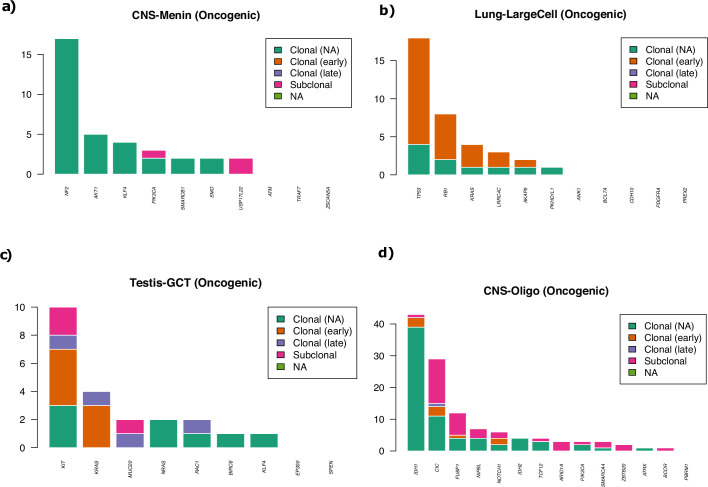 Fig.1 Candidate driver genes harboring oncogenic clonal and subclonal mutations.1
Customer Reviews
- Driver prioritization clarity using Creative Biolabs' gene mutation profiling & driver mutation detection service has significantly improved our downstream functional validation strategy. -Long-term collaboration, Mic*** Tan.
- Improved interpretation of low-frequency variants using Creative Biolabs' gene mutation profiling & driver mutation detection service has facilitated our tumor heterogeneity analysis. -Ongoing study, Lau*** Chen.
- Reliable driver mutation reporting using Creative Biolabs' gene mutation profiling & driver mutation detection service has strengthened confidence in our target selection workflow. -Multi-project usage, Jon*** Park.
FAQs
Can this service distinguish driver mutations in highly heterogeneous tumors?
Yes, clonality-aware analysis enables identification of both dominant and emerging driver events.
How does this service support studies focused on tumor evolution?
By analyzing clonal and subclonal mutation patterns, the service provides insight into mutation timing and evolutionary dynamics within tumor populations.
Can this service be applied across multiple cancer types within a single project?
Yes, the analytical framework is adaptable to diverse tumor types, enabling comparative driver mutation analysis across different cancer models.
Related Services
Chromosomal Instability & Copy Number Variation Analysis
We provide chromosomal instability and copy number variation analysis services to comprehensively characterize large-scale genomic imbalances that influence tumor evolution, clonal diversity, and disease progression.
Learn More →Replication Stress & DNA Damage Quantification
We provide replication stress and DNA damage quantification services to assess ongoing genomic fragility, replication-associated defects, and DNA lesion accumulation within cancer cells.
Learn More →Creative Biolabs' gene mutation profiling & driver mutation detection service provides a reliable foundation for identifying biologically meaningful drivers in complex cancer genomes. By combining rigorous mutation analysis with functional interpretation, we help researchers advance oncology studies with confidence. Contact our team to discuss how gene mutation profiling & driver mutation detection can support your research objectives.
Reference
- Kinnersley, Ben et al. "Analysis of 10,478 cancer genomes identifies candidate driver genes and opportunities for precision oncology." Nature genetics vol. 56,9 (2024): 1868-1877. Distributed under Open Access license CC BY 4.0, without modification. https://doi.org/10.1038/s41588-024-01785-9
 Download our brochure
Loading case studies...
Online Inquiry