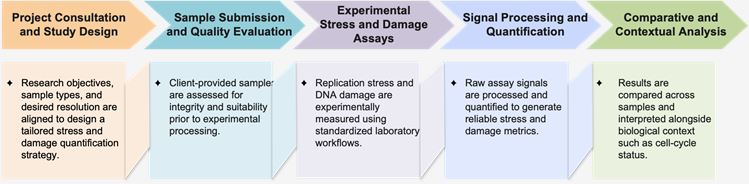
Replication stress and DNA damage are evaluated through coordinated experimental and analytical workflows to ensure consistency and interpretability.
Replication Stress & DNA Damage Quantification Service
Are you currently facing challenges such as detecting subtle replication perturbations, quantifying heterogeneous DNA damage signals, or linking genome stress to functional cancer phenotypes? Creative Biolabs' replication stress & DNA damage quantification service helps you systematically assess replication-associated stress and DNA damage levels through integrated experimental assays, quantitative analysis, and biology-oriented interpretation, enabling clearer insight into genome instability mechanisms in oncology research.
Overview What We Can Offer Workflow Required Materials Highlights Publication Customer Reviews FAQs Related Services
Overview
Replication stress and DNA damage are central drivers of genome instability and cancer evolution. Research has demonstrated that replication stress manifests as measurable molecular states and transcriptional patterns, while DNA damage encompasses diverse lesion types requiring objective-specific quantification. Integrated assessment of replication stress and DNA damage provides insight into tumor heterogeneity, adaptive responses, and vulnerability mechanisms. Creative Biolabs delivers structured, research-focused solutions to quantify genome stress states with biological context and analytical clarity.
We utilize comprehensive strategies for replication stress and DNA damage quantification service, which encompasses a detailed suite of assays including:
End-to-End Genome Stress Profiling
Multi-Layer Stress Assessment
Both upstream replication perturbations and downstream DNA damage consequences are measured to capture the full stress response.
Quantitative and Comparative Metrics
Stress and damage levels are quantified using standardized metrics suitable for cross-sample and cohort-level comparison.
Biology-Oriented Interpretation
Results are interpreted in the context of cell-cycle status, repair pathway engagement, and functional phenotypes.
Accelerate Innovation with Creative Biolabs – Start Your Consultation Today
What We Can Offer
Replication Stress Assessment
Evaluation of replication-associated perturbations that reflect fork slowing, stalling, and instability, providing insight into upstream genome stress mechanisms.
DNA Damage Quantification
Quantitative measurement of DNA lesion accumulation and damage-associated molecular signals, enabling objective comparison across cancer samples and conditions.
Pathway-Oriented Stress Interpretation
Analysis of stress-activated signaling and DNA repair pathway engagement to support mechanistic understanding of genome maintenance responses.
Heterogeneity-Aware Analysis
Assessment of variability in replication stress and DNA damage signals within and between samples, supporting studies of tumor diversity and adaptation.
Workflow
Required Starting Materials
- Tumor tissues, cultured cells, or extracted nucleic acids suitable for stress and damage assays.
- Sample background information such as cancer type or experimental conditions.
- Defined research questions related to genome stress mechanisms or responses.
Highlights
Integrated Replication Stress and DNA Damage Evaluation
Our service simultaneously captures replication-associated stress and downstream DNA damage signals, enabling a comprehensive assessment of genome stress states rather than isolated measurements.
Quantitative and Comparable Readouts
Standardized quantification methods generate reproducible metrics that support reliable comparison across samples, experimental conditions, and research cohorts.

Biology-Oriented Interpretation
Stress and damage signals are interpreted within functional, pathway, and cell-cycle contexts, strengthening biological relevance and hypothesis development.
Support for Heterogeneous Cancer Systems
The workflow is designed to accommodate variability inherent to tumor-derived samples, enabling robust analysis of complex and heterogeneous model
Discover the Creative Biolabs Advantage – Contact Us for a Customized Quote
Publication
Replication stress can be defined as a coordinated cellular state characterized by activation of specific gene expression programs and core response pathways. By integrating signals linked to DNA replication perturbation, fork protection, checkpoint activation, and repair coordination, replication stress becomes a measurable molecular phenotype rather than an isolated event. Distinct gene signatures reflect differences in replication dynamics, stress tolerance, and genome maintenance capacity across cancer types. Key components of the replication stress response include sensing of stalled replication forks, activation of checkpoint signaling, stabilization of replication machinery, and engagement of repair pathways to prevent fork collapse and excessive DNA damage. Together, these interconnected processes determine how cancer cells adapt to proliferative stress. Quantifying replication stress at the molecular and pathway level enables stratification of tumors by genome stress state and provides a framework for interpreting genome instability and adaptive behavior in oncology research.
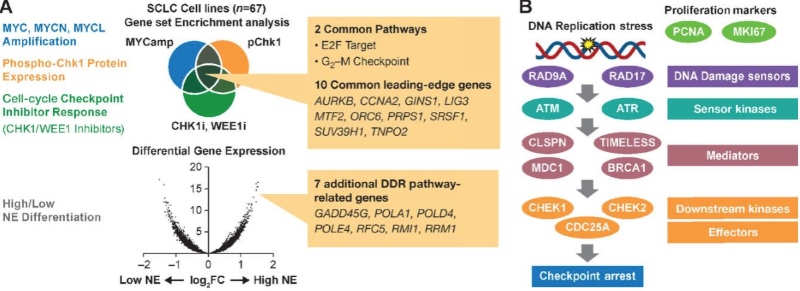 Fig.1 Schematic representation detailing the key components of the replication stress response pathway and the derivation of the repstress gene signature.1
Customer Reviews
- Clear replication stress profiling using Creative Biolabs' replication stress & DNA damage quantification service has significantly improved our understanding of genome instability mechanisms. -Ongoing research, Li*** Zhao.
- Reliable DNA damage quantification using Creative Biolabs' replication stress & DNA damage quantification service has facilitated comparative analysis across multiple tumor models. -Long-term collaboration, Ann*** Foster.
FAQs
Can this service distinguish replication stress from general DNA damage?
Yes, complementary measurements are used to differentiate replication-associated stress from downstream DNA damage signals, enabling more precise interpretation.
Is the service suitable for heterogeneous tumor samples?
The analytical framework accounts for biological variability and supports interpretation in mixed or heterogeneous cancer systems.
Can results be compared across different experimental conditions or treatments?
Standardized metrics allow reliable comparison across experimental groups, supporting controlled studies and comparative analysis.
Related Services
Mutational Signature Attribution Analysis Service
An interpretive service that links observed mutation patterns to underlying biological processes and mutagenic mechanisms shaping cancer genome evolution.
Learn More →Phenotypic Consequence Mapping Service
A functional analysis service that correlates genomic instability features with cellular phenotypes to support mechanism-driven oncology research.
Learn More →Creative Biolabs' replication stress & DNA damage quantification service provides a structured and biologically grounded approach to assessing genome stress in cancer research. By integrating experimental measurement with quantitative interpretation, we help researchers generate actionable insights into genome instability mechanisms.
Contact our team to discuss how replication stress & DNA damage quantification can support your research goals.
Reference
- Takahashi, Nobuyuki et al. "Replication stress defines distinct molecular subtypes across cancers." Cancer research communications vol. 2,6 (2022): 503-517. Distributed under Open Access license CC BY 4.0, without modification. https://doi.org/10.1158/2767-9764.CRC-22-0168
 Download our brochure
Loading case studies...
Online Inquiry