Creative Biolabs is offering the most comprehensive services for antibody development projects. With strict regulation and effective execution, we are dedicated to providing the most valuable solutions to complete your projects.
HighlightsCreative Biolabs is offering the most comprehensive services for antibody development projects. With strict regulation and effective execution, we are dedicated to providing the most valuable solutions to complete your projects.
HighlightsCreative Biolabs has established a broad range of platforms for developing novel antibodies or equivalents. These cutting-edge technologies enable our scientists to meet your demands from different aspects and tailor the most appropriate solution that contributes to the success of your projects.
HighlightsWith deep understanding in antibody-related realms and extensive project experience, Creative Biolabs offers a variety of references to help you learn more about our capacities and achievements, including infographic, flyer, case study, peer-reviewed publications, and all kinds of knowledge that can assist your projects. You are also welcome to contact us directly for more specific solutions.
HighlightsGet a real taste of Creative Biolabs, one of the most professional custom service providers in the world. We are committed to providing highly customized comprehensive solutions with the best quality to advance your projects.
HighlightsAt Creative Biolabs, we stand at the forefront of antibody engineering, leveraging over two decades of expertise to unlock the unique potential of host-specific immune systems. We are proud to offer our industry-leading Bovine (Cattle) Monoclonal Antibody Discovery Service, a specialized platform designed to exploit the exceptional structural characteristics of bovine antibodies—specifically their ultralong CDR3 regions—for research, diagnostic, and veterinary therapeutic development.
In the realm of antibody discovery, the bovine immune system is an evolutionary marvel. Unlike rodents or humans, cattle produce a subset of antibodies with exceptionally long Complementarity Determining Region 3 (CDR3) loops in their heavy chains. These ultralong CDR3s, often exceeding 60 amino acids, form a unique "knob and stalk" architecture.
This structural anomaly allows Bovine (Cattle) Monoclonal Antibodies to penetrate cryptic epitopes—deep pockets, recessed canyons on viral surfaces, and active sites of enzymes—that are typically inaccessible to standard human or murine antibodies.
Table 1. Comparison of Antibody Architectures
| Feature | Murine (Mouse) IgG | Human IgG | Bovine (Cattle) IgG (Ultralong) |
| CDR3 Length | ~9-12 amino acids | ~12-16 amino acids | Up to 60+ amino acids |
| Structural Motif | Canonical loop | Canonical loop | Stalk and Knob domain |
| Diversity Mechanism | V(D)J Recombination | V(D)J Recombination | Somatic Hypermutation & Cysteine Disulfides |
| Epitope Access | Flat/Planar surfaces | Flat/Planar surfaces | Recessed/Cryptic pockets |
| Therapeutic Potential | High (after humanization) | High | High (Veterinary & Unique Human Scaffolds) |
At Creative Biolabs, we utilize this unique biology to assist clients in developing reagents against difficult targets such as G-protein-coupled receptors (GPCRs) and ion channels.
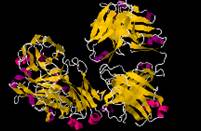
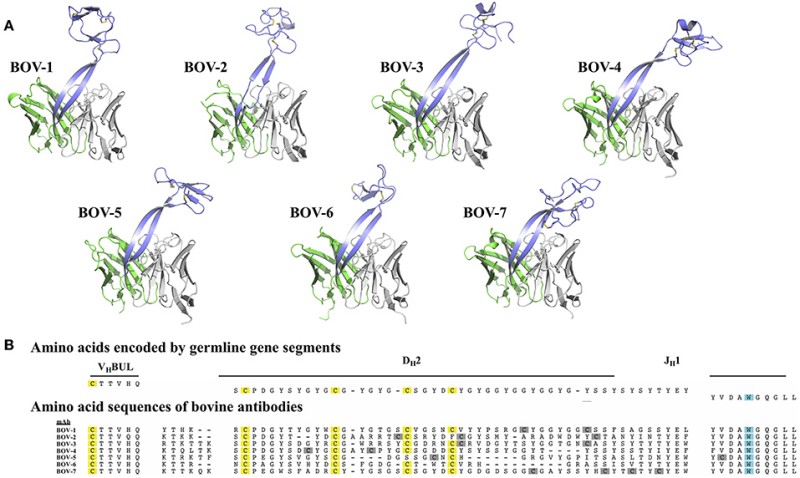 Fig. 1 Bovine Fv crystal structures and sequence alignment of the CDRH3 regions.1
While hybridoma technology has been the gold standard for decades, it faces significant hurdles in bovine species due to the lack of stable myeloma fusion partners and low fusion efficiency. Creative Biolabs has overcome these limitations by establishing a robust Bovine (Cattle) Monoclonal Antibody Discovery by phage display immune antibody library platform.
Our approach bypasses the inefficiencies of cell fusion, allowing for the direct capture of the entire heavy and light chain repertoire from immunized cattle. By utilizing phage display, we can screen billions of candidates to isolate high-affinity binders with picomolar sensitivity.
The Core Process: Construction and Screening of Immune Antibody Library
The success of our service hinges on the quality of the library. We do not simply clone genes; we capture the immunological history of the host. Our workflow for the construction and screening of immune antibody library involves:
We offer a modular, end-to-end solution. Below is the trajectory of a typical Bovine (Cattle) Monoclonal Antibody Discovery project.
Success starts with the antigen. We accept client-supplied antigens or generate them in-house (proteins, peptides, DNA, or whole cells).
This is where Creative Biolabs excels. We construct a phage display-based Bovine (Cattle) Monoclonal Antibody library with a diversity size typically exceeding 1×10^9 CFU.
We employ solid-phase, solution-phase, or cell-based panning strategies to select specific binders.
Top candidates are expressed in mammalian systems (CHO or HEK293 cells) and characterized for:
The generation of immune antibody library for Bovine (Cattle) Monoclonal Antibody requires more than standard molecular biology skills; it requires a deep understanding of bovine immunology.
While our phage display immune antibody library platform is a powerful engine, we offer a comprehensive suite of discovery technologies to ensure we always use the right tool for the job. Our Monoclonal Antibody Generation from Various Immunized Antibody Libraries Services:
Our Bovine (Cattle) Monoclonal Antibody Discovery platform is ready to tackle your most challenging targets, providing you with unique tools that standard murine antibodies cannot match. Let us help you accelerate your research with the power of the bovine immune system.
Reference
All listed services and products are For Research Use Only. Do Not use in any diagnostic or therapeutic applications.