
Creative Biolabs is offering the most comprehensive services for antibody development projects. With strict regulation and effective execution, we are dedicated to providing the most valuable solutions to complete your projects.
HighlightsCreative Biolabs is offering the most comprehensive services for antibody development projects. With strict regulation and effective execution, we are dedicated to providing the most valuable solutions to complete your projects.
HighlightsCreative Biolabs has established a broad range of platforms for developing novel antibodies or equivalents. These cutting-edge technologies enable our scientists to meet your demands from different aspects and tailor the most appropriate solution that contributes to the success of your projects.
HighlightsWith deep understanding in antibody-related realms and extensive project experience, Creative Biolabs offers a variety of references to help you learn more about our capacities and achievements, including infographic, flyer, case study, peer-reviewed publications, and all kinds of knowledge that can assist your projects. You are also welcome to contact us directly for more specific solutions.
HighlightsGet a real taste of Creative Biolabs, one of the most professional custom service providers in the world. We are committed to providing highly customized comprehensive solutions with the best quality to advance your projects.
HighlightsAt Creative Biolabs, we understand that the most promising therapeutic targets are often the most difficult to access. Conventional antibody formats frequently fail to bind to recessed epitopes found in G-protein-coupled receptors (GPCRs), ion channels, and viral envelope glycoproteins. To overcome these barriers, we proffer our premier Bovine Ultralong CDR3 Antibody Generation service. Leveraging over 20 years of expertise in antibody discovery, we utilize advanced phage display technology to construct and screen immune antibody libraries derived from immunized cattle, delivering high-affinity antibodies with unique structural capabilities.
Bovine antibodies are an anomaly in nature—in the best possible way. Approximately 10% of the bovine antibody repertoire consists of antibodies with an exceptionally long Complementarity Determining Region 3 (CDR3) in the heavy chain. While human CDR3s typically average 12-16 amino acids, Bovine Ultralong CDR3 Antibodies can possess CDR3s ranging from 50 to over 60 amino acids.
This unique structure forms a "stalk" and a tightly folded "knob" domain, stabilized by diverse disulfide bonds. This architecture allows these antibodies to penetrate deep immune-silent clefts and canyons on antigen surfaces that are sterically inaccessible to standard, flat-interface human or murine IgGs.
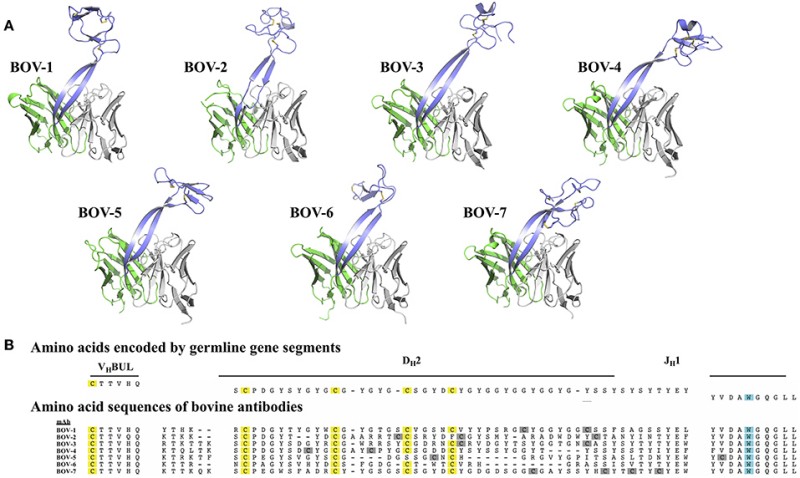 Fig. 1 Bovine Fv crystal structures and sequence alignment of the CDRH3 regions.1
The "Knob-on-Stalk" Micro-Antibody
The architecture mimics a "micro-antibody" sitting atop a standard antibody base.
Table 1. Comparison of Antibody Architectures
| Feature | Human IgG | Standard Bovine IgG | Bovine Ultralong CDR3 IgG |
| CDR3H Length | 10-20 AA | 20-30 AA | 50-70 AA |
| Structure | Loop | Extended Loop | Knob and Stalk |
| Binding Interface | Flat / Planar | Slightly Undulating | Protruding / Penetrating |
| Target Accessibility | Surface Epitopes | Surface Epitopes | Recessed/Cryptic Epitopes |
| Disulfide Bonds | Conserved | Standard | High Diversity (Odd Cysteines) |
At Creative Biolabs, we do not rely on naive libraries for this complex format. We employ a robust construction and screening of immune antibody library strategy. This ensures that the antibodies we harvest have already undergone somatic hypermutation in vivo within the bovine host, guaranteeing higher affinity and stability.
Workflow: From Immunization to Validated Lead
Our Bovine Ultralong CDR3 Antibody Generation by phage display immune antibody library workflow is a comprehensive, multi-step process designed to maximize diversity and recovery of high-value clones.
We begin by immunizing cattle with your specific antigen. Bovine immune systems are robust; however, eliciting the ultralong CDR3 lineage requires specific adjuvant strategies and scheduling.
This is the critical technical differentiator. Standard PCR methods often fail to amplify ultralong CDR3s due to their length and repetitive sequences.
We utilize the immune antibody library to perform multiple rounds of bio-panning.
The Bovine Ultralong CDR3 Antibody is a problem-solver for the biopharmaceutical industry's most challenging targets.
These multi-pass membrane proteins often have their functional sites buried within the transmembrane bundles. The "stalk" of the bovine antibody acts as a probe, extending the "knob" into these crevices to modulate function (agonist/antagonist activity).
Viral envelope proteins (like HIV gp120 or Influenza Hemagglutinin) are heavily glycosylated (covered in sugars) to shield themselves from the immune system. However, these "glycan shields" often have small holes leading to conserved binding sites. Bovine Ultralong CDR3 Antibodies can pierce this glycan shield to neutralize the virus.
By reaching into the active site (catalytic cleft) of an enzyme, these antibodies can act as potent competitive inhibitors, a feat difficult for flat human IgGs.
While our phage display immune antibody library platform is a powerful engine, we offer a comprehensive suite of discovery technologies to ensure we always use the right tool for the job. Our Monoclonal Antibody Generation from Various Immunized Antibody Libraries Services:
Trust Creative Biolabs and our proven Bovine Ultralong CDR3 Antibody Generation by phage display immune antibody library platform to deliver the high-quality reagents you need.
Reference
All listed services and products are For Research Use Only. Do Not use in any diagnostic or therapeutic applications.








