"Creative Biolabs is committed to providing highly customized comprehensive solutions with the best quality to advance our global clients’ projects."
Advanced Ferret Monoclonal Antibody Discovery Service
Background Technology Workflow Specialized Strategy Advantage Related Services FAQ Online Inquiry
In the rapidly evolving landscape of biomedical research, the ferret has emerged as an indispensable animal model, particularly for the study of human respiratory viruses. As a global leader in antibody engineering, Creative Biolabs leverages over two decades of expertise to provide a comprehensive Ferret Monoclonal Antibody Discovery Service. Utilizing state-of-the-art phage display technology and advanced immune antibody library strategies, we empower researchers to develop high-specificity, high-affinity antibodies tailored for complex therapeutic and diagnostic research.
Discuss Your Project Today
Why Ferret Monoclonal Antibodies?
Ferrets are uniquely positioned in immunology due to their physiological and anatomical similarities to humans regarding the respiratory tract. They possess a similar distribution of sialic acid receptors, making them the "gold standard" for studying viral entry, pathogenesis, and transmission.
The discovery of Ferret Monoclonal Antibody (mAbs) is critical for:
-
Neutralization Assays: Evaluating the efficacy of vaccines and antiviral drugs.
-
Epitope Mapping: Identifying conserved regions of viral proteins.
-
Diagnostic Development: Creating tools for rapid detection of respiratory pathogens.
-
In Vivo Imaging: Tracking viral progression in ferret models.
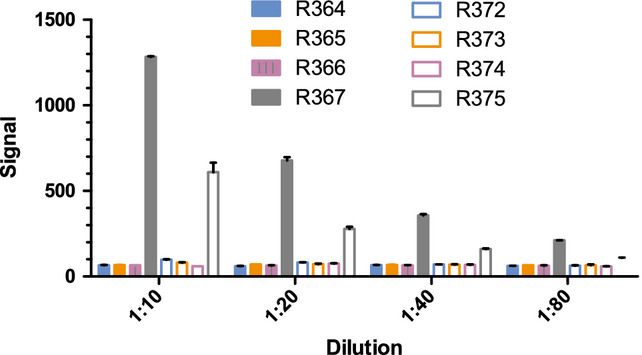 Fig. 1 Immune response. Bars represent the relative amounts of ferret anti-human mAb antibodies present in plasma samples from ferrets given either wild-type (WT) human mAb (R364-R367) or an LS mutant (R372-R375) taken 504 hours after injection.1
Our Core Technology: Phage Display-Based Ferret Monoclonal Antibody Discovery
Traditional hybridoma technology often faces limitations in ferrets due to a lack of stable myeloma fusion partners and lower efficiency in capturing the full immune repertoire. To overcome these hurdles, Creative Biolabs utilizes a robust phage display-based Ferret Monoclonal Antibody platform.
The Power of Phage Display
Phage display allows for the physical linking of the antibody genotype (within the phage DNA) to its phenotype (the antibody fragment displayed on the phage surface). This linkage enables the high-throughput construction and screening of immune antibody library sets, allowing us to isolate rare clones that traditional methods might miss.
Advantages of our Phage Display Platform
-
High Diversity: We can generate libraries with a complexity of 108 to 1010 independent clones.
-
Affinity Maturation: Capability to perform in vitro affinity maturation to boost binding strength.
-
Speed: Faster turnaround times compared to traditional hybridoma development.
-
Customization: Antibodies can be formatted into scFv, Fab, or full-length IgG.
Comprehensive Workflow for Ferret Monoclonal Antibody Discovery
Our streamlined process ensures the highest success rate in delivering functional Ferret Monoclonal Antibody candidates.
1. Ferret Immunization and Immune Response Monitoring
The process begins with a customized immunization protocol. We utilize various antigens, including recombinant proteins, DNA, whole cells, or viral particles. Our scientists monitor the immune response via ELISA to determine the optimal time for B-cell harvesting.
2. Construction of Immune Antibody Library for Ferret
The heart of our service is the construction of immune antibody library for Ferret Monoclonal Antibody.
-
RNA Extraction: High-quality total RNA is extracted from the spleen or peripheral blood mononuclear cells (PBMCs) of immunized ferrets.
-
V-Gene Amplification: Using a proprietary set of ferret-specific primers, we amplify the heavy chain (VH) and light chain (VL) variable regions.
-
Library Assembly: The amplified genes are cloned into our advanced phagemid vectors, creating an immune antibody library in scFv or Fab format.
3. High-Throughput Screening and Biopanning
The library is subjected to multiple rounds of biopanning against the target antigen. We employ various strategies:
-
Solid-Phase Panning: Antigen immobilized on immunotubes or plates.
-
Solution-Phase Panning: Utilizing biotinylated antigens and streptavidin-coated magnetic beads for superior conformational preservation.
-
Cell-Based Panning: For targets like GPCRs or ion channels that require a native membrane environment.
4. Characterization and Validation
Post-screening, positive clones are sequenced and expressed. We provide rigorous characterization, including:
-
Affinity Measurement: Using Biacore (SPR) or Octet (BLI).
-
Specificity Testing: Cross-reactivity analysis via ELISA or Flow Cytometry.
-
Stability Assessment: Thermal and chemical stability profiling.
Latest Strategies in Ferret Monoclonal Antibody Discovery
As pioneers in the field, we integrate the latest technological advancements into our Ferret Monoclonal Antibody Discovery by phage display immune antibody library workflow:
Next-Generation Sequencing (NGS) Integration
By combining phage display with NGS, we can analyze the entire library repertoire before and after panning. This allows us to identify high-frequency clones that may be missed by conventional colony picking, significantly increasing the "hit rate."
AI-Driven Antibody Modeling
We use computational biology to model the ferret antibody structures, predicting potential paratopes and optimizing humanization strategies if the antibody is intended for cross-species research.
Specialized Focus on Viral Neutralization
For infectious disease research, we offer specialized assays to screen for antibodies that block viral entry (e.g., inhibiting the interaction between the SARS-CoV-2 Spike protein and the ACE2 receptor).
Why Partner with Creative Biolabs?
With over 20 years of experience, Creative Biolabs is more than a service provider; we are your scientific collaborator.
-
Expertise: Our team comprises PhD-level scientists with deep knowledge of ferret immunology.
-
Quality: We adhere to strict quality control standards to ensure reproducible results.
-
Innovation: We constantly update our platforms with the latest phage display and immune antibody library technologies.
-
Transparency: Detailed project reports and regular communication keep you informed at every step.
Explore Our Comprehensive Services
While our phage display immune antibody library platform is a powerful engine, we offer a comprehensive suite of discovery technologies to ensure we always use the right tool for the job. Our Monoclonal Antibody Generation from Various Immunized Antibody Libraries Services:
Ready to accelerate your research with high-quality Ferret Monoclonal Antibody? Our experts are standing by to discuss your project requirements and provide a tailored proposal.
Contact Us Today for a Free Quote!
Frequently Asked Questions (FAQs)
-
Q: Why is phage display preferred over hybridoma for ferret antibody discovery?
A: Phage display is generally preferred because ferrets lack established myeloma cell lines for efficient fusion. Furthermore, phage display-based Ferret Monoclonal Antibody discovery allows for much larger library sizes, increasing the chances of finding rare, high-affinity binders.
-
Q: How large is the immune antibody library you construct?
A: We typically achieve a library size of 108 to 1010 independent clones. This high diversity is crucial for isolating specific antibodies from an immunized animal.
-
Q: Can you convert ferret scFv/Fab into full-length IgG?
A: Yes. Once the lead candidates are identified and sequenced, we can clone the variable regions into ferret-specific constant region vectors for expression as full-length, bivalent IgG in mammalian cells (e.g., HEK293 or CHO).
-
Q: Do you offer ferret antibody humanization?
A: While ferret antibodies are primarily used in ferret models, we do offer customization services, including "chimerization" or humanization, for specific research applications.
-
Q: Are these antibodies suitable for clinical use?
A: No, our services and the resulting antibodies are for Research Use Only (RUO). They are not intended for clinical diagnostic or therapeutic use in humans.
Reference
-
Nesspor, Thomas C., and Bernard Scallon. "Chimeric antibodies with extended half-life in ferrets." Influenza and Other Respiratory Viruses 8.5 (2014): 596-604. Distributed under Open Access license CC BY 4.0, without modification. https://doi.org/10.1111/irv.12273