Creative Biolabs integrates single-cell multi-omics with lineage tracing to decode cell-cycle states and developmental dynamics. Our sophisticated inference algorithms resolve temporal trajectories for unprecedented mechanistic insight.
Learn More →Advanced & Integrative Cell Cycle Services
Creative Biolabs bridges fundamental research and therapeutic application, providing high-fidelity data on lead compound interactions across diverse genetic backgrounds. We empower research and development to bypass "trial-and-error" by delivering quantitative evidence for CDKIs or RNAi therapies. Our platform maps checkpoint bypass mechanisms, identifying if resistance stems from kinase compensation or epigenetic silencing of p16 or p21. This precision refines leads and predicts response, ensuring robust data for milestone decisions.
Background Featured Services What We Can Offer Workflow Publication Why Choose Us FAQs Customer Review Related Services Contact Us
The New Frontier: Cell Cycle as a Master Regulator of Cancer Aggressiveness
Modern systems biology reveals that cell cycle dysregulation extends beyond simple proliferation to actively shape tumor malignancy. Hyperactivated programs, often coupled with MYC or KRAS, drive the formation of "cold" tumors by impairing IFN signaling and antigen presentation. This complexity is governed by epigenetic remodeling and ncRNA rheostats that bypass genetic mutations. Furthermore, cancer stem cells utilize reversible quiescence (G0) to evade chemotherapy. By applying systems biology and single-cell trajectory modeling, we resolve the non-linear dynamics of the G2/M transition, identifying vulnerabilities in p53-mutant cells over-reliant on PLK1 to prevent catastrophic aneuploidy.
Our Featured Services
Single-Cell Cell-Cycle State & Lineage Dynamic Inference
Spatial Cell Cycle Activity Mapping
Creative Biolabs offers spatial cell cycle activity mapping to visualize proliferation dynamics in situ. We integrate high-resolution imaging with spatial transcriptomics to decode how the microenvironment regulates phase transitions.
Learn More →Epigenetic & microRNA Regulation Analysis
Creative Biolabs provides high-resolution epigenetic and microRNA profiling to decode the regulatory layers of cell cycle programs. We pinpoint chromatin modifications and non-coding RNA interactions driving tumorigenesis and therapeutic resistance.
Learn More →Integrated Multi-Omics Cell Cycle Modeling & Risk Stratification
Creative Biolabs offers integrated multi-omics cell cycle modeling to decode complex regulatory landscapes. By merging high-dimensional data, we provide precise risk stratification and identify biomarkers to optimize therapeutic outcomes.
Learn More →Comprehensive Offerings
We offer an industry-leading suite of analytical tools designed to capture the non-linear dynamics of the cell cycle. Our offerings go beyond simple proliferation markers, providing a high-definition view of the tumor's proliferative architecture.
High-Resolution Proteomic Profiling
We utilize mass spectrometry and multiplexed immunoassays to quantify the stoichiometry of CDK/Cyclin complexes. This includes the detection of low-molecular-weight cyclin E (LMW-E) isoforms, which are critical predictors of genomic instability and therapeutic resistance.
Epigenetic & ncRNA Integration
Using ChIP-seq and ATAC-seq, Creative Biolabs maps the chromatin accessibility of cell cycle gene loci. We also profile microRNA and lncRNA landscapes that function as "rheostats" for G1/S transition, providing a comprehensive view of the "epigenetic-cell cycle" axis.
Systems Biology & Trajectory Modeling
We apply pseudotime analysis to data to model the "points of no return" in cell cycle progression. Our bifurcation analysis helps predict how slight variations in drug concentration will impact the global stability of the cell cycle oscillator.
Deepen Your Research – Discover Our Advanced Methodologies Now
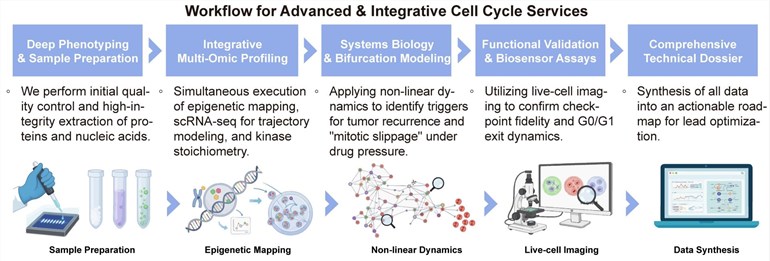
Service Workflow
To initiate a project, clients typically provide biological samples such as fixed/frozen tumor tissue or primary cell lines, alongside a drug profile including known mechanism of action (MOA) and desired concentration ranges for testing.
Publication
This study systematically investigates how the cell cycle drives functional heterogeneity in NIH 3T3 fibroblasts. By synchronizing cells and employing a novel CN correlation analysis, it quantifies distinct migration patterns and morphological changes across G1, S, and G2 phases. The research reveals that cytoskeletal dynamics and motility are tightly coordinated with cell cycle progression through the spatiotemporal regulation of CDK inhibitors (p27Kip1, p21Cip1) and Rho GTPase signaling. These findings provide a mechanistic framework linking cell cycle phase to phenotypic variation, offering new insights into cellular heterogeneity and potential drug resistance mechanisms.
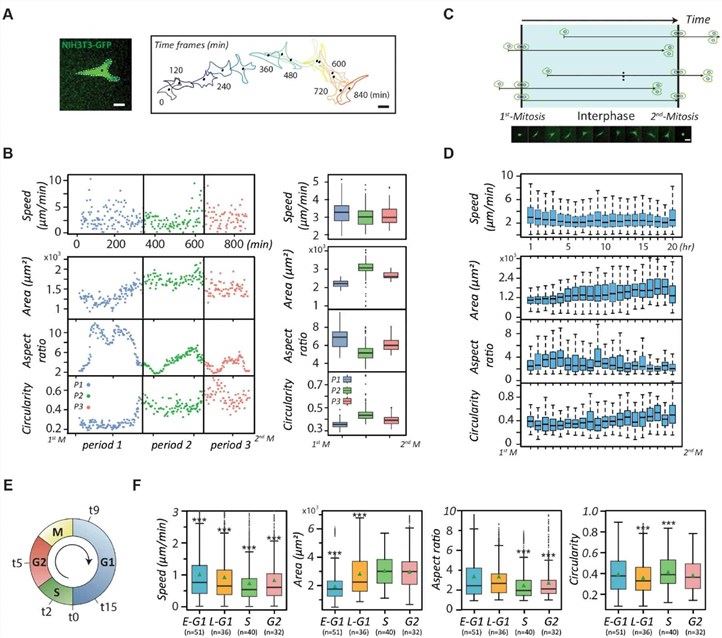 Fig.1 NIH fibroblast migration and morphology across the cell cycle.1
Why Choose Us?
Creative Biolabs stands at the forefront of oncology research by merging over 20 years of classical biological expertise with cutting-edge computational systems biology. Unlike standard CROs that provide isolated data points, we deliver a multi-layered interpretation of cell cycle dysregulation, drawing from a vast internal database and peer-reviewed "published data." Our infrastructure is purpose-built to navigate the most daunting challenges in modern drug discovery, such as resolving the heterogeneity of p53-deficient tumors and identifying the molecular triggers of cancer stem cell re-entry into the proliferative cycle. By partnering with us, you gain access to high-resolution proteomic suites and single-cell trajectory modeling that turn raw biological signals into definitive therapeutic roadmaps, ensuring that your lead candidates are optimized for both potency and research safety.
Experience the Creative Biolabs Advantage – Speak with an Expert Scientist Today
FAQs
Can your platform handle p53-deficient cell lines?
Yes, Creative Biolabs specializes in p53-mutant contexts, specifically analyzing the p21-PLK1 axis to identify alternative vulnerabilities at the G2/M transition that can be exploited by your lead compounds.
What is the primary advantage of your "integrative" approach over standard flow cytometry?
While flow cytometry provides a snapshot of DNA content, our integrative approach combines that data with proteomic stoichiometry and epigenetic state, revealing the molecular "why" behind cell cycle arrest or bypass.
Do you offer services for RNA-based cell cycle modulators?
Absolutely. Creative Biolabs has established specific pipelines for ncRNA expression profiling and miRNA-target validation within the cell cycle regulatory network.
Customer Review
-
Improved Resolution of Quiescent States
Using Creative Biolabs' services in our research has significantly improved our ability to track G0-to-G1 re-entry in chemoresistant cancer stem cells. Their biosensor assays provided clarity where traditional flow cytometry failed to resolve the quiescent population. - Dr. Ar** S -
Exceptional MOA Insight
The integrative epigenetic mapping provided by the Creative Biolabs team helped us understand why our lead candidate was failing in p53-mutant lines. They pinpointed a specific lncRNA-mediated bypass that we had completely overlooked during our internal screening. - Prof. Li* M
Related Services
Cell Cycle Functional Validation
Creative Biolabs provides kinetic validation of drug-replication interactions. We measure transition probabilities to resolve heterogeneity and optimize dosing schedules based on real-time arrest kinetics.
Learn More →Methyltransferase Panel Screening Service
Creative Biolabs provides services for DNA, RNA, and protein methyltransferases. We analyze epigenetic modifications to quantify impacts on gene silencing, stability, and cellular signaling.
Learn More →How to Contact Creative Biolabs
Creative Biolabs provides the world's most sophisticated platform for analyzing cell cycle dysregulation in cancer. By combining proteomic, epigenetic, and computational insights, we turn biological complexity into your competitive advantage.
Contact our specialist team today to discuss a customized, integrated analysis plan tailored to your lead candidate.
Reference
- Lan, Tian, et al. "Decomposition of cell activities revealing the role of the cell cycle in driving biofunctional heterogeneity." Scientific reports 11.1 (2021): 23431. Distributed under Open Access license CC BY 4.0, without modification. https://doi.org/10.1038/s41598-021-02926-4
 Download our brochure
Loading case studies...
Online Inquiry