Hyperproliferation Transcriptomic Signature Mapping Service
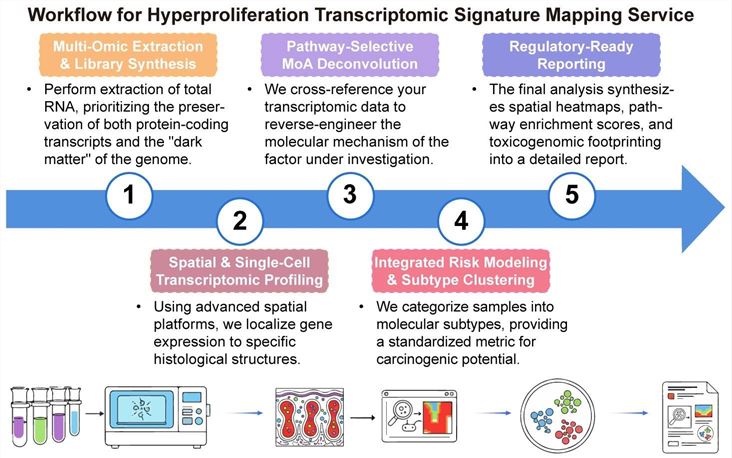
Creative Biolabs provides a high-resolution molecular lens to identify "point-of-no-return" signatures during the transition to hyperproliferation. We support applications by characterizing G2/M bypass and dysregulated mitotic spindle assembly. Our platform delivers actionable data, including the identification of immature intestinal lineages in metaplastic tissues and enhancer RNA (eRNA) activity as a sensitive indicator of metabolic reprogramming. By utilizing a 26-gene spatial signature, we stratify pre-cancerous lesions and map neoplastic risk trajectories, transforming complex transcriptomics into definitive regulatory evidence.
Introduction to Hyperproliferation Transcriptomic Signature Mapping
The detection of hyperproliferation is a foundational requirement in modern toxicology and oncology. Research has established that "sustaining proliferative signaling" is driven by specific transcriptomic signatures that precede morphological change. By focusing on G2/M phase transition genes and the regulatory 'dark matter' of enhancer RNAs, we provide a reliable method for predicting the malignant potential of environmental and chemical factors. Our service bridges the gap between raw genomic data and clinical risk, offering a robust platform for the identification of high-risk precursors.
Comprehensive Capabilities
Creative Biolabs provides an end-to-end solution for carcinogenic risk assessment, ranging from pilot screening to in-depth regulatory validation. Our offerings are modular, allowing you to tailor the analysis depth to your project's specific requirements.
High-Resolution Spatial Transcriptomic Mapping
We offer sub-cellular resolution mapping to visualize the architecture of hyperproliferative "hot zones" within intact tissue sections. This is critical for detecting focal lesions that bulk sequencing might overlook.
Enhancer RNA (eRNA) & Non-Coding RNA Profiling
Beyond standard mRNA, we profile the regulatory "dark matter" of the genome. Our eRNA mapping provides an earlier window into cellular reprogramming, serving as a superior predictor of malignant potential and recurrence.
Target Pathway & MoA Deconvolution
We provide a comprehensive "mode of action" (MoA) analysis by cross-referencing your samples against our curated database of oncogenic kinase signatures, including MAPK, PI3K/Akt, and Wnt/β-catenin pathways.
Toxicogenomic Footprinting
Our service includes the identification of chemical-specific transcriptomic "scars." We offer comparative analysis against industrial and environmental benchmarks to confirm or rule out specific carcinogenic mechanisms.
Regulatory-Grade Bioinformatic Reports
We deliver structured reports designed for regulatory submission, featuring unbiased clustering, principal component analysis (PCA)-based risk scoring, and gene set enrichment analysis (GSEA) pathway enrichment visualizations.
Explore Our Full Range of Capabilities — Contact Our Scientific Team
Workflow
The execution of a mapping project requires a collaborative and structured approach to ensure the biological relevance of the resulting data.
Publication
This study pioneers the discovery of enhancer RNA (eRNA) signatures for predicting recurrence in colorectal cancer (CRC). Through transcriptomic analysis of TCGA data, the authors identify a 22-eRNA panel for colon cancer and a 19-eRNA panel for rectal cancer. Multivariate Cox regression confirms these signatures as independent prognostic factors, superior to traditional TNM staging. The eRNA risk score is significantly elevated in relapsed patients and demonstrates high predictive accuracy (AUC >0.83), offering a novel tool for improved risk stratification in precision oncology.
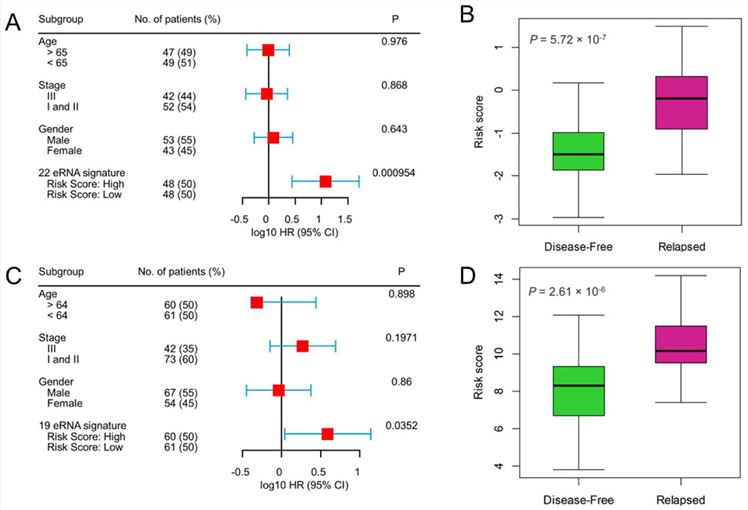 Fig.1 Enhancer RNA signature independently predicts survival and associates with relapse. 1
Why Choose Us?
Creative Biolabs distinguishes itself through a commitment to high-dimensional data and biological accuracy. While standard assays focus on downstream effects, our mapping service targets the upstream regulatory elements—specifically enhancer RNAs—that dictate cellular fate. Our platform has been validated by published data, demonstrating that our 26-gene spatial signatures can distinguish between low-risk metaplasia and high-risk neoplastic precursors with superior sensitivity. By choosing Creative Biolabs, you gain access to a toxicogenomic platform capable of tracing chemical "footprints" back to specific industrial or environmental carcinogens, providing a definitive link between exposure and transcriptomic disturbance.
Experience the Creative Biolabs Advantage — Get a Detailed Quote Today
FAQs
How does the 26-gene signature improve upon standard proliferation markers like Ki-67?
While Ki-67 indicates cells are in the cycle, our 26-gene signature identifies the quality of that cycle, specifically highlighting immature lineages and G2/M dysregulation associated with neoplastic transformation rather than simple repair.
Can Creative Biolabs handle degraded formalin-fixed paraffin-embedded (FFPE) samples for this service?
Yes. We have optimized extraction and library preparation protocols specifically designed to recover high-quality transcriptomic data from archived FFPE materials and other low-input sources.
What is the role of ' eRNAs ' in your analysis?
eRNAs are immediate-early markers of active transcription. They provide a more sensitive and earlier "signal" of cellular reprogramming than standard mRNA, making them ideal for detecting early carcinogenic shifts.
Customer Review
-
Unbiased Mechanism Discovery
Implementing Creative Biolabs' transcriptomic mapping has facilitated our understanding of compound-induced G2/M arrest. Their ability to resolve signatures spatially within the tissue niche provided the mechanistic evidence we needed for our regulatory filing. – Dr. Sarah L***n -
Superior Predictive Accuracy
The focus on eRNAs gave us a 2-week head start on detecting proliferative signals compared to our standard mRNA assays. The service is precise, and the bioinformatic support is exceptional. – Michael R***s
Related Services
Cancer Epitope Analysis Assays
Creative Biolabs provides B-cell and T-cell-based assays to analyze cancer epitopes, characterizing immunogenic peptides and MHC-restricted recognition to advance vaccines and targeted immunotherapies.
Learn More →B Cell-based Electron Microscopy Assay
Creative Biolabs provides high-resolution electron microscopy (EM) to visualize B-cell epitopes and antibody-binding regions. We deliver 3D conformational data and atomic-level structural insights into complex biological interactions.
Learn More →How to Contact Creative Biolabs
Creative Biolabs remains dedicated to delivering the most advanced transcriptomic mapping solutions to support your carcinogenic factor analysis. Our integration of spatial architecture and regulatory RNA profiling ensures that your drug discovery and safety assessment programs are supported by the most precise molecular data available.
For detailed project discussions or to receive a comprehensive technical proposal, please contact our scientific team.
Reference
- Sahu, Divya, Chen-Ching Lin, and Ajay Goel. "Transcriptomic profiling reveals an enhancer RNA signature for recurrence prediction in colorectal cancer." Genes 14.1 (2023): 137. Distributed under Open Access license CC BY 4.0, without modification. https://doi.org/10.3390/genes14010137
 Download our brochure