
Chitosan based Targeted Drug Delivery Solution
Chitosan-based delivery strategies are gaining attention because they make drug formulations easier to absorb, more stable, and more targeted. As a natural, biodegradable polymer, chitosan offers unique advantages that help improve how drugs move through the body and reach the right tissues. These benefits make it a versatile option for modern therapeutics, from vaccines to gene delivery. In this article, Creative Biolabs will break down the key concepts in simple terms so you can understand exactly why chitosan is becoming a top choice in drug delivery research.
What Is Chitosan and Why It Matters in Modern Drug Delivery
Chitosan is a natural polymer made by deacetylating chitin, which is found in shrimp shells, crabs, and some fungi. It carries a positive charge, which is unusual for a biopolymer. This single feature makes chitosan very attractive for drug delivery.
Because chitosan is biodegradable and biocompatible, it can break down in the body into safe byproducts. It also sticks well to wet surfaces such as the gut, nose, or eye. This strong mucoadhesion helps drugs stay longer at the site of absorption. As a result, chitosan can improve how much of a drug enters the body and how long it stays active (Figure 1). For teams building advanced delivery technologies, chitosan offers a flexible base. It can be turned into nanoparticles, microparticles, hydrogels, or coatings. This flexibility is one reason why chitosan-based delivery strategies are now discussed across oral, mucosal, and injectable products.
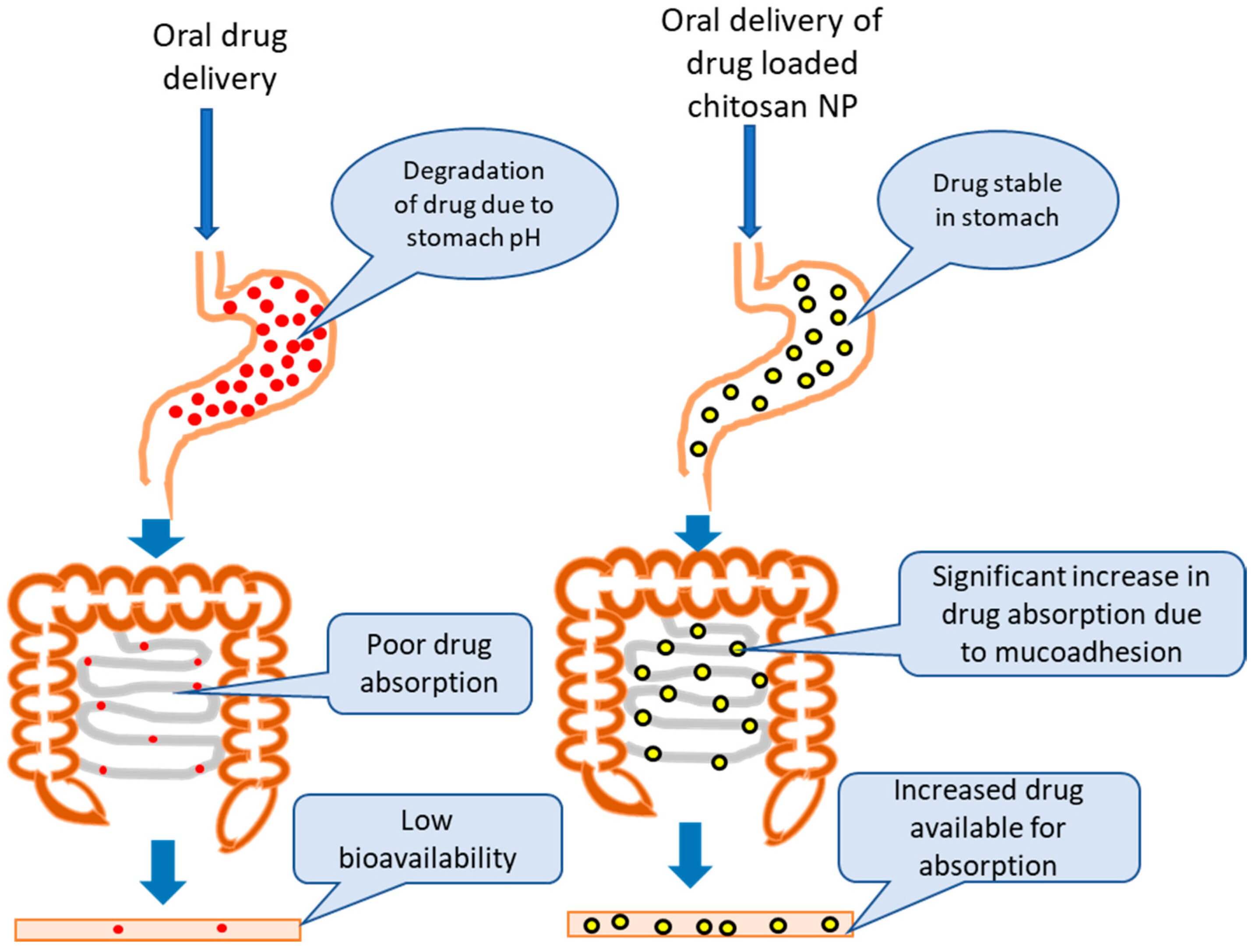 Fig.1
The mechanism of chitosan NPs in increasing drug availability for absorption by enhancing the drug absorption via
the intestinal epithelium.3
Fig.1
The mechanism of chitosan NPs in increasing drug availability for absorption by enhancing the drug absorption via
the intestinal epithelium.3
Core Benefits of Chitosan for Drug Delivery
Chitosan has several core benefits that explain its popularity in drug delivery systems (Figure 2):
Biocompatible and biodegradable
Chitosan breaks down into non-toxic sugars that the body can handle. This makes it a safe carrier for long-term or local use.
Cationic (positively charged) nature
Many drugs, cell membranes, and mucosal surfaces are negatively charged. Chitosan's positive charge facilitates its binding to these surfaces and enhances interaction with cells.
Strong mucoadhesion
Chitosan can "stick" to mucus in the gut, nose, or eye. As a result, drugs can stay longer at the absorption site and reach higher local concentrations.
Enhanced permeability and absorption
Chitosan and its derivatives can loosen tight junctions between epithelial cells. This effect can increase the transport of large or charged drugs across mucosal barriers.
Controlled and site-specific release
Chitosan can form gels, matrices, and nanoparticles that release drugs over hours, days, or even weeks. pH-sensitive or stimuli-responsive designs are especially important for targeted delivery to the colon, tumors, or infection sites.
Versatile chemistry
Because chitosan can be easily modified, scientists can attach ligands, polymers, or lipids to it. This tuning allows better solubility, stability, or targeting.
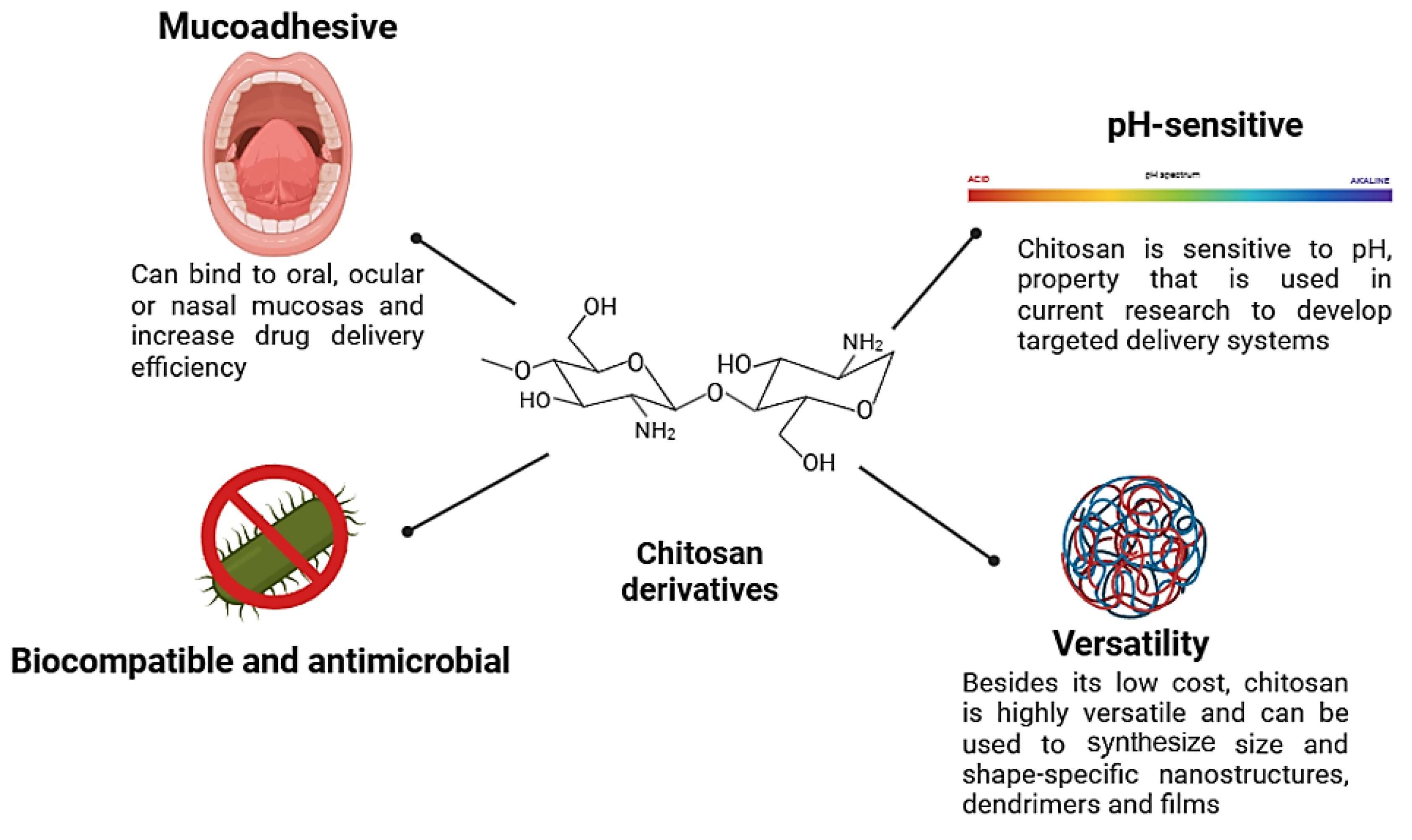 Fig.2
The characteristics of chitosan in drug delivery systems.2
Fig.2
The characteristics of chitosan in drug delivery systems.2
Overall, these features make chitosan an excellent base for modern, modular delivery systems like those offered by Creative Biolabs' module delivery platforms.
Chitosan-Based Nanoparticles and Microparticles
How Chitosan Nanoparticles Work
Chitosan nanoparticles are tiny particles made by crosslinking or ionically gelling chitosan chains around a drug. In simple terms:
- Chitosan is dissolved in a slightly acidic solution.
- A crosslinker or counter-ion is added to form particles.
- Drug molecules are trapped inside or bound to the surface.
- The particles protect the payload and release it in a controlled way.
Because of their small size, chitosan nanoparticles can move through mucus layers, interact with cells, and sometimes enter tissues more easily than larger particles.
Main Uses of Chitosan Nanoparticles
Chitosan-based nanoparticles are being explored in many therapeutic areas, for example:
- siRNA, mRNA, and DNA delivery for gene therapy and gene silencing.
- Peptide and protein delivery, where protection from enzymes is critical.
- Cancer therapy, including doxorubicin-loaded chitosan nanoparticles that enhance tumor suppression while reducing systemic toxicity.
- Antimicrobial agents, such as antimicrobial peptides and small molecules, where chitosan's own antimicrobial properties add extra benefit.
These systems align well with modular platform concepts. Different ligands, coatings, or payloads can be plugged into a chitosan nanoparticle "shell" to build custom delivery modules.
Microparticles vs. Nanoparticles: What's the Difference?
Both formats rely on chitosan, yet they serve different purposes (Table 1):
- Nanoparticles are ideal when you need deep tissue access or intracellular delivery.
- Microparticles are often preferred for oral controlled release or local implants, where a depot effect is more important than deep penetration.
Table 1 Comparison of chitosan nanoparticles with chitosan microparticles.
| Feature | Chitosan Nanoparticles | Chitosan Microparticles |
|---|---|---|
| Typical size | 10-500 nm | 1-1000 µm |
| Main advantage | Better tissue penetration, cell interaction | Longer residence time, easier to handle in dosage forms |
| Common applications | Gene therapy, cancer, ocular, nasal delivery | Oral controlled release, local depot formulations |
Biomedical and Pharmaceutical Applications
Biomedical and pharmaceutical applications of chitosan continue to expand rapidly, driven by its exceptional mucoadhesive properties, biocompatibility, and ability to enhance drug transport across challenging biological barriers.
Oral Delivery
In oral delivery, chitosan helps drugs survive the harsh gastrointestinal environment. It enhances adhesion to the intestinal wall and may increase paracellular transport by opening tight junctions. This is especially useful for insulin, peptides, and biologics that normally have poor oral bioavailability.
Nasal & Pulmonary Delivery
For nasal and pulmonary routes, chitosan-based particles or sprays can:
- Improve residence time on the nasal mucosa or in the lungs.
- Enhance absorption of vaccines or biologics across mucosal surfaces.
- Support needle-free vaccination strategies.
Nasal vaccines using chitosan as an adjuvant or carrier are an active area of research because they combine local immune stimulation with user-friendly administration.
Ocular Delivery
The eye clears substances quickly through tears and blinking. Chitosan hydrogels and nanoparticles can increase drug retention on the eye surface and raise local concentrations. Studies show improved delivery of poorly soluble antifungal or anti-inflammatory drugs when formulated with chitosan.
Vaginal & Rectal Delivery
Chitosan-based gels, films, and suppositories are used for local treatment of infections, contraception research, and hormone delivery. The strong mucoadhesion and gentle safety profile of chitosan help maintain drug contact with the mucosa and reduce dosing frequency.
Injectable and Implantable Systems
Chitosan hydrogels, scaffolds, and composite implants play a growing role in:
- Tissue engineering and regenerative medicine
- Local chemotherapy depots
- Wound healing and antimicrobial implants
These systems can be injected as liquids and gel in situ, or implanted as pre-formed scaffolds. They provide controlled, local release while supporting cell growth and matrix formation.
To further explore how modular delivery platforms can be customized using chitosan-based carriers, visit our Targeted Delivery Solutions.
Chitosan-Based Formulation Innovations
Chitosan's unique chemistry has inspired a new generation of advanced formulation technologies, enabling hydrogels, composites, and smart engineered systems that push drug delivery performance far beyond what conventional excipients can achieve.
Hydrogels
Chitosan hydrogels form when chitosan chains are crosslinked or combined with other polymers. These hydrogels:
- Hold large amounts of water.
- Release drugs in a sustained manner.
- Can be injected or applied as local dressings.
They are widely studied for wound care, local cancer therapy, intra-articular injections, and regenerative medicine.
Composites and Smart Materials
Chitosan is often combined with other materials to tune mechanical strength, swelling, and release behavior:
- Alginate-chitosan matrices for stable beads and capsules.
- Cyclodextrin-chitosan systems for improved solubility of hydrophobic drugs.
- Magnetic chitosan composites for externally guided or hyperthermia-assisted delivery.
These composites help overcome limitations of pure chitosan and make the delivery system more "intelligent".
Advanced Engineering
Emerging designs take chitosan-based delivery to the next level:
- Stimuli-responsive systems that react to pH, temperature, or enzymes.
- Layer-by-layer coatings on liposomes, nanoparticles, or implants.
- Multi-compartment "module delivery systems", where chitosan works with lipids, polymers, or inorganic carriers to enable sequential or combination release.
At Creative Biolabs, these concepts align with modular targeted delivery platforms, where chitosan-based carriers can be integrated into custom module delivery systems to match specific payloads, routes, and targeting ligands.
Safety, Regulatory Status, and Clinical Experience
Chitosan has a long history of use in food, cosmetics, and medical products. Several safety evaluations and GRAS (Generally Recognized as Safe) notices have concluded that chitosan can be safely used in foods and beverages at defined levels.
Key safety and regulatory points:
- Low toxicity in animal and human studies when used within recommended limits.
- Local irritation is usually mild and depends on the degree of deacetylation, molecular weight, and formulation.
- Chitosan is often treated as an excipient or functional polymer in drug products, although regulatory classification can vary by region and application.
For developers, early discussion with regulatory experts is important. Data on purity, source (marine vs. fungal), and residual proteins should be carefully documented.
Related Services You May Be Interested in
FAQs
What is chitosan, and why is it used in drug delivery?
Chitosan is a natural polymer with a positive charge and strong mucoadhesion. It is used in drug delivery because it improves absorption, protects sensitive drugs, and supports controlled release across many routes, including oral, nasal, ocular, and injectable delivery.
Is chitosan safe for humans?
Chitosan has been widely studied and is generally considered safe when used at appropriate levels. Several GRAS notices and safety reviews support its use in foods and biomedical products, although careful source and purity control are important for each application.
What are the most common types of chitosan delivery systems?
The most common chitosan-based systems include nanoparticles, microparticles, hydrogels, films, and coatings. These formats are used for oral, nasal, ocular, pulmonary, vaginal, and injectable delivery, and they can be tuned for controlled or targeted release.
Which drugs work best with chitosan carriers?
Chitosan carriers are especially useful for drugs that are unstable, poorly soluble, or poorly absorbed, such as peptides, proteins, nucleic acids, and some hydrophobic small molecules. Chitosan-based systems can protect these drugs and help them cross biological barriers more effectively.
What future innovations are being explored in chitosan-based delivery?
Researchers are developing stimuli-responsive chitosan systems, multi-layered composites, and targeted nanoparticles for cancer therapy, gene delivery, and advanced vaccines. Many of these innovations combine chitosan with lipids, inorganic particles, or responsive polymers to achieve precise spatial and temporal control.
Summary: Why Chitosan-Based Delivery Is Becoming a Top Choice
Chitosan-based delivery strategies sit at the intersection of safety, flexibility, and performance. The polymer's positive charge, mucoadhesive nature, and easy chemical modification make it an ideal backbone for many advanced delivery systems.
Developers can design nanoparticles, microparticles, hydrogels, and composite carriers that:
- Protect fragile drugs.
- Improve absorption through mucosal and epithelial barriers.
- Enable controlled and site-specific release.
- Support modular design in complex therapy pipelines.
With strong market growth and growing regulatory familiarity, chitosan is becoming a strategic material for next-generation drug delivery platforms.
Partner with Creative Biolabs for Chitosan-Based Delivery Success
As chitosan-based delivery strategies move from research to real products, choosing the right partner becomes just as important as choosing the right polymer. At Creative Biolabs, we combine targeted delivery expertise, modular platform design, and deep formulation know-how to help you turn chitosan concepts into robust, testable candidates.
Whether you need:
- Early feasibility studies on chitosan nanoparticles, hydrogels, or composites.
- Integration of chitosan carriers into custom module delivery systems for complex biologics.
- Systematic characterization and optimization for absorption, release profile, and stability.
Our team can support you from idea to preclinical stage with flexible, project-based solutions.
If you are planning a new chitosan-based delivery program—or want to upgrade an existing one—reach out to Creative Biolabs today. Together, we can design smarter, safer, and more effective chitosan-based delivery systems that move your pipeline forward with confidence.
References
- Desai, N. et al. "Chitosan: A Potential Biopolymer in Drug Delivery and Biomedical Applications." Pharmaceutics 15, 1313 (2023). https://www.mdpi.com/1999-4923/15/4/1313.
- Stefanache, A. et al. "Chitosan Nanoparticle-Based Drug Delivery Systems: Advances, Challenges, and Future Perspectives." Polymers 17, 1453 (2025). https://www.mdpi.com/2073-4360/17/11/1453. Distributed under Open Access license CC BY 4.0, without modification.
- Mohammed, M., Syeda, J., Wasan, K. & Wasan, E. "An Overview of Chitosan Nanoparticles and Its Application in Non-Parenteral Drug Delivery." Pharmaceutics 9, 53 (2017). https://www.mdpi.com/1999-4923/9/4/53. Distributed under Open Access license CC BY 4.0, without modification.