
Microneedle based Targeted Drug Delivery Solution
Microneedle-based delivery strategies are revolutionizing the way drugs, vaccines, and cosmetic substances are administered by providing a gentle and effective alternative to traditional injections. These tiny, painless needles create micro-channels in the skin, allowing medications to be absorbed more easily and precisely. Because the process is simple, fast, and far less intimidating, microneedle systems are becoming a preferred option in both pharmaceutical and consumer applications. In this guide, Creative Biolabs will explain how the technology works and why it is shaping the future of modern drug delivery.
Introduction: What Are Microneedles?
Microneedles are very small needles, usually a few hundred micrometers long. They are long enough to cross the outer skin layer (the stratum corneum) but short enough to avoid reaching the deeper pain nerves and blood vessels. As a result, they can deliver actives through the skin with minimal pain.
Over time, microneedles have evolved from simple solid metal pins to engineered systems made from different materials and in many formats:
- Solid microneedles – used to pre-treat the skin, then a drug patch is applied on top.
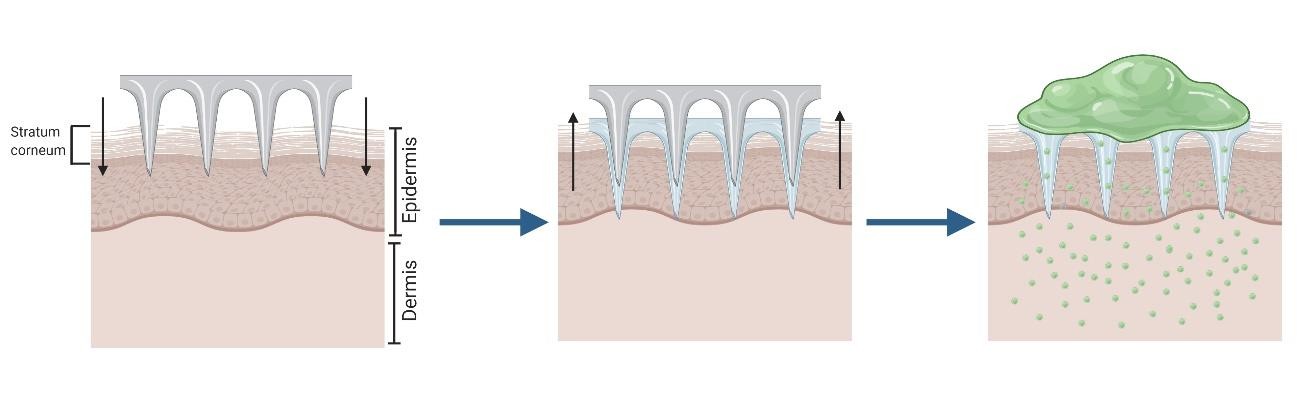 Fig.1
The "poke and patch" approach with solid microneedle arrays (MNA).2
Fig.1
The "poke and patch" approach with solid microneedle arrays (MNA).2
- Coated microneedles – the drug is coated directly onto the needle surface and dissolves after insertion.
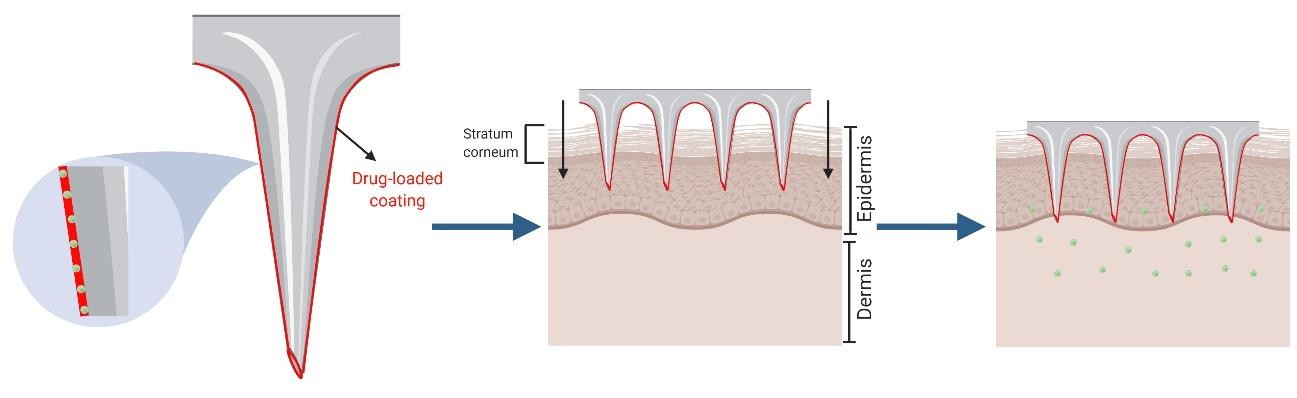 Fig.2
The "coat and poke" approach with coated microneedles.2
Fig.2
The "coat and poke" approach with coated microneedles.2
- Dissolving microneedles – the needles themselves are made of a drug-loaded material that dissolves inside the skin.
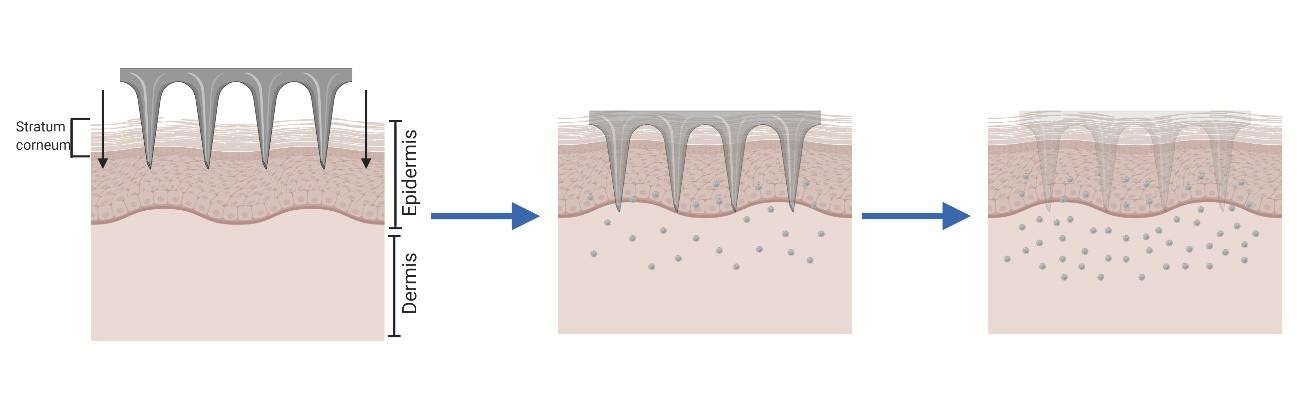 Fig.3
The "poke and release" approach with dissolving microneedles.2
Fig.3
The "poke and release" approach with dissolving microneedles.2
- Hollow microneedles – tiny tubes that can inject liquid formulations into the skin.
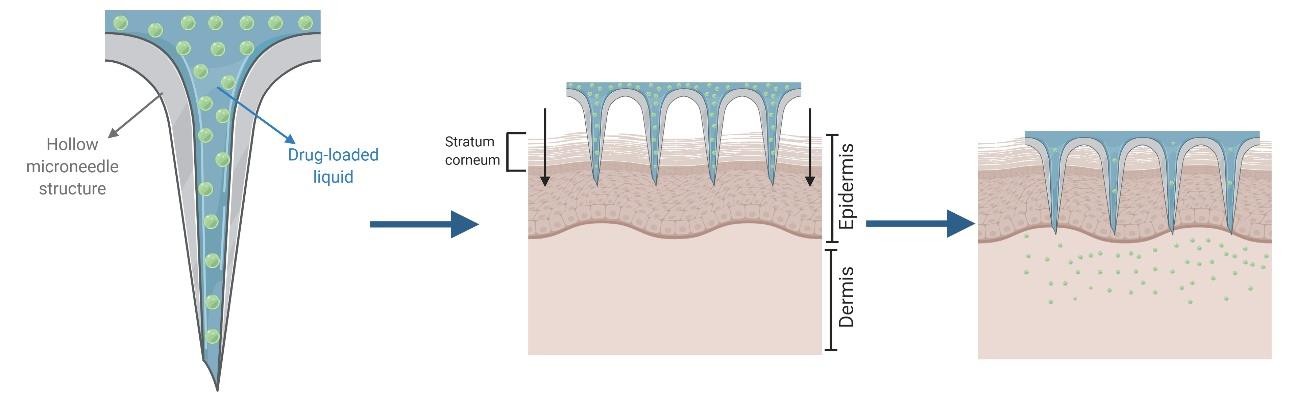 Fig.4
The "poke and flow" approach with hollow microneedles.2
Fig.4
The "poke and flow" approach with hollow microneedles.2
- Hydrogel-forming microneedles – swell inside the skin and slowly release actives.
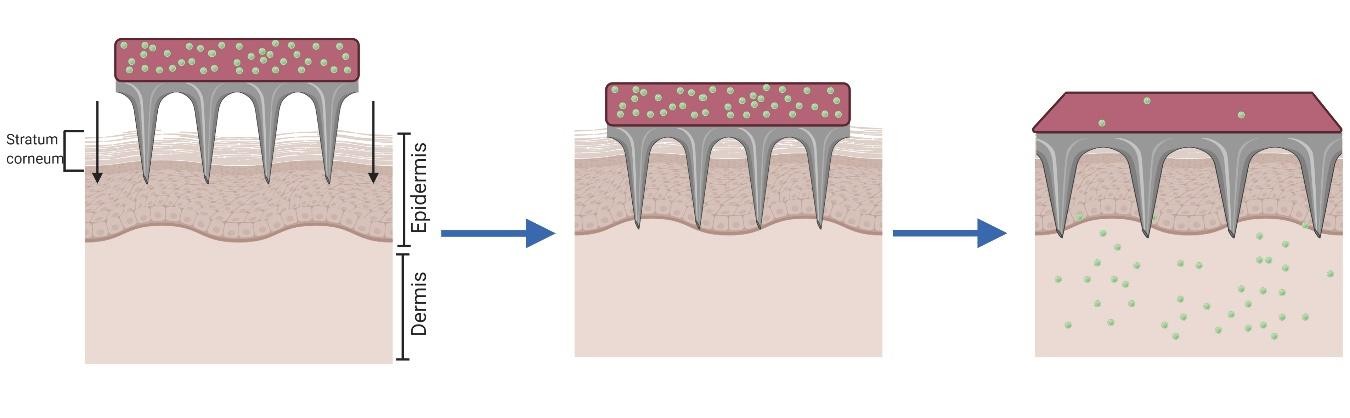 Fig.5
An alternative to "poke and patch" approaches with hydrogel-forming microneedles.2
Fig.5
An alternative to "poke and patch" approaches with hydrogel-forming microneedles.2
Common materials include silicon, metals (like stainless steel), biodegradable polymers, sugars, and ceramics. As materials and designs have improved, microneedle-based delivery strategies have become safer, more reliable, and more flexible for both research and commercial use.
Curious about which microneedle type fits your application?
Share your active ingredient, desired release profile, and use case with our Microneedle Innovation team. We'll recommend the optimal microneedle format (solid, coated, dissolving, hollow, or hydrogel-forming) and material, plus key design considerations tailored to your goals.
How Microneedle-Based Delivery Systems Work
To understand microneedles, it helps to picture the skin as a strong wall. The outer layer, the stratum corneum, works like a brick wall that blocks most drugs. Many promising molecules never get through this wall when used in simple creams or patches.
Microneedle arrays solve this problem by:
- Piercing the outer skin with many tiny needles.
- Creating micro-channels that are wide enough for drug molecules, but too small to cause major pain or bleeding.
- Delivering the drug into the upper dermis or epidermis, where it can be absorbed into local tissues or nearby blood vessels.
Depending on the microneedle type:
- A coating can dissolve and release the drug quickly.
- A dissolving needle can slowly melt and release its payload.
- A hollow needle can deliver liquid formulations at controlled rates.
Because these micro-channels bypass part of the usual skin barrier and avoid the liver's first-pass metabolism, microneedle-based delivery strategies can improve bioavailability, reduce dose needs, and make delivery more predictable.
Benefits of Microneedle Delivery vs Traditional Methods
One of the strongest reasons to adopt microneedles is the clear benefit over conventional injections and patches. Table 1 contrasts core features of traditional syringe/needle injections and microneedle-based delivery—critical for understanding microneedles' value in modern drug delivery.
Traditional injections often cause pain (worse with repeats) and trigger common needle phobia. They need trained staff, carry a higher infection risk (if reused/misused), require careful sharps disposal, and lead to poor compliance with frequent use—even though their dose control is good, it depends on technique.
Microneedles, by contrast, cause minimal discomfort, drastically reduce needle fear, and can be self-administered. Their shallow penetration and single-use designs lower infection risk; well-engineered arrays ensure precise dosing. Better comfort and convenience boost compliance, and some systems are biodegradable or low-risk for sharps waste—solving key pain points of traditional methods.
Table 1 Comparison of transethosomes with liposomes and ethosomes.
| Feature | Traditional Injection (Syringe/Needle) | Microneedle-Based Delivery Strategies |
|---|---|---|
| Pain level | Often painful, especially for repeated doses | Typically minimal discomfort |
| Fear/needle phobia | Very common | Greatly reduced |
| Skill needed | Usually, it must be given by trained staff | Can be designed for self-administration |
| Infection risk | Higher if reused or misused | Lower due to shallow penetration and single-use designs |
| Dose control | Good, but can be impacted by technique | Can be highly precise with well-engineered arrays and formulations |
| Patient compliance | Often poor with frequent injections | Better compliance due to comfort and convenience |
| Waste and sharps handling | Requires careful sharps disposal | Some systems are biodegradable or low-risk for sharps waste |
In short, microneedle-based delivery strategies combine comfort, safety, and control, which is attractive for both patients and healthcare systems, as well as for cosmetic users.
For advanced delivery projects, companies like Creative Biolabs also integrate microneedles with other targeted delivery systems, such as nano- or micro-carriers, to further tune release profiles and targeting. You can explore related modules on our targeted delivery solutions.
Key Applications of Microneedle-Based Delivery
Microneedle technology is already being explored and used across several key areas.
Pharmaceutical Drug Delivery
Microneedles support transdermal delivery of drugs that are hard to absorb through the skin alone. Examples include:
- Certain analgesics and anti-inflammatory drugs
- Hormones and peptides
- Experimental drugs that need controlled, local, or systemic delivery
Because microneedles allow precise dosing and can be designed as single-use patches, they fit well with research and future clinical strategies where reliability and ease of use are essential.
Vaccine Delivery
Microneedle patches have gained attention for vaccine delivery, such as:
- Influenza
- Viral infections (including research programs for COVID-19 and other emerging viruses)
- Experimental vaccines for infectious diseases
Compared with traditional injections, microneedle-based vaccine delivery can:
- Use lower doses in some designs
- Support room-temperature-friendly formulations in certain systems
- Enable self-administration in a home or community setting
This combination may help expand access in large-scale public health campaigns.
Cosmetic and Dermatology Applications
In aesthetic and skincare fields, microneedling and microneedle patches are used for:
- Collagen stimulation and skin rejuvenation
- Scar and wrinkle improvement
- Transdermal delivery of cosmetic actives, such as vitamins, peptides, or brightening agents
Here, pain-free or low-pain delivery is a major selling point. Consumers are drawn to minimally invasive, yet effective, solutions.
Peptide, Hormone, and Macromolecule Delivery
Many peptides, proteins, and other biomacromolecules are difficult to deliver orally because they are broken down in the gut. Microneedle delivery strategies allow bypassing of the digestive system and release of molecules closer to the bloodstream or specific local tissues.
Emerging Innovations and Future Directions
Research teams worldwide are pushing microneedle technologies into exciting new territory.
Biodegradable Microneedles
Biodegradable microneedles are made from materials that safely break down in the skin. Benefits include:
- No sharp waste
- Lower risk of retained fragments
- More single-use formats
Smart Microneedles with Sensors
Some next-generation designs integrate sensors or electronics. These smart microneedles could:
- Glucose or other biomarker
monitoring
- Drug release adjustment according to real-time data
- Remote monitoring by connection to digital health platforms
Hydrogel-Forming Microneedles
Hydrogel microneedles can swell in the skin and act like tiny sponges that release drugs slowly. This approach is promising for:
- Long-acting delivery
- Localized depot formation
- Combination therapies
Combination with Other Delivery Platforms
Microneedles can be combined with:
- Lipid-based carriers
- Polymer nanoparticles
- Other controlled-release systems
Creative Biolabs can design multi-layered strategies tailored to your project, enabling the spatiotemporal control of drug release through the integration of microneedles with advanced carriers.
Challenges and Limitations in Microneedle Delivery
Despite strong advantages, microneedles are not perfect. A balanced view is important.
Key challenges include:
Dose loading limits
As each microneedle patch can only carry a certain amount of drug, high-dose drugs may require larger or multiple patches.
Stability of sensitive molecules
Proteins, peptides, and vaccines can be sensitive to heat, humidity, and processing steps. Formulation must protect them during manufacturing, storage, and use.
Manufacturing consistency
Since any variation in needle height, strength, and drug content can impact dose delivery and safety, it is essential to ensure the uniformity of needles produced.
Skin variability
Skin thickness varies by body site, age, and individual. Patches must be designed and tested to perform reliably across realistic patient or consumer groups.
Regulatory and quality expectations
As microneedle products move closer to late-stage development, they must meet strict quality, safety, and performance standards.
For these reasons, careful design, analytical testing, and in vitro / in vivo evaluation are central parts of any microneedle-based delivery strategy.
How Creative Biolabs Supports Microneedle-Based Delivery Research
In terms of microneedle-based delivery systems, we provide relevant services as follows:
- Formulation design and optimization for your microneedle-based delivery system
- Integration of microneedles with nanocarriers and advanced delivery modules
- In vitro & in vivo assessment of delivery performance
- Analytical characterization, stability testing, and release profiling
By combining microneedles with our broad targeted delivery modules, research teams can explore innovative dosing concepts, new routes of administration, and differentiated products in crowded markets.
For Research Use Only. Not For Clinical Use.
Related Services You May Be Interested in
FAQs
What are microneedles mainly used for?
Microneedles are primarily used to deliver drugs, vaccines, cosmetic actives, and biomolecules through the skin with minimal pain. They are especially useful when oral delivery is not effective or when traditional injections are hard to accept.
How do microneedle patches work?
Microneedle patches carry many tiny needles on a small base. When you press the patch onto the skin, the needles create micro-channels or dissolve inside the skin. Then the active ingredient moves through these channels into deeper layers, where it can be absorbed more easily.
Are microneedles safe?
When designed and used correctly, microneedles have demonstrated a good safety profile in numerous studies. They avoid deep penetration and create only tiny, short-lived openings in the skin. However, each product must still be tested for safety, stability, and performance.
What types of microneedles exist?
The main types include solid, coated, dissolving, hollow, and hydrogel-forming microneedles. They differ in how they hold the drug, how they release it, and whether they remain intact or dissolve in the skin.
What are the main drawbacks of microneedle delivery?
The main drawbacks include limited drug load per patch, stability issues for sensitive molecules, and the need for strict manufacturing control. Additionally, not all drugs are suitable for transdermal delivery, making early feasibility studies crucial.
Conclusion: Why Microneedle Delivery Strategies Matter Now
Microneedle-based delivery strategies bring together science, engineering, and user comfort in a way that traditional needles cannot. They reduce pain, support self-administration, and open new options for complex drugs, vaccines, and cosmetic actives. At the same time, strong market growth and ongoing innovation show that microneedles are more than a short-term trend.
For researchers and developers seeking to unlock the full potential of this platform, collaborating with a partner experienced in targeted and advanced delivery systems, such as Creative Biolabs, can expedite development and help transform ideas into robust, study-ready solutions.
For Research Use Only. Not for Clinical Use.
References
- Cao, J., Wu, B., Yuan, P., Liu, Y. & Hu, C. "Advances in Research of Hydrogel Microneedle-Based Delivery Systems for Disease Treatment." Pharmaceutics 16, 1571 (2024). https://www.mdpi.com/1999-4923/16/12/1571.
- Guillot, A. J. et al. "Microneedle-Based Delivery: An Overview of Current Applications and Trends." Pharmaceutics 12, 569 (2020). https://www.mdpi.com/1999-4923/12/6/569. Distributed under Open Access license CC BY 4.0, without modification.
- Sadeqi, A., Kiaee, G., Zeng, W., Rezaei Nejad, H. & Sonkusale, S. "Hard polymeric porous microneedles on stretchable substrate for transdermal drug delivery." Sci Rep 12, 1853 (2022). https://www.nature.com/articles/s41598-022-05912-6.