
Mokola Virus Development Services
Pseudotyped of lentiviral vectors (LVs) have been widely used as gene transfer tools for the central nervous system (CNS) in the past decade, because they transduce most cell types in the brain, leading to high levels and long-term transgene expression. Creative Biolabs has established a variety of LVs optimization platforms to make LVs targeting CNS. With years of experience and advanced technology in this field, we provide high-quality pseudotyping services of lentiviral vectors to targeting neuronal cells.
Mokola Virus Introduction
Mokola virus (MOKV), a rabies-related virus, is a member of the genus Lyssavirus, which belongs to the Rhabdoviridae family. MOKV infects cats and other sub-Saharan mammals but rarely infects humans. The infection of MOKV can be identified by anti-lyssavirus nucleocapsid monoclonal antibody typing. It shares antigen serotypes with rabies virus (RV, another member of the Rhabdoviridae family), but exhibits a broader tropism. MOKV is able to infect various cell types, but tropism is mostly restricted to neurons. It recognizes specific receptors on the surface of neurons and enters neurons through these receptors.
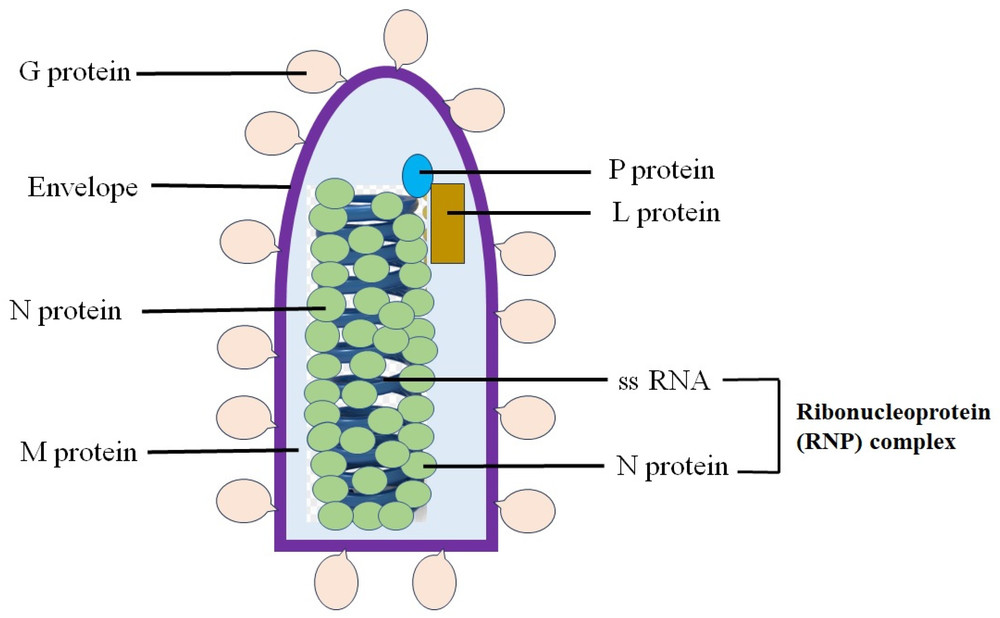 Figure 1 Structure of a rabies virus: The nucleoprotein (N) coats the linear single-stranded RNA (ssRNA) to form a nucleocapsid with helical symmetry.1
Structure and Function of Mokola Virus Envelope Glycoprotein (MOKV-Env)
MOKV-Env is a type I fusion protein composed of G protein trimer responsible for receptor binding and membrane fusion. Its structure includes a larger extracellular domain, a transmembrane domain, and a shorter cytoplasmic tail. The neural tendency of MOKV-Env is closely related to its ability to bind to specific receptors on the surface of neurons. Research has shown that neuronal cell adhesion molecule (N-CAM) is a key receptor for MOKV-Env mediated entry into neuronal cells. This specific interaction is the molecular key for MOKV LVs to open the door to the central nervous system, providing a mechanistic basis for their targeted delivery.
Comparison with Rabies Virus Glycoprotein (RV-G)
Although MOKV Env and rabies virus glycoprotein (RV-G) are both known for their neurotropic properties and belong to the same virus family, they are not exactly the same. RV-G has been widely studied for its ability to mediate retrograde transport, which refers to the movement of viral particles from peripheral nerve endings to the spinal cord and brain.
| Feature | Mokola Virus Envelope Glycoprotein (MOKV-Env) | Rabies Virus Glycoprotein (RV-G) |
|---|---|---|
| Virus Family | Lyssavirus | Lyssavirus |
| Neurotropism | Strong, with specificity for neurons | Strong, with specificity for neurons |
| Primary Receptor | N-CAM (Neuronal Cell Adhesion Molecule) | p75NTR, AChR, etc. |
| Retrograde Transport | Capable | Capable, extensively studied |
| Immunogenicity | Potential immunogenicity, less studied | Potential immunogenicity, more studied |
| LV Pseudotyping Use | Emerging tool for nervous system gene therapy | Widely used for neural tracing and gene therapy |
| Unique Feature | Potentially more efficient or differentiated neuronal targeting | Classic neural tracing and pseudotyping tool |
Molecular Engineering of MOKV-Pseudotyped Lentiviral Vectors (MOKV-LVs)
The pseudotyping process involves co transfecting three basic components into production cells: (1) a packaging vector containing the minimum lentiviral genome required for virus assembly; (2) Transfer vectors carrying therapeutic transgenes; And (3) plasmids expressing MOKV glycoprotein instead of the natural viral envelope. During virus assembly, MOKV-G integrates into the lipid envelope of newly formed lentiviral particles and controls subsequent cellular entry pathways through its specific receptor interactions.
Applications of MOKV-LVs in Neurological Diseases
MOKV LVs have great potential in central nervous system (CNS) gene therapy, but traditional carriers are difficult to effectively deliver therapeutic drugs.
Neurodegenerative Diseases
For diseases such as Alzheimer's disease, Parkinson's disease, and Huntington's disease, MOKV LVs can be used to deliver genes encoding neurotrophic factors, glioblastoma (GDNF)) or enzymes that can compensate for genetic defects.
Neurological Injury and Regeneration
After spinal cord injury, MOKV LVs can deliver genes that promote neuronal survival and axonal regeneration, potentially restoring lost motor and sensory functions.
Brain Tumors
In the treatment of glioblastoma, MOKV LVs can be designed to deliver suicide genes or oncolytic payloads that specifically target cancer cells without affecting surrounding healthy neurons.
Challenges and Future Directions of MOKV-LVs
Production Challenges
The production of MOKV LVs has not been smooth sailing. Compared with VSV-G, MOKV Env has lower fusion activity, which leads to lower virus titers, making large-scale production for clinical trials challenging. Further optimization of the packaging system and purification scheme is needed to increase the yield and consistency of the carrier.
Safety and Immunogenicity
A key issue with any viral vector is its safety. Although MOKV has not been proven to cause human diseases, the immunogenicity of MOKV Env remains a key research area. The existing immunity to the relevant virus may neutralize the vector, so it is necessary to thoroughly evaluate the possibility of generating a novel immune response against the MOKV Env protein. Strategies such as protein engineering modification of MOKV Env may help reduce this risk.
Core Services at Creative Biolabs
Creative Biolabs' facility is at the forefront of lentiviral vector technology, focusing on the development and production of custom designed MOKV-LVs. We provide comprehensive services aimed at providing full support to researchers and biotechnology companies from conceptual design to final product. We provide customized solutions for gene therapy, cell engineering, and research applications to ensure high-quality, high titer vector production.
| Service Category | Key Deliverables | Target Applications |
|---|---|---|
| Custom MOKV-LV Design | Cloned MOKV G plasmids, optimized LV backbones (with user-specified transgenes), and sequence verification | Gene therapy, neurobiology research, vaccine development |
| MOKV-LV Production | Purified MOKV-LVs (titers up to 10⁹ TU/mL), endotoxin testing, and sterility certification | In vitro cell transduction, in vivo animal studies |
| Tropism Engineering | Modified MOKV G proteins (e.g., scFv-fused, receptor-targeted) and validated vectors with refined cell specificity | Targeted cancer therapy, cell-type-specific imaging |
| Quality Control (QC) & Characterization | Titer (flow cytometry/qPCR), transduction efficiency assays, stability testing (in blood/CSF), and cytotoxicity analysis | Regulatory compliance, preclinical trial preparation |
MOKV-LVs Production and Quality Control
| Step | Description | Quality Control Metrics |
|---|---|---|
| 01 Plasmid Construction | Construct the MOKV-Env expression plasmid and the three other plasmids of the system | Plasmid sequence verification, endotoxin testing, concentration measurement |
| 02 Cell Co-transfection | Co-transfect HEK293T cells with the four plasmids | Assessment of transfection efficiency (e.g., fluorescent protein expression rate) |
| 03 Virus Harvest & Concentration | Collect the supernatant containing viral particles and concentrate | Total particle count, total protein quantification |
| 04 Purification | Purify the virus via ultracentrifugation or column chromatography | Purity assessment (e.g., SDS-PAGE), impurity detection |
| 05 Titer Determination | Measure the infectious titer of the MOKV-LVs | Functional titer, physical titer |
| 06 Functional Validation | Verify the vector's neuronal transduction ability in vitro or in vivo | Neuron-specific transduction rate, gene expression level |
Advantages of Our MOKV-LVs
- Target specific neuronal subpopulations with enhanced precision
- Reduce off-target transduction in non-neuronal tissues
- Achieve efficient gene delivery to challenging primary neuronal cultures
- Develop more accurate disease models for neurological disorders
Frequently Asked Questions
Q: What are the main advantages of MOKV LV compared to VSV-G-LV?
A: The main advantage is their enhancement and more specific orientation towards nerve and muscle cells. This makes them superior tools for targeted gene delivery in neurological and neuromuscular disease research, which may result in fewer off target effects compared to the broad orientation of VSV-G-LV.
Q: What biosafety level is required for working with MOKV-pseudotyped lentiviral vectors?
A: The MOKV pseudovector cannot replicate and can usually be treated with BSL-2 preventive measures. However, specific requirements may vary depending on the genetically modified organism being delivered. We provide detailed biosafety information for each batch of vector borne goods.
Q: Are there any special containment requirements for MOKV-LVs?
A: The standard slow virus vector control program is applicable. In addition to the standard lentiviral vector protocol, MOKV glycoprotein does not introduce additional containment requirements.
Q: How does the transduction efficiency of MOKV LV compare to that of VSV-G pseudovector in neuronal cells?
A: In neuronal cell types, especially primary neurons and certain neuronal cell lines, MOKV LV typically exhibits equivalent or higher transduction efficiency compared to VSV-G pseudovector. The exact performance depends on specific neuronal subtypes and experimental conditions.
Q: Can MOKV LV be used for in vivo applications?
A: Yes, MOKV LV is suitable for in vivo applications, especially for neuronal targeting. We recommend direct intracranial injection of central nervous system targets. Our technical team can provide optimized solutions for specific in vivo applications.
Q: What is the typical titer range of your MOKV pseudotype lentiviral vector?
A: Our standard formulation produces functional titers ranging from 1*10^8 to 1*10^9 TU/mL, with higher concentrations available upon request. Each batch of goods includes an analysis certificate that contains the precise titer of the batch.
Customer Review

"For our studies of autism spectrum disorder models, we require precise transduction of cerebellar Purkinje cells. Creative Biolabs' MOKV-LV exhibits excellent cell type restriction, with negligible off-target transduction in neighboring cell types. The custom modification service enables us to integrate activity-dependent promoters, enabling complex experimental designs that were previously unattainable."
- Dr. Amanda Fisher, Assistant Professor
- Project: Autism spectrum disorder mechanism research
- Key Results: Specific Purkinje cell targeting, successful activity-dependent promoter incorporation
- Application: Cell-type specific transduction for behavioral research
Reach Out to Us Now!
Creative Biolabs provides one-stop Mokola-pseudotyped LVs development services to targeting neuronal cell. We also offer unsurpassed service and support for LVs vector design, safety determination, and development. Our experienced staff consists of Ph.D. level scientists with a broad background in different life sciences disciplines to help you with any questions about LVs in your research. Please contact us for more information.
Reference
- Chen S J, Rai C I, Wang S C, et al. Infection and prevention of rabies viruses. Microorganisms, 2025, 13(2): 380. https://doi.org/10.3390/microorganisms13020380 Distributed under Open Access license CC BY 4.0, without modification.)
