
Pseudotyping Services of Lentiviral Vectors with Lyssavirus
Viral pseudotyping is a strategy that can be used to create viral vectors with new tropism and trafficking properties. Lentiviral vectors pseudotyping with lyssavirus have shown great potential in gene therapy, due to their ability to transduce neurons, offering a gene therapeutic approach for the treatment of motor neuron diseases. At Creative Biolabs, we specialize in the engineering of high-titer, neurotropic lentiviral vectors that bypass the limitations of traditional delivery methods.
Background of Lyssavirus
The Lyssavirus genus belongs to the Rhabdoviridae family and includes classical rabies virus (RV) and rabies-related viruses, such as the Mokola virus (MK), which differ with respect to phylogeny, pathogenicity, and immunogenicity. Lyssaviruses are able to infect various cell types, but tropism is primarily restricted to neurons in vivo. They interact with ubiquitous components of plasma membranes in a similar manner to the vesicular stomatitis virus (VSV), which is another member of the Rhabdoviridae family. In addition, lyssaviruses recognize specific receptors on the surface of neurons and enter neurons through these receptors. The receptors for lyssaviruses include the nicotinic acetylcholine receptor (nAChR), the neural cell adhesion molecule (NCAM), and the p75 neurotrophin receptor (NTR). They are type I transmembrane glycoproteins with an average size of 520 amino acids, which form trimers protruding from the virion surface.
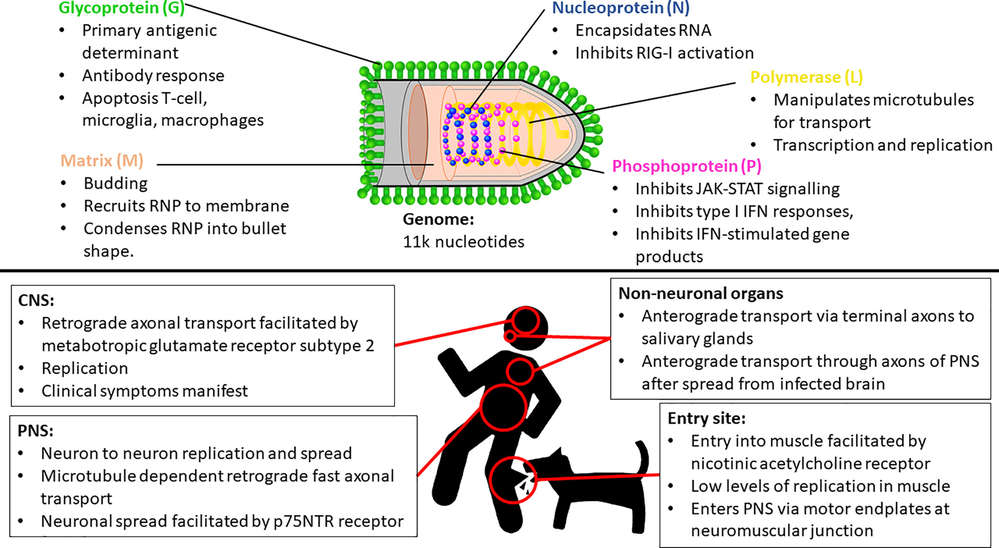 Figure 1 Key insights of Rabies lyssavirus (RABV) entry, spread and proliferation, and some important functionalities of each RABV protein. IFN, Interferon; CNS, Central nervous system; PNS, Peripheral nervous system; RNP, Ribonucleoprotein complex.1
RV-G Protein
The RABV-G protein is a type I transmembrane protein responsible for both receptor binding and low-pH-triggered membrane fusion within endosomal compartments. Its structure includes a receptor-binding domain that engages specific neuronal surface molecules. Key neuronal receptors identified for RABV-G include the nicotinic acetylcholine receptor (nAChR), the neural cell adhesion molecule (NCAM), and the p75 neurotrophin receptor (p75NTR). These interactions are characterized by high affinity, ensuring selective attachment to neuronal membranes. Upon internalization via endocytosis, the acidic environment of the endosome induces a conformational change in RABV-G, driving fusion of the viral and endosomal membranes and release of the viral core into the cytoplasm. This efficient, receptor-specific entry pathway is the foundation upon which lyssavirus pseudotyping is built.
The Pseudotyping of Lentiviral Vectors with Lyssavirus
Gene therapy for neurological diseases requires the transfer of genetic material to post-mitotic neurons. Primate and non-primate LVs are ideal candidates for this gene delivery tool because they can transduce both dividing and non-dividing cells, resulting in stable integration and long-term expression of the transgene. Targeting such vectors to specific cell populations in vivo can be achieved by pseudotyping. Since LVs have the ability to integrate into the non-dividing cell genome, including central nervous system (CNS) cells, it is tempting to increase the tropism of LVs for neurons by producing pseudotypes with the glycoproteins (GPs) of viruses that exhibit a powerful neurotropism.
LVs such as those derived from the human immunodeficiency virus (HIV), feline immunodeficiency virus (FIV), and equine infectious anemia virus (EIAV) have been pseudotyped with RV glycoprotein (RVG) and MK glycoprotein (MKG). The lyssavirus GPs used to pseudotype LVs are mainly derived from the RV strain RabSADB19 and the MK MokETH strain. This pseudotyping extends the host range of LVs to various cell types, especially neuronal cells. What's more, pseudotyped LVs can effectively deliver genes to neurons and mediate stable and long-term transduction of neural cells.
Advantages of Lyssavirus-Pseudotyped Lentiviral Vectors
High-Efficiency Neuronal Transduction
Lyssavirus-pseudotyped LVs exhibit a "lock-and-key" precision for neurons. In heterogeneous cultures or complex brain tissue, these vectors selectively transduce neuronal populations, ensuring that the genetic payload—whether it be a fluorescent marker or a therapeutic shRNA—is expressed where it is most needed.
Retrograde Axon Transport
Perhaps the most significant "superpower" of Lyssavirus-G is retrograde transport. Following distal injection into a target muscle or a specific brain region, the vector is taken up by axon terminals and transported microtubuledependently back to the nucleus of the projecting neuron. This allows researchers to target specific neural circuits without needing to access the deep-seated nuclei directly.
Reduced Cytotoxicity
Standard VSV-G pseudotypes can be "harsh" on delicate primary neurons, often leading to altered morphology or premature cell death. Lyssavirus-pseudotyped LVs are notably gentler, preserving the physiological integrity of the neurons for long-term functional studies.
Applications in Modern Science
Neuroscience Research: Circuit Tracing
By utilizing the retrograde transport properties, these vectors are indispensable for mapping neural connectivity. Researchers can identify which brain regions project to a specific target, enabling the visualization of complex "connectomes."
Gene Therapy & Translational Research
For diseases like Amyotrophic Lateral Sclerosis (ALS) or Parkinson's Disease, delivering genes to the entire spinal cord or deep brain structures is a massive challenge. Lyssavirus-pseudotyped LVs allow for "remote delivery," where a peripheral injection can result in therapeutic gene expression in the central cell bodies of the motor neurons.
Our Services
By partnering with Creative Biolabs for your lyssavirus pseudotyping needs, you gain access to a precision-engineered gene delivery system that opens new frontiers in understanding and treating neurological conditions. Our technology bridges the gap between viral engineering and neural circuit biology, empowering your most ambitious research.
Lentiviral Vector Design & Production
Our production pipeline is robust and quality-controlled:
- Third-Generation System: We employ a state-of-the-art, replication-incompetent split-genome lentiviral system for enhanced biosafety.
- Vector Construction: Custom cloning of your transgene of interest into optimized transfer plasmids.
- High-Titer Production: Viral particles are produced via transient transfection in HEK-293T cells under standardized protocols.
- Concentration & Purification: Vector supernatants are concentrated via ultracentrifugation or tangential flow filtration and purified to remove cellular debris.
- Batch Consistency: Rigorous quality control ensures high lot-to-lot reproducibility.
Validation & Characterization
Every batch undergoes comprehensive functional validation:
- In Vitro Validation: Titration and transduction efficiency testing on relevant neuronal cell lines and/or primary neuronal cultures.
- Retrograde Transport Assay: Confirmation of retrograde functionality in compartmentalized microfluidic chamber systems or via in vivo injection into projection areas.
- Expression & Functional Assay: Verification of transgene expression and activity (e.g., fluorescence, CRISPR editing efficiency, electrophysiological response to DREADD ligand).
Comparison with Other Pseudotyping Strategies
| Feature | Lyssavirus-G (RABV) | VSV-G | AAV-Retro |
|---|---|---|---|
| Primary Tropism | Highly Neurotropic | Ubiquitous | Neurotropic |
| Transport | High Retrograde | Minimal | High Retrograde |
| Cargo Capacity | ~8-10 kb | ~8-10 kb | ~4.7 kb |
| Integration | Yes (Long-term) | Yes (Long-term) | No (Episomal) |
| Cytotoxicity | Low | Moderate/High | Very Low |
Our Workflow & Timeline
Our streamlined process ensures efficiency:
- Consultation & Project Scoping: Discussion of research goals and experimental design.
- Envelope Selection & Vector Design: Finalizing pseudotype and constructing plasmid.
- Virus Production & QC: Production, concentration, and quality control (titering, sterility).
- Functional Validation: Performing agreed-upon validation assays.
-
Delivery & Reporting: Shipment of virus and comprehensive data report.
A typical project timeline from design to delivery ranges from 8 to 12 weeks.
Frequently Asked Questions
Q: Do these vectors spread trans-synaptically?
A: No. Our pseudotyped lentiviral vectors are replication-deficient. They move from the axon to the cell body (retrograde transport) but do not jump across the synapse to the next neuron. For trans-synaptic spreading, one would need a replication-competent G-deleted Rabies system.
Q: Do Lyssavirus-pseudotyped lentiviruses possess retrograde axonal transport capability?
A: Yes, Lyssavirus-pseudotyped lentiviruses possess retrograde axonal transport capability. This is a core feature, especially with wild-type RABV-G, which binds to receptors such as p75NTR and NCAM at axon terminals. The viruses are internalized and utilize dynein-driven transport to move retrogradely along microtubules, achieving speeds of tens to hundreds of mm per day. Our production system optimizes G protein density and conformation to enhance this function. For stronger retrograde labeling, we recommend wild-type RABV-G; for specific biosafety needs, we can provide engineered variants with modulated retrograde capacity.
Q: Is this system suitable for in vivo nervous system-targeted delivery?
A: The system is exceptionally well-suited for in vivo nervous system-targeted delivery. Advantages include flexible administration routes, such as stereotaxic injections into specific brain regions or spinal cord and peripheral organ delivery. Its inherent neurotropism reduces off-target transduction, ensuring cleaner data. Additionally, lentiviral genome integration allows for long-term, stable transgene expression, making it ideal for chronic disease modeling. We provide comprehensive technical support, including titer guidance and injection protocols.
Q: Advantages of Lyssavirus-pseudotyped lentiviruses over AAV-retro serotype?
A: Lyssavirus-pseudotyped lentiviruses and AAV-retro are complementary tools with distinct advantages. Lentiviral vectors have a large cargo capacity, accommodating transgenes over 8 kb, while AAV's capacity is around 4.7 kb. Lentiviruses also result in stable integration, ensuring persistent transgene delivery in dividing cells, and achieve higher expression levels more quickly post-transduction. Different immunogenic responses between lentiviruses and AAV make the former a better choice in certain experimental models.
Q: Supported species models for neuroscience research?
A: Our Lyssavirus-pseudotyped lentiviral system has been validated across various species, including rodents (most commonly used in mouse and rat models), non-human primates (like macaques and cynomolgus monkeys, where it shows excellent neuronal transduction efficiency), and emerging model organisms such as ferrets and tree shrews. The system is also effective for ex vivo brain slice cultures. For uncertain species, we offer pilot testing to optimize transduction conditions.
Connect with Us Anytime!
Creative Biolabs is a leading supplier of lentiviral vector production, providing viral vector-based gene delivery services for research and preclinical applications, including LVs optimization, vector design, safety determination, as well as LVs development service. Our team of scientists and engineers will work together to accomplish your research and production goals. If you want to know more details, please feel free to contact us.
Reference
- Scott T P, Nel L H. Lyssaviruses and the fatal encephalitic disease rabies. Frontiers in Immunology, 2021, 12: 786953. https://doi.org/10.3389/fimmu.2021.786953 (Distributed under Open Access license CC BY 4.0, without modification.)
