
With integrated targeted delivery system development and engineering techniques, Creative Biolabs offers a comprehensive liposome development platform that provides either individual service modules or fully comprehensive service. We tailor services to develop high-quality enzymosomes-based drug delivery services to meet the needs of our clients. Our professional scientists will do their best to meet every customer's requirements.
Enzymosomes is an attractive currently emerging targeted vesicular drug delivery system. It fundamentally uses enzymes, which possess a targeted catalytic function for a substrate, which is incorporated within cell-like structures with high lipid background. Enzymes play roles in catalysis, site-specific pharmacological action, prodrug activation, etc. But their low lipid membrane penetrability presents a significant disadvantage, if an enzyme is encased to the surface of the liposome, the degradation of the enzyme and transmutations can be minimized, thus enhancing their half-life along with targeted action. Enzymosomes is a novel drug delivery system which can channel the active form of the drug to the site of action and rapidly degrade them for easy uptake. Enzymes can be restrained with liposome surface by two approaches, i.e. by coupling functional hydrophobic compartments like long chain fatty acids with the enzyme or by associating the enzyme and the phospholipids of the liposome layer. Using the rational approach to enhance therapeutic efficacy and lower side effects are visualized by carrying the therapeutic agent to the destined tissue receptors especially seen on an organ or system. Such mutated vesicles have improved solubility, stability, therapeutic index for the sheathed drug molecule.
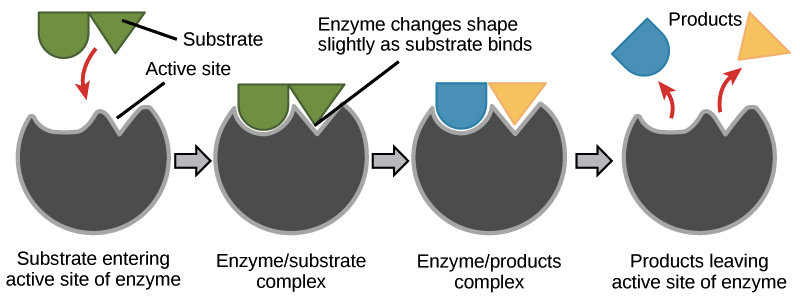 CC BY 4.0, https://zh.wikipedia.org/wiki/File:Enzyme-substrate_complex.png)" /> Fig.1 According to the induced-fit model, both enzyme and substrate undergo dynamic conformational changes upon binding.
One of the utilization of such lipid nanocarriers system is in the therapeutics of central nervous system (CNS) disorders like epilepsy, seizures as these serve as natural attractants of blood brain barrier (BBB) due to its lipophilicity. The enzymes act as therapeutic proteins are supplied through polymeric carriers like liposomes, lipoplexes, among which the attachment of enzymes to exposed areas of liposomes shows a maximum response. The vesicular delivery system loaded with drugs displays precise results at the site of infection or inflammation, with least drug toxicity and side effects, useful for centrally acting drugs which have to BBB which plays a fundamental homeostatic role of the brain. It also contributes to embellish the bioavailability of drugs, the merest amount of drug concentration available for systemic circulation, by minimizing the purchase cost. The covalently bound enzyme and liposome will result in minimum alterations in the activity of the enzyme and the enzyme-loaded in a vesicle preserves its structural integrity and enzymatic activity when investigated in vitro and in vivo. Advances in the application of enzymosomes are variably applicable in fields like the production of new recombinant proteins, biotechnological products etc.
Creative Biolabs has long-term devoted to the development of drug delivery system discovery and design. As we have finished lots of projects based on our extensive experience, we are therefore confident in offering the best services and products for our customers all over the world. If you are interested in our service, please do not hesitate to contact us for more details.
 For Research Use Only. Not For Clinical Use
Supports
Online Inquiry

Creative Biolabs is a world-leading liposome provider with extensive experience in liposome preparation, custom formulation development, and characterization.

© 2026 Creative Biolabs. All rights reserved.