
Creative Biolabs-Lipid Based Drug Delivery

Features of Liposomes

Because of their characteristic bilayer structure, liposomes can cross the cell membrane, so they can be used as a means of transportation of nutrients and some types of drugs. After reaching a specific predetermined position in the body, the lipid will rupture or decompose, thus releasing potentially lifesaving drugs.

At present, many researchers have studied and worked on liposomes, but only a small number of liposomal products have been approved for human use. This may be due to many reasons, such as high cost of liposome production, especially large-scale production, toxicity of some liposome formulations, relatively short half-life, instability, low solubility, encapsulation of low molecules and compounds into vesicles, and sometimes oxidation and hydrolysis of phospholipids, etc.
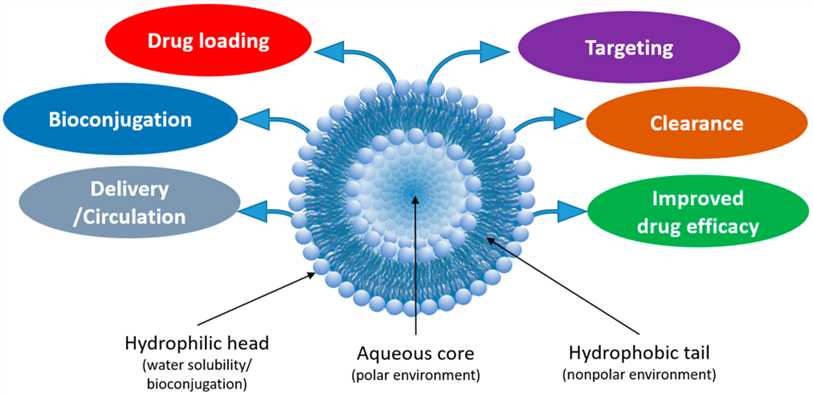
Fig.1 Structural features of liposomes and their advantageous features for improved drug delivery and therapeutic efficacy. (Almeida, Bethany, et al, 2020)Fig.1 Structural features of liposomes and their advantageous features for improved drug delivery and therapeutic efficacy.1,2

Overcome Key Challenges in Advancing Liposome Formulations

With the in-depth development of liposome research, the preparation process has also been improved. The existing technology has been able to overcome various shortcomings in the preparation of liposome formulations before, and can achieve:
  • Manufacturing conditions of reproducible liposomes
  • Liposome particle size was controlled by instrument parameters
  • The combination of drug loading and liposome one-step molding can achieve efficient and multifunctional drug loading
  • Fast and easy liposome production and optimization
  • Seamless way to scaling up production

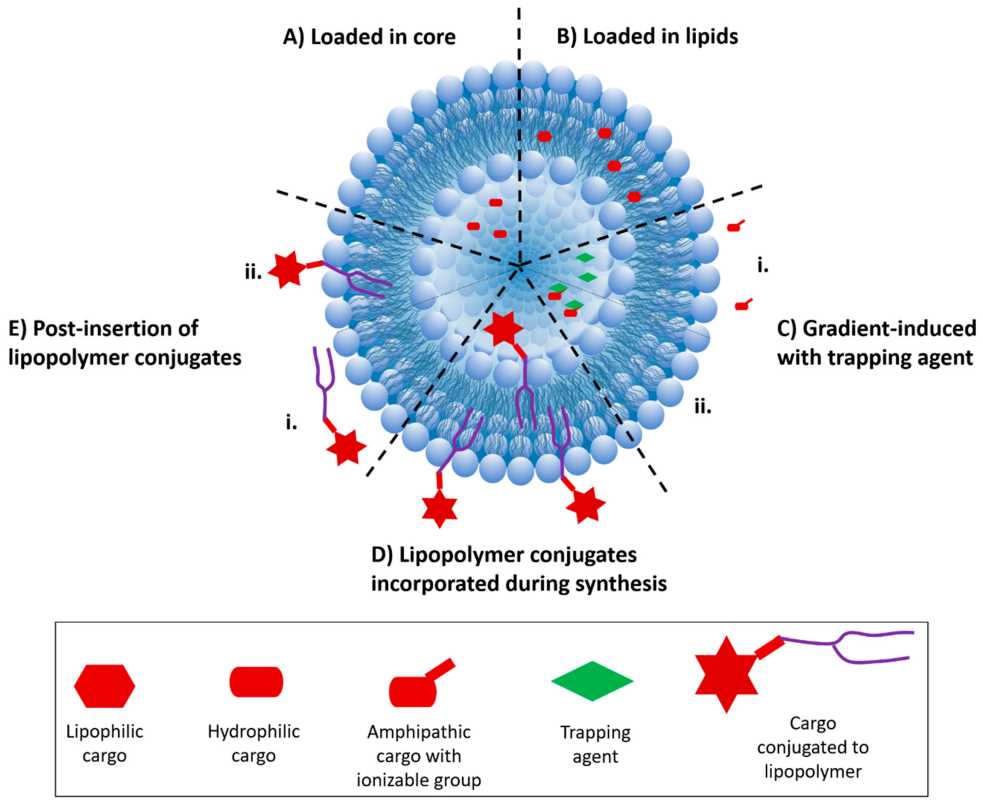
Fig.2 Various modes of liposomal drug incorporation. (Almeida, Bethany, et al, 2020)Fig.2 Various modes of liposomal drug incorporation.1,2

Advantages of Liposomal Drug Delivery System

Liposomes are particularly fascinating in the field of drug delivery because of their unique properties, including:

  • By formulating them into liposomes as the drug carrier, many drugs can be stabilized.
  • Liposomes are composed of naturally occurring substances, so they have the unique advantages of being non-toxic and biodegradable. When encapsulated by liposomes, it can protect biologically active substances from degradation. The drugs entrapped in liposomes will not be activated under physiological conditions and will not cause adverse side effects. The encapsulation of drugs in liposomes can promote the local delivery of drugs and increase the utilization rate through controlled release.
  • As a system for drug delivery, liposomal dispersions may be beneficial through several mechanisms. They can dissolve water-insoluble drugs (such as minoxidil or amphotericin B), avoid the site and reduce toxicity by reducing absorption to sensitive tissues.
  • Liposomes can preserve the drug intact and deliver it to the targeted site.
  • They also enhance the ability of the drug to penetrate into the deepest layer of the skin.
  • In addition to being a good carrier for other ingredients, liposomes themselves also have advantages because they can reduce skin dryness (emollient properties).
  • They stabilize the hydrolysis and oxidation of drugs.
  • The liposome emulsion has low immunogenicity.

We have strong and extensive expertise and years of experience in the field of drug delivery and lipid biophysics. For more details about our services, please directly contact us.

References

  1. Almeida, Bethany, et al. "Recent progress in bioconjugation strategies for liposome-mediated drug delivery." Molecules 25.23 (2020): 5672.
  2. under Open Access license CC BY 4.0, without modification.
For Research Use Only. Not For Clinical Use

Supports

Formulation Science Background of Liposome Research Highlights
Resources Technical Supports Featured Services Knowledge Center
Optimizing LNP Molar Ratios for Transfection Efficiency
Scalability Challenges in mRNA-LNP Manufacturing
Beyond mRNA: LNP Delivery for CRISPR/Cas9
Cationic Lipids Evolution: DOTAP to Ionizable Lipids
LNP Storage Stability: Lyophilization vs. Liquid
Modulating LNP Biodistribution: Overcoming Liver Accumulation
Active vs. Passive Targeting (EPR): A Guide to Tumor Drug Delivery
Immunoliposomes: Comparing Pre-insertion vs. Post-insertion Techniques
Crossing the BBB: Advances in Transferrin and Peptide-Modified Liposomes
pH-Responsive Liposomes for Tumor Microenvironment
Thermosensitive Liposomes combined with HIFU
Aptamer-Modified Liposomes: A Cost-Effective Antibody Alternative
Ethosomes vs Transfersomes for Dermal Delivery
Strategies for Encapsulating Poorly Water-Soluble Small Molecules in Liposomes
Multivesicular Liposomes: The Architecture of Sustained Release
Mechanisms of Liposomal Adjuvants in Enhancing Vaccine Immune Response
Protecting Enzymatic Activity: Liposomal Encapsulation Strategies for Enzymes
Cryo-TEM vs. DLS: Interpreting Discrepancies in Liposome Particle Size Data
Validating In Vitro Release Methods: Dialysis vs. Sample Separation Techniques
Predicting Long-Term Stability of Liposomal Suspensions using Zeta Potential
Troubleshooting Low Liposome Encapsulation Efficiency
Application of Multi-omics Analysis in Liposome Toxicology Assessment
The Ultimate Guide to Liposome Preparation
Fluorescent Liposomes for Cellular Uptake: Labeling, Controls, and Troubleshooting
How to Design Stealth Liposomes for Long Circulation
Homemade vs. Commercial Kits: Why Standardization Matters in Liposome Research

Online Inquiry